
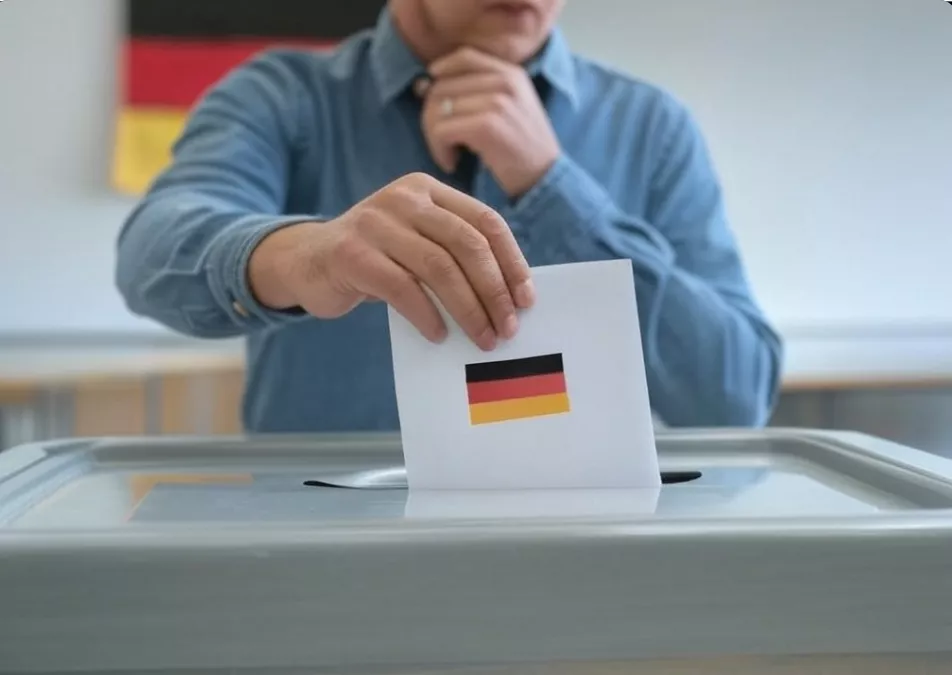
(Patria) - For only the fourth time in its recent history after World War II, Germany is holding early parliamentary elections.
Today, German citizens are going to the polls for early parliamentary elections following the collapse of Chancellor Olaf Scholz's ruling "traffic light coalition." This election day, considered crucial for the future of Europe's largest economy, brings great uncertainty.
According to the latest polls, the conservative CDU/CSU Union, led by Friedrich Merz, is the favorite, while the Social Democratic Party (SPD), the Greens, and the Alternative for Germany (AfD) are showing significant support.
The main campaign themes were migration, economic recovery, and reducing bureaucracy. The results are expected to shape Germany's political landscape for years to come, and forming a new government could take time due to the need for coalition negotiations.
Polling stations are open from 8 AM, with the first projections expected after they close at 6 PM.
Polls conducted in the final days before the election show an uncertain situation, with several key players and possible shifts in the balance of power.
CDU/CSU (Union)
Support: Around 28-32% (varies by institute).
Details: The conservative bloc, led by Friedrich Merz, remains in first place but shows a slight decline compared to earlier months when it reached over 33%. For example, a Forsa poll from February 21 shows 29%, while Allensbach for FAZ gives 32%. ZDF's "Politbarometer" from the same period states 28%, indicating a possible erosion of support in the final stretch of the campaign.
Trend: Stable, but with indications of losing some voters due to controversies surrounding cooperation with the AfD on migration issues.
AfD (Alternative for Germany)
Support: Around 20-22%.
Details: The right-wing party is showing consistent growth and solidifying its second position. A Forsa poll from February 21 gives them 21%, while some earlier surveys (e.g., YouGov) show up to 22%. They are particularly strong among younger voters casting their first vote, where they reach 20% support according to some analyses.
Trend: Rising, despite isolation from other parties that refuse to form a coalition with them.
SPD (Social Democratic Party)
Support: Around 15-17%.
Details: Chancellor Olaf Scholz's party is struggling with low ratings after the collapse of the "traffic light coalition." A Forsa poll shows 15%, while YouGov from mid-February reports 17% with a slight recovery. However, this is far below the results needed for a leading position.
Trend: Stagnation with slight signs of improvement, but with limited coalition potential.
Greens
Support: Around 12-15%.
Details: The party shows stable support but without significant growth. Forsa gives them 13%, while ZDF states 14%. Their position depends on the possibility of entering a coalition with the CDU/CSU or SPD, although there is resistance within the CSU to such cooperation.
Trend: Stable, with an emphasis on environmental issues that are losing importance compared to migration and the economy.
Die Linke (The Left)
Support: Around 8-9%.
Details: The party shows an unexpected jump, especially after protests against the cooperation between the CDU and AfD. YouGov from February 18 shows 9%, while Forsa states 8%. This ensures they will pass the 5% electoral threshold.
Trend: Rising, attracting voters to the left of center.
FDP (Liberals)
Support: Around 4-5%.
Details: The Liberals are fighting for survival, often below the 5% threshold. Forsa and ZDF agree on 5%, but with a possible deviation of 3%, making their entry into the Bundestag uncertain.
Trend: Uncertain, with the risk of falling below the threshold.
BSW (Sahra Wagenknecht Alliance)
Support: Around 3-6%.
Details: The new populist-left party has fluctuating support. Some surveys (e.g., YouGov) give them 6%, while Forsa reports 3%. Their entry into parliament is not guaranteed.
Trend: Uncertain, dependent on voter mobilization in the final days.
Key Themes and Impact on Polls
Migration: Still a dominant theme, especially after attacks linked to migrants. AfD and CDU/CSU are benefiting from this issue, while SPD and Greens are losing support due to a perception of indecisiveness.
Economy: Growing in importance (14% of voters highlight it as key according to YouGov), which favors Merz's economic program, but also SPD's rhetoric about stability.
Protests against AfD: Mobilization of voters to the left of center (e.g., 160,000 demonstrators in Berlin on February 2) has boosted support for The Left and the Greens.
Poll Methodology
Institutes: Forsa, YouGov, Allensbach, and ZDF's "Politbarometer" are most frequently mentioned. Samples are around 1500-2000 respondents, with a margin of error of ±3%.
Date: Most recent polls were conducted between February 18 and 21, 2025.
The CDU/CSU remains the favorite, but with a smaller lead than a month ago. The AfD is a stable second force, while the SPD, Greens, and The Left have a chance for coalition influence. The FDP and BSW are on the verge of entering parliament, which could complicate government formation. The final outcome will depend on turnout and the decision of undecided voters (around 20% according to YouGov), leaving room for surprises.
Komentari (0)
Prijavite se za komentiranje
PrijavaJos nema komentara. Budite prvi!
Minuta
Sve →Iz drugih kategorija

High Representative Not Elected: Germans, French and British Against Americans, New Attempt at End of June

ČOVIĆ WITHOUT MERCY: How Those Who Brought Ademović to Office Created a Political Hell for Him



Sunny Saturday, quite warm



Tragedy in Albanian resort: Two minors drown












