
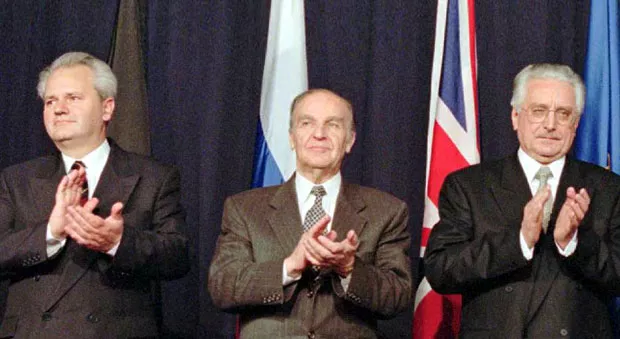
SARAJEVO, (Patria) - The Dayton Peace Agreement was initialed on this day, November 21, 1995, in Dayton, and signed three weeks later. The agreement established two entities – the Federation of BiH and RS.
Although it was intended to be a temporary solution, the Dayton Peace Agreement is still a subject of much debate today, with some calling it the "straitjacket of BiH".
Three weeks after it was initialed, on December 14, 1995, the Dayton Peace Agreement was signed, ending the aggression against BiH.
"This is not a just peace, but it is a more just peace than the continuation of war. In the current situation, and in the world as it is, a better peace could not have been achieved," said the then-President of the Presidency of the Republic of Bosnia and Herzegovina, Alija Izetbegović, after the signing ceremony of the Dayton Peace Agreement on December 14, 1995, at the Élysée Palace in Paris.
The Dayton Agreement also resulted in everyone being a winner. Some fought for Bosnia and Herzegovina, others legalized the Republika Srpska, and a third group continued to dream of a third entity. The actors of the Dayton agreement strived in the days after its initialing to justify their actions, to explain why they lost some territories, kept others, why they accepted some solutions and not others.
The agreement consists of 11 annexes, including Annex 4 – the Constitution of Bosnia and Herzegovina. It confirmed the sovereignty, territorial integrity, and independence of Bosnia and Herzegovina as a state. It stipulated that BiH consists of two entities, the Federation of Bosnia and Herzegovina and Republika Srpska, and that it is composed of constituent peoples, Bosniaks, Croats, and Serbs, along with others. It prescribed the competencies of BiH and the entities, as well as the relations between BiH institutions, and the method of amending the BiH Constitution.
The Dayton constitutional arrangement has become one of the main problems in the functioning of modern BiH, as well as an obstacle on its path towards Euro-Atlantic integration. It has also become an obstacle to the very internal functioning of the state and a subject of dispute between political options regarding what BiH should look like as a state in the future and what its internal organization should be. In the past years, no consensus has been reached on any proposal for constitutional changes. Precisely today, as RS has begun transferring competencies, referring to Dayton, it seems that peace in BiH has never been more threatened. Neither the diplomatic offensive of the US, the EU, nor other countries has calmed the spirits in RS, whose ultimate goal is the independence of RS. Aided by Serbia, Russia, and Hungary, the authorities in RS are not giving up on transferring competencies, although they were previously transferred to the state level in the BiH Parliament. The unilateral withdrawal of competencies by the National Assembly of Republika Srpska (NSRS) without the BiH Parliament is not acceptable, the High Representative in BiH, as well as US and EU diplomats, have conveyed this to RS. However, the authorities in RS, led by Milorad Dodik, are not abandoning their intentions. Another set of competency withdrawals is announced for December, including the BiH Armed Forces.
In the BiH entity of RS, in accordance with the entity's holiday law, today, November 21, is celebrated as the Day of the Establishment of the General Framework Agreement for Peace in BiH and is a non-working day.
The peace agreement was signed by the then-presidents of BiH Alija Izetbegović, Croatia Franjo Tuđman, and Serbia Slobodan Milošević.
Komentari (0)
Prijavite se za komentiranje
PrijavaJos nema komentara. Budite prvi!
Minuta
Sve →Iz drugih kategorija

High Representative Not Elected: Germans, French and British Sabotaged Americans, New Attempt at End of June

ČOVIĆ WITHOUT MERCY: How Those Who Brought Ademović to Office Created a Political Hell for Him



Sunny Saturday, quite warm



Tragedy in Albanian resort: Two minors drown












