
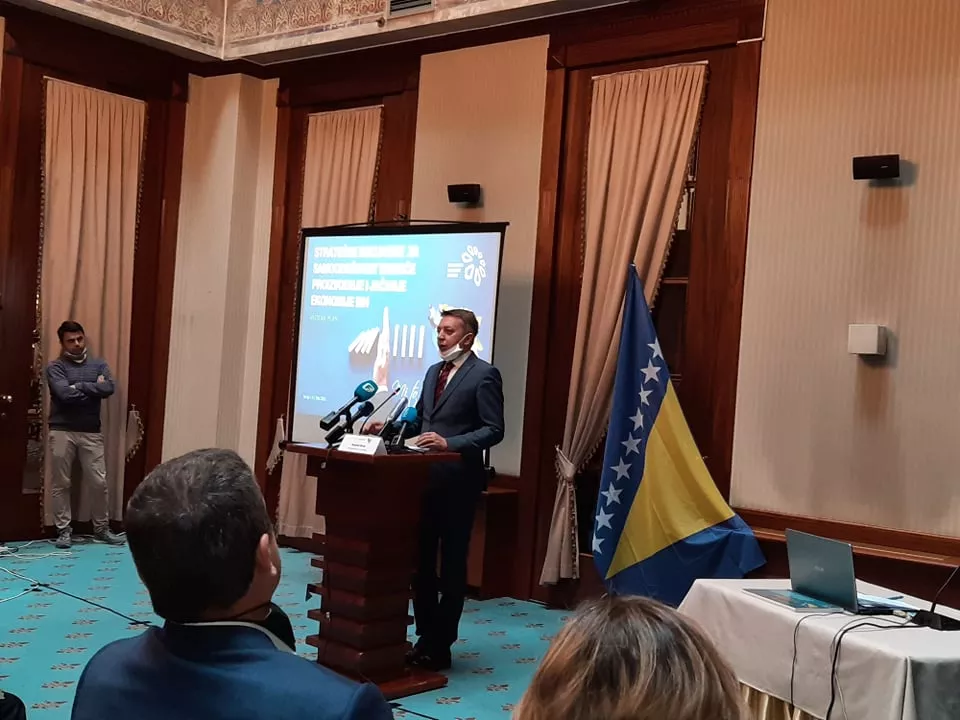
SARAJEVO, (Patria) – The initiative "We Can Do It" was presented today at the Hotel Evropa in Sarajevo. It is a document that contains more than 150 measures to be implemented in protecting domestic production, promoting it, increasing demand, and recovering the economy that has suffered significant consequences during the coronavirus pandemic and lockdown measures.
The Sarajevo Business Forum (SBF) platform brought together a group of domestic experts from various fields who have prepared key guidelines for the authorities in Bosnia and Herzegovina to help domestic companies.
Amer Bukvić, Director of BBI Bank, stated that during the coronavirus pandemic, they realized that we depend on what we produce.
“The key areas are the food and pharmaceutical industries and the energy sector. We must work on import substitution and export promotion. The import of food and medicines is worth around 2.7 billion KM, and priority should be given to purchasing domestic food, medicines, and energy,” said Bukvić.
He emphasized the need for consolidation of public enterprises, as well as a massive public education and awareness campaign on purchasing domestic products.
“It would be good to create an online marketplace for all small and medium-sized enterprises so that everyone in Bosnia and Herzegovina knows what we have,” said Bukvić.
Rusmir Hrvić, President of the Management Board of AS Holding, stated that regarding the food sector, it is important to highlight three components: agriculture, food processing, and retail.
“The main problem is in agriculture; in our country, agriculture is linked to social categories or those who have surplus time and land, while abroad, every inch of land is cultivated, as is the case in Austria,” said Hrvić.
Using the example of biscuit production, he showed how domestic products can be used to create a final product ready for the market.
“We are talking about vertical integration, but state incentives are needed, as well as the setting of achievable strategic goals,” said Hrvić.
Nedim Uzunović, Director of the largest Bosnian pharmaceutical company Bosnalijek, stated that during the crisis, the company turned to the domestic market and did not feel the impact of border closures.
“We managed to respond to all challenges, and we at Bosnalijek made the decision to focus on the domestic market,” said Uzunović, adding that 250 million KM goes to foreign drug manufacturers based on essential lists.
“We ask all levels of government to support domestic producers,” added Uzunović.
Elvir Švrakić from the Association of Electronic Media stated that the media industry employs thousands of workers.
“Domestic companies and the media constitute a significant segment. Only joint cooperation can lead to a change in consumer awareness,” said Švrakić.
Nataša Pucar, Director of Corporate Communications at Studen Holding, emphasized that during the crisis, citizens of Bosnia and Herzegovina could buy basic foodstuffs in Bosnia and Herzegovina – oil, sugar, flour, but that a step further must be taken.
“We are a country of healthy food. In retail chains, imported products are still prioritized, and this is one of the measures from the initiative to change that. It is high time we understood why we need to talk about self-sustainability,” said Pucar.

She called on institutions to support the “We Can Do It” initiative because it can only be implemented through joint efforts.
Zoran Puljić, Director of the Mozaik Foundation, emphasized the importance of state support in the form of incentive funds for the development of start-ups, as many do not meet the conditions for obtaining bank loans.
Komentari (0)
Prijavite se za komentiranje
PrijavaJos nema komentara. Budite prvi!
Minuta
Sve →Iz drugih kategorija

High Representative Not Elected: Germans, French and British Sabotaged Americans, New Attempt at End of June

ČOVIĆ WITHOUT MERCY: How Those Who Brought Ademović to Office Created a Political Hell for Him



Sunny Saturday, quite warm



Tragedy in Albanian resort: Two minors drown












