
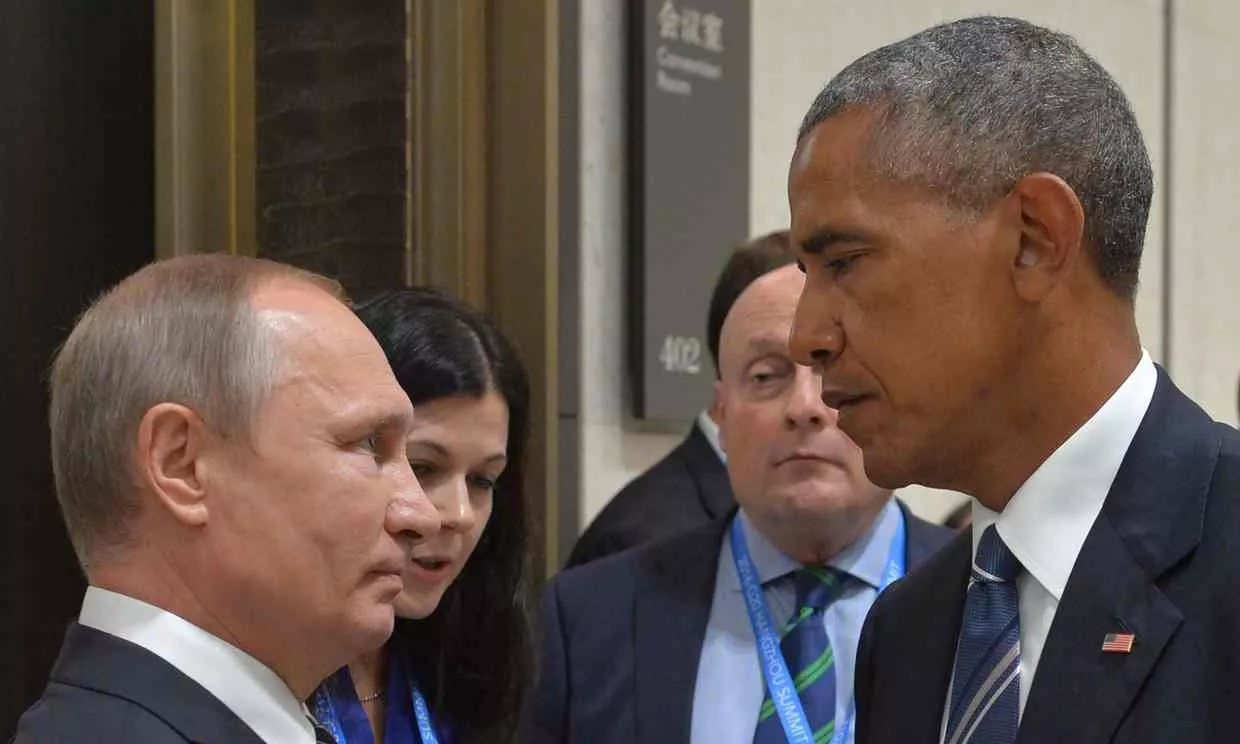
Despite cold relations, Moscow and Washington seem to be on the verge of an ambitious deal, writes the British Guardian.
American and Russian aircraft came within just 3 meters of each other and barely avoided a collision this week over the Black Sea; Barack Obama and Vladimir Putin exchanged hostile glances during their meeting at the G20 summit; Obama's Democrats accused the Russians of hacking their computer system.
The relationship between Washington and Moscow has never been simple. However, they now appear to be a step away from a deal that would lead them into a joint operation in Syria.
This ambitious deal is being finalized in Geneva between US Secretary of State John Kerry and Russian Foreign Minister Sergey Lavrov.
There is concern that Kerry is blinded by a desire to erase a major stain on his foreign policy record before leaving his position.
The essence of this technically complex agreement was presented in a letter to opposition groups authored by Michael Ratney, the US special envoy for Syria.
The basic tenets of the agreement are that Russia will prevent Syrian regime government planes from flying, meaning the regime government will not bomb areas controlled by the opposition, regardless of who is present in that area, Ratney's letter states.
He added that this includes areas where Jabhat Fatah al-Sham is present, along with other opposition factions. In July, the militant group changed its name from Jabhat al-Nusra in an effort to distance itself from al-Qaeda, but the US still considers it a terrorist organization and a legitimate target. A stumbling block in the negotiations on the deal is the method of marking areas where Jabhat Fatah al-Sham is in the majority.
Ratney said that for the "gesture" of grounding Assad's air force, America would "offer Russia coordination in weakening al-Qaeda in Syria. This coordination implies an agreement to stop bombing by the Assad regime or sporadic bombing by Russia."
- Before we realize any deal, we told the Russians that both they and the (Assad) regime must stop attacks on the opposition and establish a ceasefire, Ratney added.
He also said that the conditions include lifting the siege of Aleppo, the second-largest and most significant city in Syria, which is the site of the greatest bloodshed in the country.
About 250,000 residents of eastern Aleppo endure continuous bombardment and watch as rebels try to prevent the government from cutting off supply lines. The Americans say the deal also includes the regime withdrawing from the main supply route, the Castello Road, ceasing fighting around the Ramouseh road, thereby allowing humanitarian aid to enter Aleppo through Ramouseh and Castello, as well as a cessation of all attacks and operations in all parts of the country.
America insists that all these withdrawals must occur before the US and Russia can implement any deal. One official traveling with Kerry to Geneva emphasized the importance of lifting the siege of Aleppo:
- We must have a situation where it is clear within anything agreed with the Russians that Aleppo will no longer be under siege.
One of the major issues in the negotiations will be the enormous effort by both the US and Russia to create a map of northern Syria with legitimate targets for bombing.
Marking areas of the Islamic State is relatively easy, as are civilian areas. However, it has been significantly more difficult to "untangle" legitimate Syrian opposition groups from Jabhat Fatah al-Sham, especially in the case of pragmatic cooperation between anti-regime groups on the crowded and unclear battlefield.
European diplomats claim there is a fundamental problem of lack of trust between the US and Russia, which requires America to try to obtain guarantees from Moscow regarding the types of sanctions for the Syrian government if it nevertheless launches aircraft. The Americans also claim that the Russians are unwilling to refrain from indiscriminate bombing when the plan requires precision and targeting.
The purpose of the ceasefire must also be clear. A ceasefire would allow the return of humanitarian convoys to besieged cities, which the Syrian government has so far blocked, leading to enormous frustration among humanitarian organizations.
The ceasefire is also a basis for peace negotiations. The Syrian High Negotiations Committee this week developed a detailed concept for a transition path from the Assad regime to a new unitary state, but the plan, praised by British Foreign Secretary Boris Johnson, was ridiculed by the Syrian government.
Previous talks in Geneva on transition were halted by the (in)action of the Syrian government at the time. There is very little visible sign that Russia, or the military balance in Syria, would change the political dynamics enough for a turning point if negotiations continue.
Boris Johnson a few days ago described Syria as "the most urgent political issue in the world." But for many, Syria's future lies not in Geneva, but in today's talks between Hillary Clinton and a group of experienced security advisors. Perhaps Kerry cares about resolving a major foreign policy challenge, but the ugly truth is that many are shifting their gaze from the statements of Kerry and Obama to those of the next commander-in-chief in Washington.
Komentari (0)
Prijavite se za komentiranje
PrijavaJos nema komentara. Budite prvi!
Minuta
Sve →Iz drugih kategorija

High Representative Not Elected: Germans, French and British Sabotaged Americans, New Attempt at End of June

ČOVIĆ WITHOUT MERCY: How Those Who Brought Ademović to Office Created a Political Hell for Him



Sunny Saturday, quite warm



Tragedy in Albanian resort: Two minors drown












