
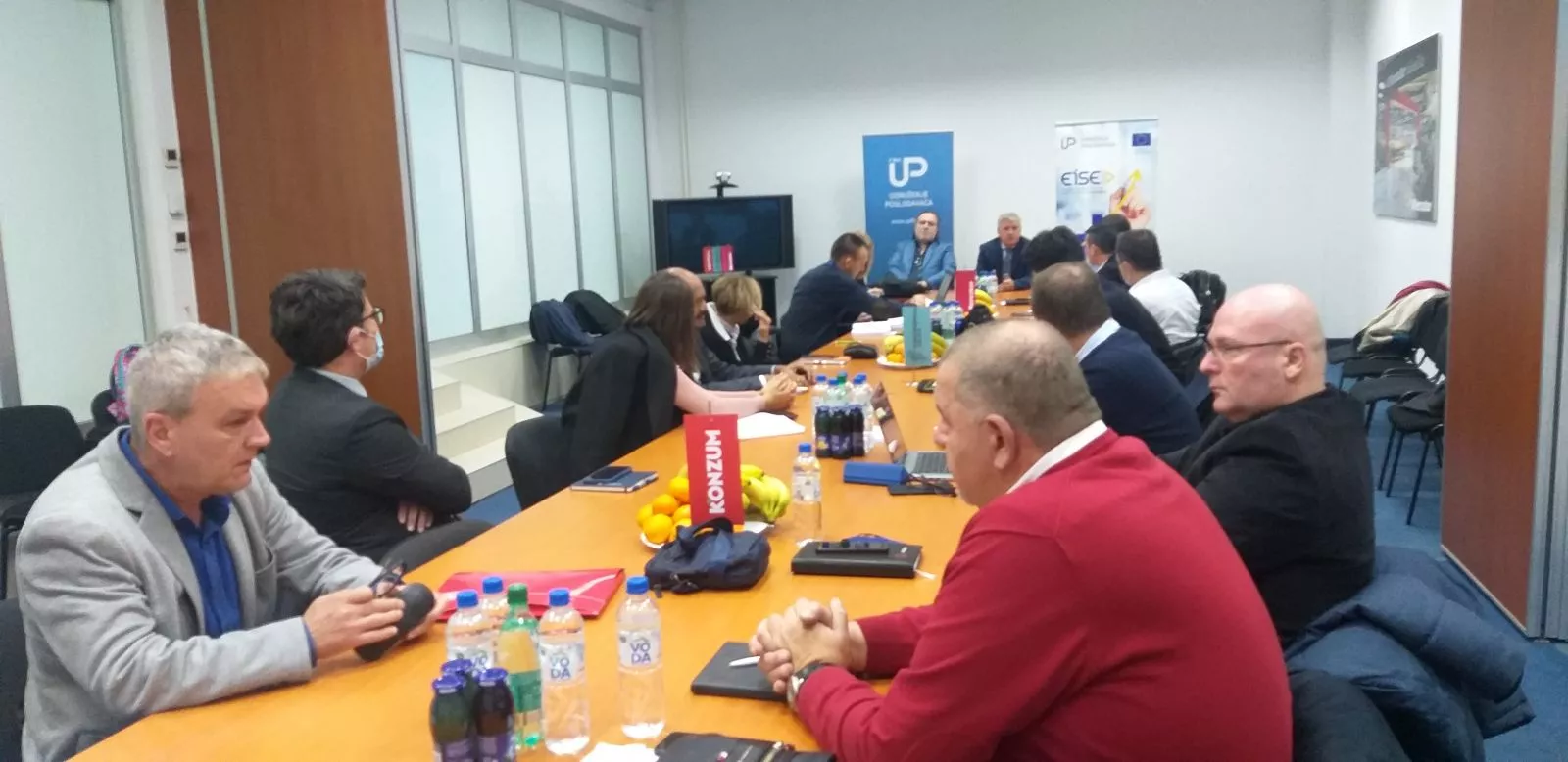
The Association of Employers of the Federation of Bosnia and Herzegovina is organizing a warning strike with a half-hour work stoppage in hundreds of companies in the Federation of BiH, due to contracts that economic entities have received from the power utilities from FBiH, which increase the price of electricity for the next period by up to 350 percent. The warning strike will be organized on Friday, December 17, 2021.
Guesting on Rezime, Adnan Smailbegović, president of the Association of Employers of FBiH, says that the political crisis significantly affects the economic situation.
"All foreign investors who might come here and intend to come, when they hear what is happening, they simply stop, they wait. Secondly, young people are leaving. The BiH economy is losing its best workforce, and if this continues, this will remain a country of old people. Who will produce, who will fill the budgets? The option of importing labor, which is scarce, is one of the potential possibilities, and this is a topic that we, as employers, will probably try to elaborate on a bit in the coming period, because many companies can no longer find labor."
He points out that the situation is no different in the RS.
"However, the RS has much more flexible things, they solve them much faster and easier."
He emphasizes that the current situation has not disrupted the relations between businessmen from FBiH and RS, and that they cooperate very well.
"However, we cannot push through some things, but businessmen understand each other excellently. The problems are very similar, the solutions are very similar, but of course, politics is what should ultimately make decisions."
The financially most difficult problem is contributions
Smailbegović says that out of 500 million marks, about 160-180 million relates to the increase in minimum wages, and thus the increase in all wages.
"We participated in that and even agreed on a significant increase in wages, an average of 28%, so that through contributions, it will draw nearly 200 million from the economy. The next blow is this announced electricity price increase, which is already happening. That is also close to 200 million. And we have added these fiscal cash registers for which the Ministry of Finance has adopted a regulation, which is about 80 million. When you add it all up, you have approximately 500 million just from these three items."
He believes that many things can be resolved and improved.
"We even made a public initiative 3-4 years ago, 20+5+6, where we processed all these issues. But the financially most difficult problem is contributions, because workers in BiH take the least home from what they earn. Money goes into budgets. Pension, health, unemployment, etc. These contributions are significantly high. The government has made a law that has been in parliamentary procedure for 3 years. We are not entirely happy with this law, we think it could be even better, but in any case, it is better than the current one."
A significant part of the economy will not withstand the electricity price increase
He explains that contributions in FBiH are 41.5% of gross wages or 68% of net wages.
"The FBiH Government has reduced it by about 9% of gross wages, so it is around 18%. We think it can go down by another 4-5% and I think that 30% of gross wages would be a completely realistic contribution at this moment. For example, RS is going with 31% from January 1st."
When it comes to the electricity price increase, Smailbegović says: "This increase started significantly around September. Today it is already close to 300%. This is something that a significant part of the economy will either not withstand, or will withstand with great difficulty, or will withstand with consequences. One of the ideas we are considering is not to sign contracts with Elektroprivreda for next year. If individual companies do not sign, it means that EP will disconnect them. But if we, at the level of the Association of Employers, adopt this initiative and if 80-90% of our companies do not want to sign a contract, then it can be significant. We are thinking about it very seriously. The Federal Government has an obligation and legal possibility to suspend the electricity market. EP BiH is even behaving somewhat in accordance with the law that has been in force for about 6-7 years. The government really needs to make a move."
Citizens and workers will pay the final bill for the electricity price increase
He points out that in the next two days they will hold a half-hour warning strike.
"In at least a hundred companies, we will stop production for half an hour. The next step, if that does not yield results, then we will most likely agree and call on all our members not to sign electricity supply contracts for next year. A single-digit increase, somewhere up to 10%, is something that would not disrupt anyone and is acceptable at the start. I think that for the economy, a maximum of 20% is acceptable."
He emphasizes that citizens and workers will pay the final bill for the electricity price increase.
"The increase in electricity prices means an increase in product prices, an increase in service prices on the domestic market. Those who export will reduce the number of workers, reduce production, perhaps even reduce wages, reduce exports. So, it's again at the expense of citizens. Ultimately, unfortunately, the citizens of this country will pay for it."
Smailbegović says that the FBiH Government and entrepreneurs have a very good communication.
"I think that governments, parliaments, or political parties operating here have a primary interest in winning elections. When you have some moves or reform laws that need to be passed, they often do not benefit everyone. Sometimes reforms can be painful for some categories. The overall picture must be considered. Governments and parties pay more attention to elections than to the economy, employment, workers, etc."
Create a positive business environment
When asked what he most criticizes the current FBiH Government for, he answers: "The passage of regulations, laws, and other matters is very poor. And even when some things are agreed upon, they do not get passed and we do not reach the final result. In this mandate, several good moves have been made, but also a large number of bad moves for the economy."
He points out that the business environment in Croatia and Serbia is significantly better.
"Our authorities should create a positive business environment, and then investments will come on their own."
"The pandemic had a negative impact on some companies, primarily tourism. However, some other companies experienced growth during the pandemic, companies that are export-oriented," concluded Smailbegović.
Komentari (0)
Prijavite se za komentiranje
PrijavaJos nema komentara. Budite prvi!
Minuta
Sve →Iz drugih kategorija

High Representative Not Elected: Germans, French and British Sabotaged Americans, New Attempt at End of June

ČOVIĆ WITHOUT MERCY: How Those Who Brought Ademović to Office Created a Political Hell for Him



Sunny Saturday, quite warm



Tragedy in Albanian resort: Two minors drown












