
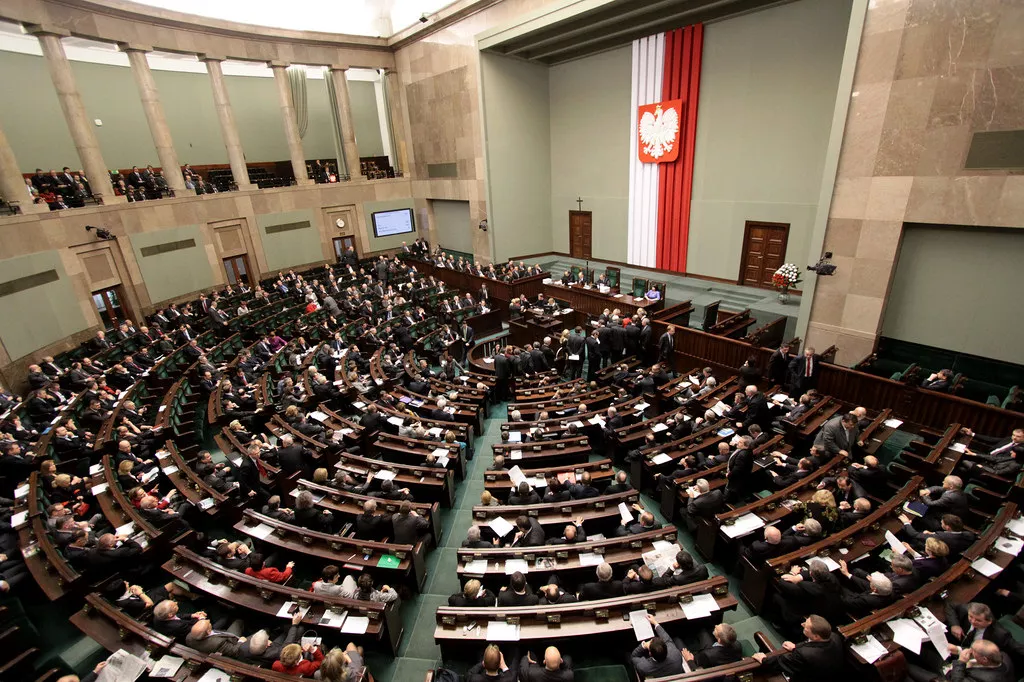
(Patria) - Poland's ruling party wants to ask voters in a referendum if they support accepting "thousands of illegal immigrants from the Middle East and Africa" as part of an EU relocation plan, AP reports.
Mateusz Morawiecki announced the referendum question in a new video posted on social media. He suggested that his Law and Justice party is seeking to leverage migration in its election campaign, a tactic that helped it take power in 2015.
Poland currently hosts more than a million Ukrainian refugees, who are primarily white and Christian, but officials have long made it clear that they consider Muslims and others from different cultures a threat to the nation's cultural identity and security.
EU interior ministers in June backed a plan to share responsibility for migrants entering Europe without permission - the cause of one of the bloc's longest-running political crises.
The Polish government wants to hold the referendum alongside parliamentary elections, scheduled for October 15. Morawiecki said the question would be: "Do you support the admission of thousands of illegal immigrants from the Middle East and Africa within the framework of the forced relocation mechanism imposed by the European bureaucracy?"
The video announcing the question includes scenes of burning cars and other street violence in Western Europe. A Black man licks a huge knife in apparent anticipation of committing a crime.
Party leader Jaroslaw Kaczynski then says: "Do you want this to happen in Poland too? Do you want to stop being masters of your country?"
Opposition politician Robert Biedron reacted by saying the migration question was meaningless because participation in the EU mechanism was not mandatory and could be replaced by other forms of joint responsibility, while Poland itself could be entitled to support or waive its contribution due to the large number of Ukrainian refugees.
Biedron, a Member of the European Parliament for The Left party, published a letter on X, formerly known as Twitter, from EU Commissioner for Home Affairs Ylva Johansson. In it, she outlines the conditions of the relocation mechanism and the reasons for seeking an exemption.
Leaders announced two more questions in recent days. They will ask voters for their views on the privatization of state-owned companies, and the second question is whether they support raising the retirement age, which Law and Justice lowered to 60 for women and 65 for men.
The questions are framed to portray the opposition party, Civic Platform, as a threat to Poles' interests. The pro-business and pro-EU party, which governed from 2007 to 2015, raised the retirement age during its time in power, favored privatization, and signaled a willingness to accept several thousand refugees.
The video is aimed directly at Civic Platform leader Donald Tusk, a former president of the European Council.
"Tusk is the biggest threat to our security, he is the biggest threat to Poland's security," Morawiecki says.
"Let's not allow Tusk, as an envoy of the Brussels elites, to undermine security in Poland," he added.
The European asylum system collapsed eight years ago after more than a million people entered the bloc, most of them fleeing conflict in Syria, overwhelming reception capacities in Greece and Italy, in a process that triggered one of the EU's biggest political crises.
Since then, the 27 EU countries have argued over which countries should take responsibility for people arriving without authorization and whether other members should be obliged to help them do so.
Initially, Poland was neither an entry country nor a destination country for migrants and refugees. It became the former two years ago when migrants began crossing from Belarus, which European authorities see as an attempt by Russia's ally to cause turmoil in Poland and other European countries. Poland responded by building a large wall on its border.
It has recently increased its military presence on the border, fearing a rise in migration and other possible instabilities.
In addition to disagreements over migration, Law and Justice has long been in conflict with the EU over the bloc's perception that the government in Warsaw is undermining democratic norms, AP reports.
Komentari (0)
Prijavite se za komentiranje
PrijavaJos nema komentara. Budite prvi!
Minuta
Sve →Iz drugih kategorija

High Representative Not Elected: Germans, French and British Sabotaged Americans, New Attempt at End of June

ČOVIĆ WITHOUT MERCY: How Those Who Brought Ademović to Office Created a Political Hell for Him



Sunny Saturday, quite warm



Tragedy in Albanian resort: Two minors drown












