
By Armin Sijamić
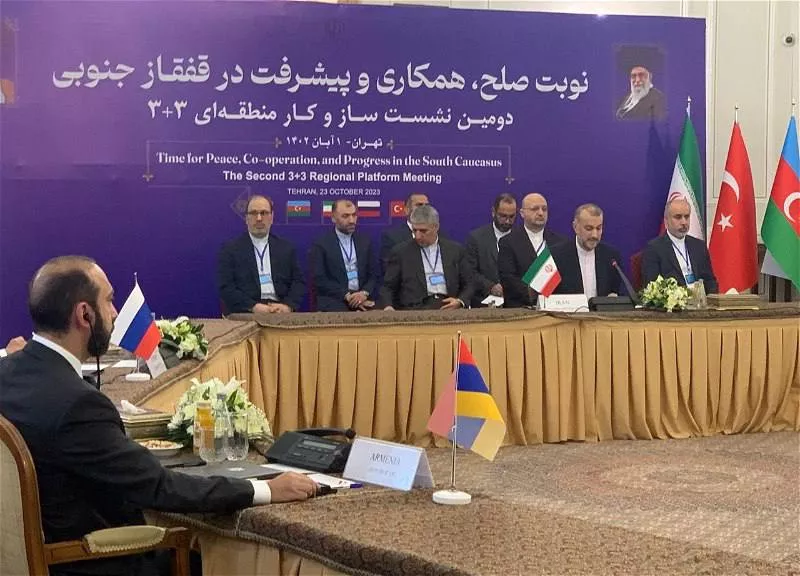
While the world's attention is focused on the war in the Gaza Strip, an important meeting was held in Iran. The topic was the Caucasus and the relations between Armenia and Azerbaijan. The meeting sent a message that those who do not come from that part of the world are not welcome there. A perfect example of how Moscow sees a multipolar world.
The United States' preoccupation with preventing the war in the Gaza Strip from spreading across the Middle East is the most desirable option for Russia and China. Washington's engagement with its allies is an opportunity that rivals are waiting for and counting on.
After Russia's aggression against Ukraine, the Russian neighborhood became a territory where the West saw an opportunity. The Kremlin currently lacks the strength to defeat Kyiv, and consequently, Russian positions in the Caucasus or Central Asia are becoming more vulnerable. Now that Washington is occupied with Israel and Palestine, the meeting in Tehran is a hint of what Russia has been striving for since the collapse of the USSR.
The Caucasus and Regional Powers
The meeting in Tehran on Monday was an opportunity for the foreign ministers of Iran, Russia, Turkey, Azerbaijan, and Armenia to negotiate about the Caucasus. Georgia did not send its minister. The meeting in the 3+3 format is an initiative that brings together three South Caucasian states (Azerbaijan, Armenia, and Georgia) and three regional powers (Russia, Turkey, and Iran).
The strengthening of regional powers and blocs is what Moscow sees as the future world order. Several Russian strategists have explained this idea in terms of the division of responsibilities among major powers for specific parts of the world. Simply put, major powers would impose order in their neighborhoods, and then a few of them would manage global processes.
Those who oppose this understanding of power distribution have noted that some states could be trapped within a bloc. For example, if this vision had prevailed in recent decades, the Baltic states would not have escaped Moscow and joined the West. However, this is part of the multipolar world that Russia advocates for, or rather, what is being created before our eyes, according to the Secretary-General of the United Nations, Antonio Guterres.
The Caucasus is an excellent testing ground for this idea, as only the states invited to the meeting have direct access to it. Iran and Turkey support this concept for their own reasons, the main one being stability on their borders and limiting the influence of Russia and powers outside the region.
Nagorno-Karabakh is Resolved, Other Issues are Next
The meeting in Tehran was an opportunity for representatives of Azerbaijan and Armenia to meet for the first time since Baku's military operation in Karabakh, when they regained control of the breakaway territory. It seems that this issue has already been resolved, and the two countries and their neighbors intend to deal with other matters.
“The conflict, as a whole, is resolved. Both sides agree that Karabakh belongs to Azerbaijan, and that was the main issue that needed to be resolved,” Sergey Lavrov said in Tehran. “Of course, practical steps remain for the full normalization of relations, including preparations for a peace treaty, border demarcation, and the establishment of unimpeded economic and transport links,” he added.
Official Yerevan, under the leadership of Prime Minister Nikol Pashinyan, has made similar statements, although this pro-Western politician is under pressure from the Armenian public. Around one hundred thousand refugees have arrived in Armenia from Karabakh, refusing to live under Baku's control.
Nevertheless, Pashinyan's room for maneuver is shrinking. Although he wants to continue on the path towards the West, he has announced the country's withdrawal from the military alliance with the Kremlin and the withdrawal of the Russian army from Armenia so that the country can turn towards NATO. His playing both sides, seeking Western support while asking Russia to defend Armenians from Azerbaijan, could be jeopardized in the new constellation of relations in the Caucasus.
Iranian Foreign Minister Hossein Amirabdollahian said before the meeting that the talks in Tehran represent a “historic opportunity” and that “the war in the South Caucasus has ended, and it is time for peace and cooperation.” He then added that “the presence of outsiders in the region will not only fail to solve any problems but will further complicate the situation.”
This is an open message to the West. Russia's rejection of Western interference is understandable in itself, while Iran, along with the West, is also betting on Israel, which has excellent ties with Azerbaijan. Turkey, as Azerbaijan's main ally, when Israel is acting against Ankara's interests in the Gaza Strip, will likely reconsider Baku's stance towards Tel Aviv. Furthermore, Turkey does not want France in the Caucasus, with whom it competes for influence from the Middle East to North Africa.
That France is following the meeting in Tehran is evident from the statement by French Defense Minister Sébastien Lecornu that Paris will help strengthen Armenia's air defense with three radars and Mistral anti-aircraft missiles. Recently, Azerbaijan condemned the delivery of weapons to Armenia, stating that France would be responsible for a new war between the two countries.
The Russian-Iranian Connection and the Zangezur Corridor
The meeting in Tehran was an opportunity to showcase the strong ties between Iran and Russia. In addition to meeting with his counterpart Amirabdollahian, Lavrov also met with Iranian President Ebrahim Raisi.
“The current bilateral agenda was thoroughly discussed, with an emphasis on the further development of the entire complex of Russian-Iranian multifaceted partnership in accordance with the agreements reached between Russian President Vladimir Putin and Iranian President Ebrahim Raisi,” stated the Russian Ministry of Foreign Affairs. In addition, the implementation of joint projects in the energy and logistics sectors was highlighted, including the full launch of the North-South international transport corridor. Further steps to strengthen Russian-Iranian ties were agreed upon, and Western sanctions were condemned, the ministry announced.
The relationship between Russia and Iran could be the key to maintaining stability in the Caucasus, while speculation continues that Azerbaijan might launch a new war against Armenia in an attempt to connect the exclave of Nakhichevan with the rest of its territory. In other words, the issue of the Zangezur corridor, which Baku desires, could be the next major issue in the Caucasus.
Armenia borders Iran, and this would divide Azerbaijan into two parts. Baku and Ankara's interest is a corridor connecting the part adjacent to Turkey with the rest of Azerbaijan and further into Central Asia, where Ankara has interests. At the same time, Armenia and Iran's interest is to maintain the border, which Moscow also supports in its intention to limit Turkey's influence in the Caucasus and Central Asia.
The establishment of a forty-kilometer-long corridor could aid the economic development of all five countries, but the establishment of a gas pipeline between Turkey and Azerbaijan, which is rich in energy resources and connected via the Caspian Sea to other important oil and gas producers, poses a threat to Russian energy plans.
Pashinyan stated yesterday in Tbilisi that he hopes his country will conclude a peace agreement and establish diplomatic relations with Azerbaijan in the coming months and open its border with Turkey. From the same location, Azerbaijani Prime Minister Ali Asadov stated that his country wants to establish transport links with Armenia.
Russia, Turkey, and Iran will try to reach an agreement on the South Caucasus, to which Pashinyan, who seeks to distance Armenia from the Kremlin and bring it closer to the West, will have to submit. As the West is geographically very distant from Armenia, in an environment that is currently not favorably disposed to the presence of other powers, Pashinyan and Armenia could become an example of how those who wish to join another camp fare in a multipolar world according to the Kremlin's vision.
Komentari (0)
Prijavite se za komentiranje
PrijavaJos nema komentara. Budite prvi!
Minuta
Sve →Iz drugih kategorija

High Representative Not Elected: Germans, French and British Against Americans, New Attempt at End of June

ČOVIĆ WITHOUT MERCY: How Those Who Brought Ademović to Office Created a Political Hell for Him



Sunny Saturday, quite warm



Tragedy in Albanian resort: Two minors drown












