
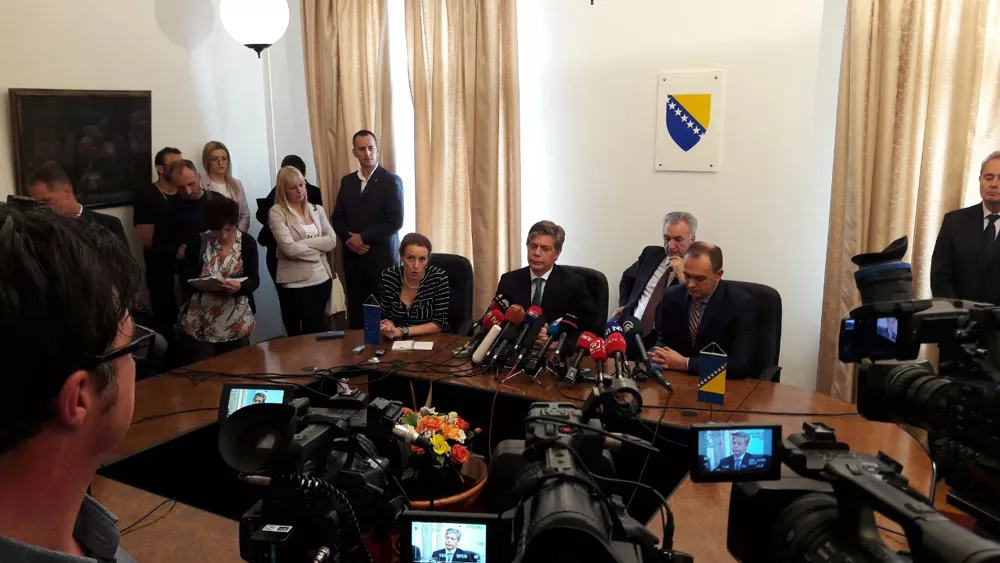
After political conditions were met, the adjusted Stabilisation and Association Agreement (SAA) was initialled in Sarajevo today. The Stabilisation and Association Agreement was initialled between the European Communities and its Member States on one side, and Bosnia and Herzegovina on the other, to take into account Croatia's accession to the EU. The agreement was initialled by the head of the BiH negotiating team, Hamdo Tinjak, and the head of the EU Delegation to BiH and EU Special Representative in BiH, Lars-Gunnar Wigemark, reports the Patria News Agency.
Lars-Gunnar Wigemark pointed out that a normal procedure would take six months, and only after it is completed will the ratification procedure of the SAA enter into force.
- What is an integral part of this protocol is a phased approach over a three-year period, so the next weeks and months should be used to develop a study that will predict potential damages. One of the immediate activities after the protocol enters into force is the activation of autonomous trade measures. This unblocking will immediately bring benefits to fruit and vegetable producers who have been suffering the consequences since January. In addition, there are many issues in the agricultural sector that have very little to do with the SAA, I would say almost none. So we must be careful not to mix apples and oranges – Wigemark emphasized, stating that a coordination mechanism must be established to develop an agricultural strategy.
Hamdo Tinjak emphasized that every ordinary citizen should be happy because a European perspective is opening up for them.
- This is a better future for agriculture; we need a general approach, we need to see why certain sectors were not developed even without the SAA. Our businessmen, using pre-accession funds, will be able to be competitive, and that is the problem, because we could not get the opportunity to compete with European producers. We have been negotiating quotas that will be imported into BiH duty-free all along; anything above those quantities will be subject to customs duties. All of this involves quantities that cannot threaten our market. Milk has the largest quota, but there is a trial period for that product – Tinjak added.
Mirko Šarović, Minister of Foreign Trade and Economic Relations of BiH, touched upon the aid promised by Germany and clearly emphasized that this aid will not be of a social nature.
- There will be no such support. This is a process in which we will define the sectors that will be most affected, due to the import of duty-free goods, especially in the dairy and meat and meat product industries. These are the most sensitive sectors, and in that regard, experts will make a certain assessment, and projects will be worked on to help these sectors become competitive – Šarović added.
What is the SAA
The Stabilisation and Association Agreement (SAA) was signed in 2008 and entered into force in June 2015. Its trade part, the Interim Agreement, has been in force since 2008. Thanks to the SAA, 85% of domestic exports go to the EU market. In the context of Croatia's accession to the EU in July 2013, and in accordance with the EU's traditional trade methodology, the European Commission has been negotiating adaptation protocols with a large number of countries, including Western Balkan countries, since the end of 2012, in order to avoid disrupting existing bilateral trade with Croatia.
Bosnia and Herzegovina is the last in a series of Western Balkan countries that will also have an harmonized protocol. The agreement is based on the mutual interest of both parties. Although it retains the principle of traditional trade, the agreement takes into account the fundamental sensitive issues on the BiH side, primarily concerning certain products, as well as the need for BiH to limit the administrative and financial burden of work on quotas as a result of the SAA adaptation. From the date of its provisional application, the EU will automatically reintroduce certain trade preferences for exports from BiH to the EU market for certain categories of agricultural products, such as fruits and vegetables (so-called "autonomous trade measures"). These benefits were suspended for BiH from January 1, 2016, due to the failure to adapt the SAA.
Komentari (0)
Prijavite se za komentiranje
PrijavaJos nema komentara. Budite prvi!
Minuta
Sve →Iz drugih kategorija

High Representative Not Elected: Germans, French and British Against Americans, New Attempt at End of June

ČOVIĆ WITHOUT MERCY: How Those Who Brought Ademović to Office Created a Political Hell for Him



Sunny Saturday, quite warm



Tragedy in Albanian resort: Two minors drown












