
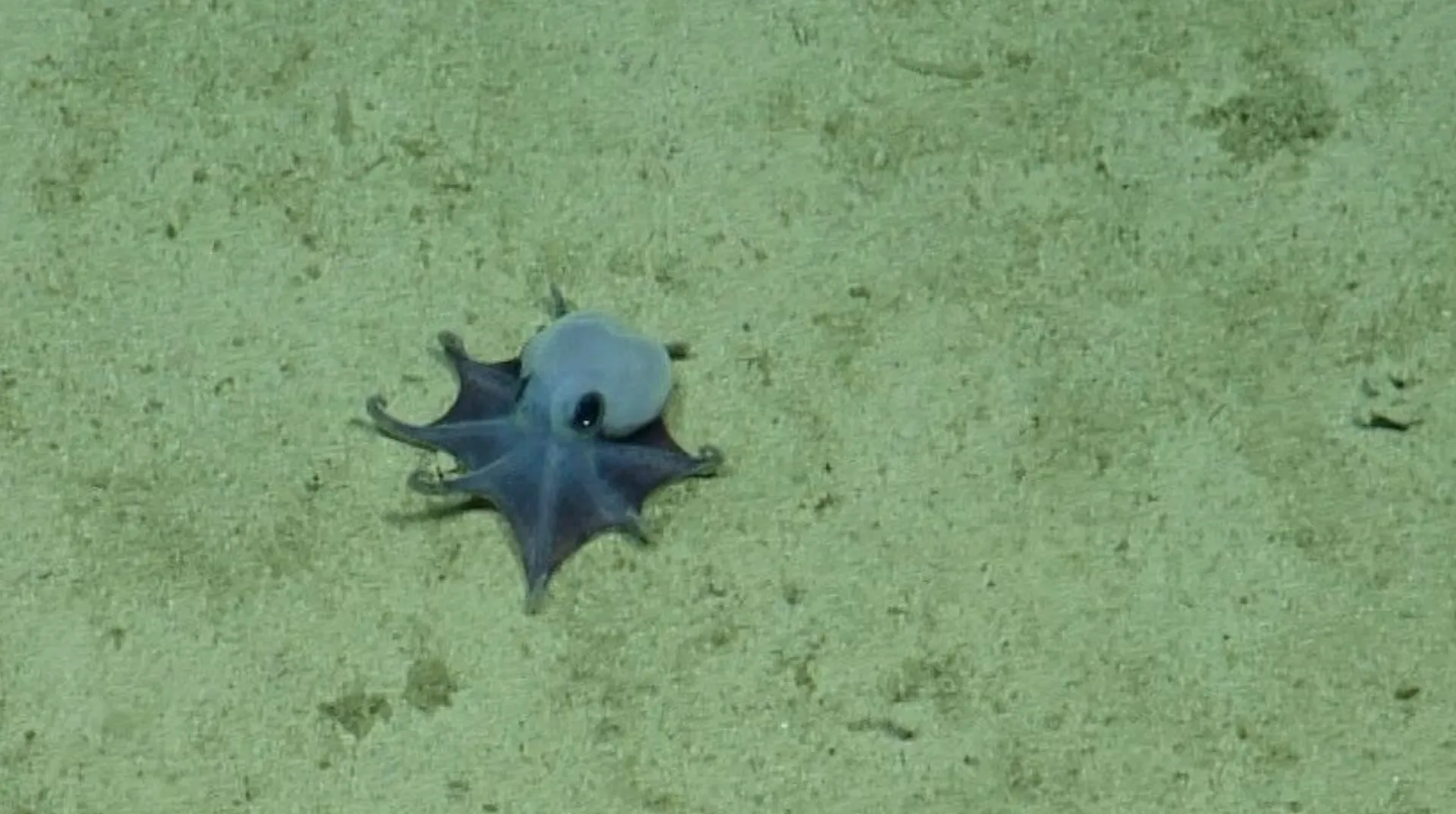
(Patria) - Scientists have discovered a new, tiny blue octopus species at the bottom of the ocean near the Galapagos Islands that can fit in the palm of your hand.
This is the result of research conducted using a remotely operated submersible, the Charles Darwin Foundation announced.
The new octopus species was found at about 1,800 meters below the sea surface.
Octopus expert Janet Voight from the Chicago Museum of Natural History says she immediately knew it was something exceptional, although initially she only had photos at her disposal, and later a preserved specimen.
Voight stated that the closest known related octopus species had previously been registered off the coast of Uruguay, in a completely different ocean area.
Since there was only one specimen, scientists did not want to dissect it for classical analysis, but instead used computerized tomography (CT) to create a three-dimensional model.
- There's nothing like the feeling of studying something for a whole day that no human has seen before you - said Stephanie Smith, head of the museum's X-ray laboratory.
The new species, named "Microeledone galapagensis", stands out not only for its blue color but also for its small size within the Megaleledonidae family, whose members are generally much larger and live in the Southern Ocean around Antarctica.
- Its short arms with only one row of suckers distinguish it from most known octopuses - said Voight.
She added that this octopus also differs in its smooth skin on its back and its specific color - its back is light blue, while its underside is dark purple.
Scientists believe that such coloration may have a protective function in the deep sea, as the dark part of the body covers prey that might emit light, thus protecting the octopus from predators.
Experts point out that discoveries of new octopus species in the deep sea are not uncommon, given that large parts of the ocean floor remain unexplored.
This species was first seen in 2015 near Darwin Island, named after the British scientist Charles Darwin, whose stay in the Galapagos contributed to the development of the theory of evolution.
Komentari (0)
Prijavite se za komentiranje
PrijavaJos nema komentara. Budite prvi!
Minuta
Sve →Iz drugih kategorija

High Representative Not Elected: Germans, French and British Against Americans, New Attempt at End of June

ČOVIĆ WITHOUT MERCY: How Those Who Brought Ademović to Office Created a Political Hell for Him



Sunny Saturday, quite warm



Tragedy in Albanian resort: Two minors drown












