
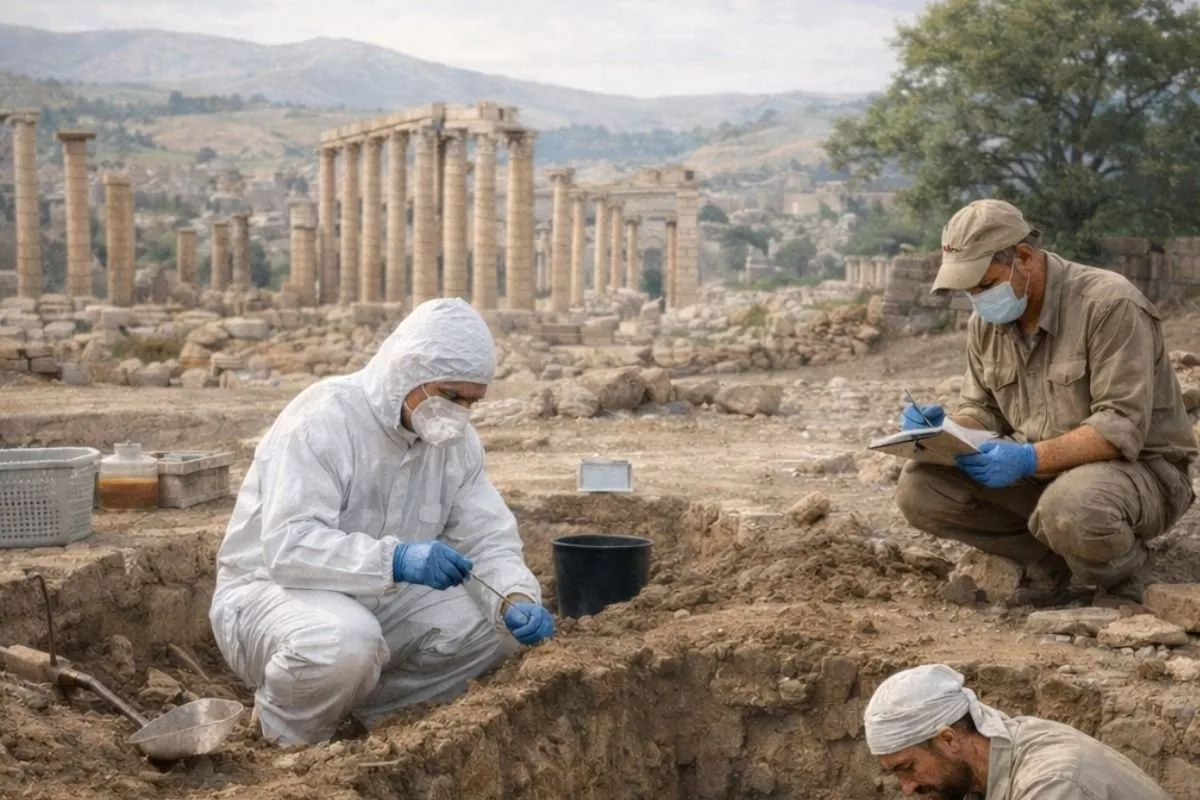
(Patria) - A research team led by American scientists has verified the first mass grave in the Mediterranean region, in present-day Jordan, where victims of the earliest recorded pandemic in the world were buried, providing new details about the Justinianic plague that killed millions of people in the Byzantine Empire between the sixth and eighth centuries.
DNA taken from human remains in the mass grave in Jerash, in present-day Jordan, shows that the bacterium Yersinia pestis caused bubonic plague.
The Justinianic plague was the first recorded pandemic of bubonic plague that ravaged the Byzantine Empire and parts of Europe, Asia, and Africa. It was named after Emperor Justinian I, who himself survived the disease.
The pandemic killed between 30 and 50 million people, significantly weakening the empire and paving the way for later epidemics such as the Black Death.
The latest findings, published in the journal 'Journal of Archaeological Science', offer what researchers call a rare empirical insight into the mobility, urban life, and vulnerability of citizens affected by the plague. The new research focused on the victims, their way of life, and susceptibility to the disease in Jerash, a regional trade center and the epicenter of the pandemic that raged from 541 to 750 AD.
"The Jerash site provides us with a human story of who died and how the city experienced the crisis," said the lead author of the study and associate professor in the Department of Global, Environmental, and Genomic Health Sciences at the University of South Florida, Rejs Đijang.
She pointed out that pandemics are not only biological but also social events.
"By connecting biological evidence from bodies with the archaeological environment, we can see how the disease affected real people in their social and ecological context," explained the scientist.
According to her, this helps us understand pandemics in history as lived events, not just epidemics recorded in historical chronicles.
A multidisciplinary team of archaeologists, historians, and geneticists from the University of South Florida, Florida Atlantic University, and the University of Sydney compiled the study, and Đijang and her researchers studied DNA extracted from teeth.
They discovered a diverse demographic composition of the victims, which, she said, showed that an otherwise largely mobile population, during the plague epidemic, remained together, trapped in the same place due to the disease, similar to how travel was suspended during the recent COVID pandemic.
"People move, they travel, and here they were gathered by the crisis," pointed out Đijang, adding that ancient pandemics thrived in densely populated cities.
Excavations revealed that more than 200 people were buried in the grave in Jerash, known as the Pompeii of the Middle East due to its preserved Greco-Roman ruins.
Đijang stated that the victims included men and women, old and young, "people in their prime, as well as adolescents," reported Tanjug.
Komentari (0)
Prijavite se za komentiranje
PrijavaJos nema komentara. Budite prvi!
Minuta
Sve →Iz drugih kategorija

High Representative Not Elected: Germans, French and British Against Americans, New Attempt at End of June

ČOVIĆ WITHOUT MERCY: How Those Who Brought Ademović to Office Created a Political Hell for Him



Sunny Saturday, quite warm



Tragedy in Albanian resort: Two minors drown












