
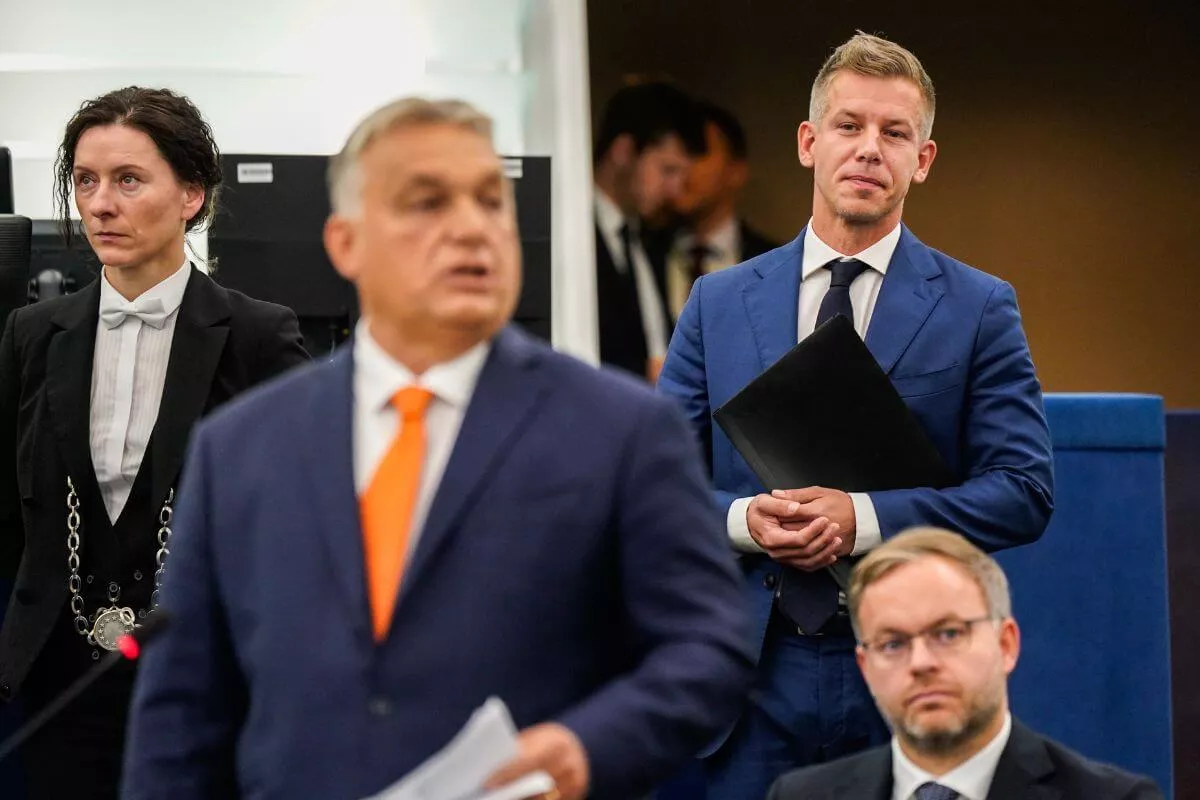
(Patria) - Hungarian opposition leader Peter Magyar says next week's elections, where he faces pro-Russian Prime Minister Viktor Orban, will be a "referendum" on whether Hungary will continue its path towards Eastern autocracies or reclaim its place among Europe's democratic societies.
Magyar, a former Orban ally, represents the most serious threat to the nationalist prime minister who has been in power since taking office in 2010.
In an interview with the AP, Magyar said that the European Union's longest-serving leader has in recent years led the country in a "180-degree turn," jeopardizing its Western orientation by moving closer to Moscow.
Despite this turn, "Hungarians still see that Hungary's peace and development are guaranteed by its membership in the European Union and NATO," Magyar said. "I think this will truly be a referendum on our country's place in the world."
Magyar spoke to AP on Thursday after a campaign rally for his center-right Tisza party in Kiskunhalas, a small town of about 25,000 inhabitants. It was one of hundreds of rallies he has held in large and small settlements across the country, as part of a campaign in which he visits up to six towns a day before the April 12 elections.
Orban has earned a reputation as a staunch disruptor within the European Union due to his frequent vetoes of important decisions. He is campaigning by warning of numerous external dangers that he says threaten Hungarians – the war in Ukraine, a clique of EU bureaucrats and financial elites united against Hungary, and the ever-present immigration crisis.
Magyar, who is leading in most polls, has focused on issues affecting voters' daily lives, such as the struggling state health and public transport sectors and what he describes as widespread government corruption.
At each of his rallies, he accuses Orban and his nationalist-populist Fidesz party of making Hungary the "poorest and most corrupt" country in the European Union and portrays it as a "peaceful, humane, and functional" country within reach.
In addition to this domestic message, Magyar increasingly points to Orban's balancing act with the European Union and his move towards Russia as crucial issues for the country's future.
"I believe Tisza will have a convincing election victory, because not even Fidesz voters want our country to be a Russian puppet, a colony, an assembly plant, instead of belonging to Europe," he said.
"Tisza is Blue"
Magyar and his party have surprised many Hungarians with their meteoric rise. For almost a decade and a half, a wide range of fragmented opposition parties have tried and failed to pose a serious threat to Orban's power.
While opposition politicians have often criticized Orban during parliamentary debates, they have rarely made an effort to win over his voters in rural areas. Frustrated after a series of bitter defeats, many opposition voters have fallen into political apathy.
Magyar, a 45-year-old lawyer and former Fidesz member, was previously married to an Orban ally who served as Hungary's justice minister. After working as a diplomat in Brussels for several years, he returned to Hungary and took positions in state institutions, becoming familiar with the workings of Orban's system.
But after a political scandal in 2024 involving a presidential pardon for an accomplice in a child sexual abuse case, he publicly distanced himself from Orban's party, accusing it of overseeing deeply rooted corruption and taking over Hungarian institutions.
He quickly founded the center-right Tisza party, named after Hungary's second-largest river – the Tisza, which, just four months after Magyar's entry into politics, won thirty percent of the vote in the European Parliament elections.
As Tisza's popularity grew, the chant heard at its rallies became the motto for its rise: "Tisza is Blue."
Magyar has framed his electoral task as dismantling Orban's autocratic system, but has pledged to retain some of the prime minister's policies he considers positive, such as the fence along the southern border to prevent migrants from entering and the popular utility price reduction program.
Nevertheless, his party, a member of the largest, center-right group in the European Parliament, deviates from the constellation of far-right political movements in Europe and beyond that see Orban as a prime example of nationalist populism in action.
In a sign of admiration from U.S. President Donald Trump and his MAGA movement towards Orban, Vice President JD Vance will visit Budapest on Tuesday to support his re-election.
Constructive, but Critical
Many European Union leaders are watching the Hungarian elections in the hope that Orban will be defeated. His frequent vetoes, which recently included blocking a large 90 billion euro European Union loan for Ukraine, were often to satisfy his eurosceptic base, Magyar said, "vetoing just so he could say at home that he vetoed."
The prime minister's behavior has led to renewed calls within the European Union to reform the bloc's founding treaties by reducing the number of decisions requiring unanimity – a way to alleviate the paralysis that can be caused by unyielding member states.
Magyar said that under a Tisza government, European leaders can expect a "constructive stance," but one that is "critical and ready for debate. We want to be at the negotiating table."
Despite Orban's exploitation of EU unanimity rules, the ability to veto important decisions is a "valid option," he continued, adding: "I don't think European leaders have a problem with this, they have a problem with the unnecessary role of a troublemaker."
"The task of the Hungarian prime minister at any time is to represent Hungarian interests, and if necessary, to represent them strongly," he said. "No matter the cost."
Russian Energy
Orban has confused, and even angered, almost every leader in Brussels with his conciliatory approach to Russia and his closeness to President Vladimir Putin. Some Brussels officials, and many of his opponents at home, have accused him of violating his obligations to the bloc on behalf of Moscow.
While almost every country in the Union cut off supplies of Russian fossil fuels after the invasion of Ukraine in February 2022, Hungary, along with Slovakia, maintained, and even increased, supplies, provoking the anger of many countries that accused them of helping to finance the war.
Magyar has condemned Hungary's rapprochement with Moscow, as well as reports that Russian intelligence services are interfering in elections to turn them in Orban's favor, but said his future government would take a "pragmatic" approach to Russia.
"Pragmatism means that we have no say in Russia's internal affairs, and they have no say in our affairs," he said.
"We are both sovereign countries and we respect each other, but we don't have to like each other."
Magyar has criticized Orban's government for failing to diversify its energy sources and advocated for reaching new agreements and building new infrastructure to bring oil and gas from other sources into landlocked Hungary.
Nevertheless, he said, "this does not mean that we have to stop using Russian oil tomorrow. It means that the European Union's resources must be used well."
Komentari (0)
Prijavite se za komentiranje
PrijavaJos nema komentara. Budite prvi!
Minuta
Sve →Iz drugih kategorija

High Representative Not Elected: Germans, French and British Against Americans, New Attempt at End of June

ČOVIĆ WITHOUT MERCY: How Those Who Brought Ademović to Office Created a Political Hell for Him



Sunny Saturday, quite warm



Tragedy in Albanian resort: Two minors drown












