
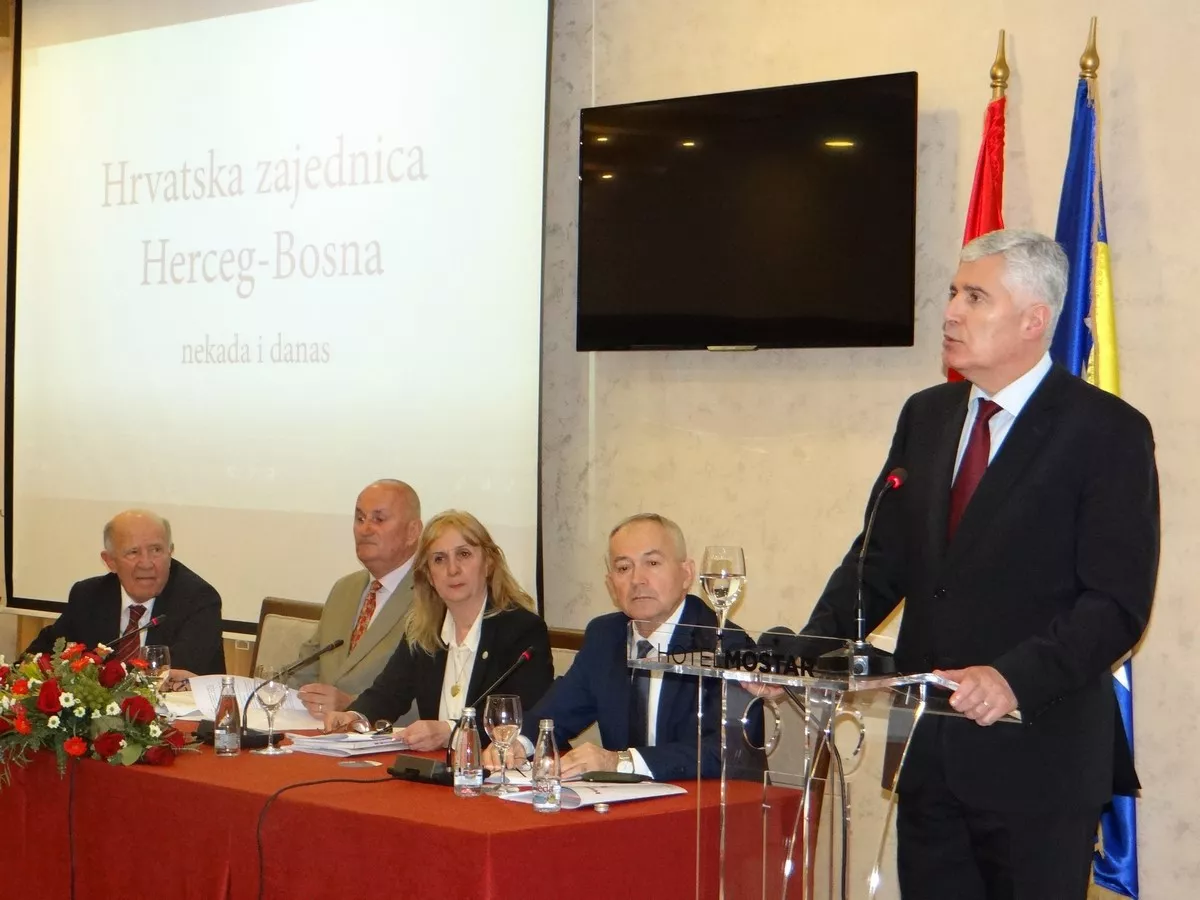
(Patria) - The Youth of the Croatian Democratic Union of BiH issued a statement with the working title 'The question is whether the young SDA colleague Kurtović would be free to speak today, as he is speaking, if it weren't for the Croatian Community of Herceg-Bosna'.
"First of all, we must emphasize that we will proudly commemorate November 18th as long as the Croatian people in Bosnia and Herzegovina live and breathe - it is the most important day of our national history, as well as one of the most important dates in the history of the state of Bosnia and Herzegovina. We were the first to stand in its defense, while official Sarajevo was eating candied fruits then," says the HDZ Youth.
For the HDZ Youth to objectively assess things and call them by their true name, they should first read the judgment of the International Court in The Hague, which on November 29, 2017, delivered its verdict on the character of that para-state entity, deeming it to have been created through a Joint Criminal Enterprise, while the political and military leadership (Prlić, Praljak, Ćorić, Petković, Stojić, Pušić) of that para-state were sentenced to 111 years in prison.
One of the convicted, Slobodan Praljak, did not have the courage to face the 20-year prison sentence, so he drank poison in the courtroom, which led to his death. Leading politicians of the HDZ in BiH and the state leadership of neighboring Croatia paid tribute to the convicted criminal Praljak, and the Croatian Parliament observed a minute of silence in his honor. Colleague Haris Ljevo wrote for years about the evil that this JCE idea brought to the citizens of BiH, and a part of it is published below.
"The so-called Herceg-Bosna existed for about three years, and in that short time, it did not have time to produce any Nobel laureates in physics, mathematics, or literature, it did not create any athlete who achieved a result worth mentioning, companies in that mini-state were not involved in producing quality chocolates, building roads, railways... However, in a very short time, so many significant events occurred in the area under the control of the so-called Herceg-Bosna authorities that historians will have material to deal with for the next few centuries. To list them all would require thousands of pages, but I will mention only a few.
The Mosque in Ahmići Was Destroyed
The massacre in Ahmići was carried out on April 16, 1993, in which members of the Jokeri unit killed 116 Bosniak civilians, a large number of women and children, including a three-month-old baby. The mastermind of the operation in Ahmići, Dario Kordić, was sentenced by the International Criminal Tribunal for the former Yugoslavia in The Hague to 25 years in prison, and after his release from prison, he gives religious lectures and fights against women's right to abortion, because, in his opinion, no one has the right to take a life given by God.
The massacre in Stupni Do near Vareš, in which 38 Bosniaks were killed, was carried out on October 23, 1993, by members of the Maturice and Apostoli units under the command of Ivica Rajić, who pleaded guilty in The Hague and was sentenced to 12 years in prison. Rajić received orders from Milivoj Petković, who was definitively sentenced to 20 years in prison in The Hague. Petković ordered Rajić to go to Vareš and sort out the situation, and to show no mercy to anyone.
Among the greatest symbols of the failed mini-state are certainly the numerous camps, including Dretelj, Heliodrom, Gabela...
The Heliodrom camp was located near Rodoč, south of Mostar, which was previously used only as an HVO helipad, whose helicopter hangars and garages were converted into prison cells. HVO members began holding Bosniak men in the camp from 1993 to mid-1994. The number of prisoners was approximately around 1,800 in May 1993, dropping to around 500 in June. Prisoners were subjected to psychological and physical abuse. In the most severe cases, they were forced to walk in front of HVO forces as human shields. Guards beat them, especially if the HVO was losing on the battlefield. Some prisoners were taken for forced labor, such as digging trenches or building military fortifications, as well as collecting the bodies of dead HVO soldiers.
HDZ leader Dragan Čović, as the general director of the Soko Mostar company, sent a request in June 1993 to Josip Praljak, then deputy warden of the Heliodrom camp, to "for the needs of the Soko Mostar Aviation Industry, allow the release of ten prisoners for the purpose of performing certain tasks." The approval for the transfer of detainees was signed the next day by Stanko Božić, director of the Central Military Investigation Prison Mostar. As stated, "the departure of detainees for work outside the prison grounds was approved by Berko Pušić in an oral conversation with director Stanko Božić."
Camps in Herzegovina Were the True Face of Herceg-Bosna
The then Herceg-Bosna was not immune to terrorism either. Although today Croatian political representatives from BiH and Croatia consider Bosniaks to be the originators of terrorism in these areas, and even in Europe, the event of April 18, 1993, from Vitez refutes them.
A tanker containing half a ton of explosives exploded near the mosque in Stari Vitez, destroying the offices of the wartime presidency of the Bosnian authorities in Vitez, killing at least six people and injuring 50. The International Criminal Tribunal in The Hague accepted that this action could be defined as pure terrorism committed by elements within the Croatian forces that were attacking the Bosniak population of Stari Vitez.
In addition to terrorism, camps, and massacres, the para-state Herceg-Bosna was also characterized by planned shelling of civilian targets such as the market in Zenica. The market in Zenica was shelled by the HVO on April 19, 1993, from the village of Putičevo, 15 kilometers from Zenica, killing 15 and wounding 50 civilians. The shells arrived in three waves of two each, at 12:10, 12:24, and 12:29. Two artillery pieces were used: D-30 J Howitzers, manually loaded with slow firing rates. It was a professionally executed artillery attack carried out with the help of observers. Two Danish members of the ECMM visited the scene of the massacre immediately after the shelling and photographed the crime scene. The photographs showed scenes of devastation of the market, scattered bodies on the ground, destroyed cars and a bus stop, and damaged buildings. Croats blamed Serbs for the massacre, but the ICTY rejected such claims in the Kordić case.
The murders and torture in the camps were accompanied by the planned destruction of cultural monuments of Bosnia and Herzegovina that testified to the centuries-old existence of BiH as a state. The main symbol of Mostar and Herzegovina, the Old Bridge, was destroyed on November 9, 1993, leaving the whole world stunned by this monstrous act of the HVO. The HVO destroyed the Old Bridge as part of a campaign of shelling and terrorizing Mostar. The day before, the HVO had begun a campaign to destroy the bridge by firing dozens of projectiles at its arch and towers, which culminated in its final destruction the following day. After the release of 36 transcripts of Franjo Tuđman, it can be concluded that the destruction of the bridge was part of a deliberate campaign of aggression by Croatia, which, among other things, was reflected in urbicide... A quarter of a century after the horrific crimes and camps, the final verdicts of the Court in The Hague, the political leadership of the HDZ and the parties gathered around that party and Dragan Čović celebrate that project, calling it the aspiration of the Croatian people for survival in BiH."
The time for confronting the past and one's own crimes is clearly not yet near.
Komentari (0)
Prijavite se za komentiranje
PrijavaJos nema komentara. Budite prvi!
Minuta
Sve →Iz drugih kategorija

High Representative Not Elected: Germans, French and British Sabotaged Americans, New Attempt at End of June

ČOVIĆ WITHOUT MERCY: How Those Who Brought Ademović to Office Created a Political Hell for Him



Sunny Saturday, quite warm



Tragedy in Albanian resort: Two minors drown












