
By: Dean Džebić
Without exception, this year's budget of the Ministry of Defence of Bosnia and Herzegovina has caused
political disputes in BiH, and somewhat disputes common sense as well. On the other hand, while one person's misfortune is another's gain, this time it has benefited the bureaucratic apparatus, i.e., the administration, which like a Leviathan devours every surplus, turning it into excess paper and a deficit of funds.
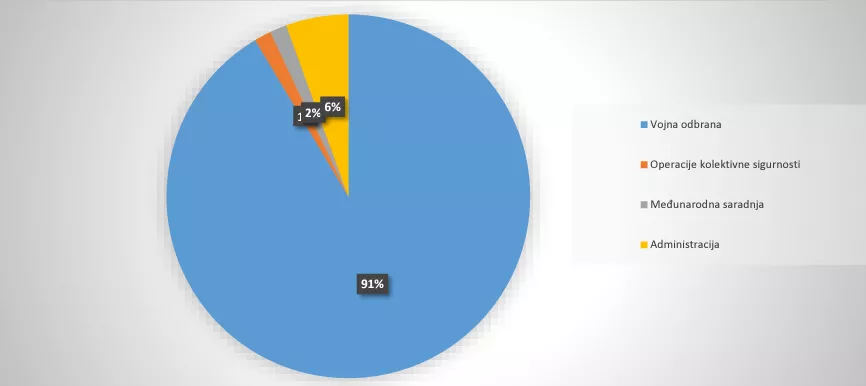
According to the new budget, which by all indications has nine digits rather than ten, the administration alone will spend 20 million convertible marks, or 5.1 percent of the total budget of the Ministry of Defence.
The Famous Increase
Since taking over the ministry, Minister Zukan Helez has been bringing sweet intelligence stories daily, as well as some "project completions" that he has, in the manner of a goalscorer, set up and completed for himself.
The rumour about the increase in the MOBiH budget, which the minister has attributed to himself, is also well-known, even though it concerns an increase in the gross salary coefficients for state-level employees. So, if mathematics and logic have not completely abandoned this society, the matter is very clear. The MoBiH budget for last year, 2022, was KM 306,765,000, which is an equilibrium of funds that have ranged from 290 to 300 million convertible marks since 2015. Considering the salary increases for personnel and employees at the state level, MoBiH, with its 10,000 employees, has by far the largest appetite for coefficient increases, so the new "increased" budget for 2023, amounting to KM 392,259,000, has considerably melted away. A powerful eighty-six million marks of an even more powerful budget increase has powerfully melted away, so according to the document "Budget for Citizens 2023," as much as 98 percent goes to personnel costs!
Of course, the salaries of officers, non-commissioned officers, soldiers, and civilian personnel in MoBiH should have been increased, but certainly not at the expense of such a poor, non-developmental, and under-capacitated ministry budget.
To avoid being unfair, of the remaining 2 percent in addition to the aforementioned 98 percent, 1.6 percent of these funds are allocated for equipment procurement and modernization, which, according to the linear cost breakdown for 2023, means that the BiH Armed Forces will have a meager KM 3,857,000 for modernization and armament procurement needs.
Of the billion shown in the budget graphic, which is presented in a circular graph by the Ministry of Finance and Treasury, there is no practical mention.
Minister Helez's Billion vs. Minister Amiđžić's Millions
The show put on by the Minister of Finance and Treasury, Srđan Amiđžić, regarding the received requests from the Ministry of Defence is a topic in itself, but based on the items he read and the figure he stated, someone made a serious mistake. Therefore, the adopted Plan for Modernization and Development of the BiH Armed Forces 2020-2027, which was adopted by the Presidency of BiH, established the needs for modernization and procurement, i.e., renewal of equipment, with the aim of increasing the operational capabilities and capacities of the BiH Armed Forces.
That document clearly defined the needs and priorities for the procurement of armaments and equipment by the Supreme Commander of the BiH Armed Forces, i.e., the Presidency of BiH. Accordingly, for the period from 2020 to 2027, funds for modernization must be secured, which will be added to the operational budget.
Therefore, we are not talking about an annual budget of 1.7 billion convertible marks, but 40 percent of executed funds, as stated in the Work Program of the Ministry of Defence of BiH of KM 1,124,290,000. To put it more simply, the MoBiH budget for 2023 foresaw an increase in the operational budget amounting to KM 392,259,000 plus 40 percent of the funds allocated for modernization in the 2020-2027 Modernization Plan.
Specifically, 392 million convertible marks for operational costs of personnel, salaries, services, and other annual capability maintenance needs, with an additional KM 450,000,000 for modernization needs.
Naturally, a short circuit occurred when encountering the ignorance of the people dealing with budgets, and the current and only operational budget of MoBiH is KM 392,259,000. The modernization process is condemned to donations from foreign partners and allies. The stated figure of 1.7 billion KM is sufficient to address the most important and significant projects of suspended modernization over a seven-year period, considering that the BiH Armed Forces have generally not been invested in with current budget funds.
The existing ratio of personnel costs to modernization is anything but satisfactory, given that it was not foreseen as such. On the other hand, our neighbour Croatia achieved a ratio of 60-30 (personnel costs – modernization costs) during the peak of its campaign for NATO accession, referring to 2008 and 2009, which is particularly important to emphasize.
Budget Advisor
Below the radar of the mainstream media, the news about the appointment, or rather the assignment, of a British advisor to the MoBiH went unnoticed. Mrs. Claire Avinson, a long-time head of administrative affairs and budget, took up her duties at the MoBiH shortly before Minister Helez's visit to Great Britain.
This pragmatic move by Great Britain, one of the largest partners and donors of the MoBiH, should be understood as a kind of assessment of defence planning and budget execution, according to which the entire budget, with a statistical error, goes to personnel costs. Mrs. Claire's task will be to monitor budget execution as well as its planning in the coming period, which represents a Houdini-like feat given the established practice.
Public Procurement Law as a Security Threat
Undoubtedly, the worst-drafted and adopted law at the state level is the one on public procurement, which, given the enormous number of contracting authorities, multispectrally reflects on the national security system of Bosnia and Herzegovina. The amendments made have not resulted in significant changes, leaving considerable room for favouritism and clientelism. The fact that law firms in BiH live off appeals against public procurement tenders indicates how bad the Public Procurement Law actually is, which can be an exceptional security challenge for the national security system.
The case of the tender for the procurement of bread and pastries for the Ministry of Defence of BiH repeats itself year after year like a boomerang, given that the same law allows for relatively easy tender cancellations, forcing the contracting authority into a direct agreement if the allocated funds permit. Just as an analogy with bread, this year too, the BiH Armed Forces will receive crumbs, while the administration, i.e., the bureaucracy, will get the whole loaf. Some are full, some are hungry.
Komentari (0)
Prijavite se za komentiranje
PrijavaJos nema komentara. Budite prvi!
Minuta
Sve →Iz drugih kategorija

High Representative Not Elected: Germans, French and British Against Americans, New Attempt at End of June

ČOVIĆ WITHOUT MERCY: How Those Who Brought Ademović to Office Created a Political Hell for Him



Sunny Saturday, quite warm



Tragedy in Albanian resort: Two minors drown












