
By Armin Sijamić
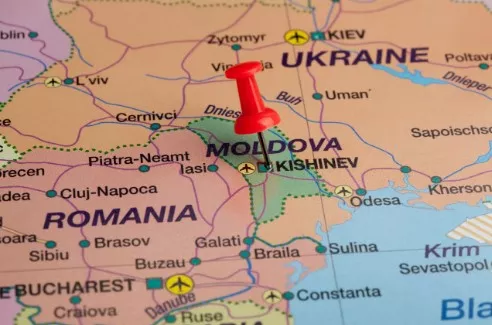
In recent months, news of growing instability has been coming from Moldova, a country bordering war-torn Ukraine and NATO and EU member Romania, while having strong pro-Russian elements that keep a part of its territory separate from the internationally recognized state. What can Europe's poorest country with 2.6 million inhabitants and just over 33 thousand square kilometers of area expect in such circumstances?
At the beginning of the war in Ukraine, Moldova is once again a topic. In recent months, Moldova has complained about running out of Russian natural gas, and several times about electricity, which it receives from Ukraine, where Russia has destroyed the country's energy infrastructure in missile attacks. A few days ago, the government fell, but that will not change much, as the new prime minister is from the same pro-European party that applied for EU membership in March 2022. Dorian Receanu, former defense advisor to President Maia Sandu, is the new prime minister.
Yesterday, Moldova announced that it was closing its airspace, and recently reported Russian missiles falling on its territory, as well as Russia using Moldovan airspace to attack Ukraine. At the same time, the opposition, for Russia, uses the poor standard of living as the main arguments this time, as if these opposition parties, along with the government, are not to blame for Moldova being the poorest country in Europe for decades. Vladimir Voronin and Igor Dodon, leaders of the communist and socialist parties and former presidents of Moldova, blame the current government for all problems. Dodon was the president of Moldova until December 2020.
The opposition is preparing protests for the coming days. It demands that the government pay citizens the increased bills they have been receiving in recent months. Inflation is causing major problems for the government, and Russia has been an important import and export market for Moldovan products for decades. President Sandu, fearing unrest, banned the arrival of FK Partizan fans from Belgrade for a match scheduled for today. On Monday, she announced that Russia is trying to provoke the violent overthrow of the government in Chisinau with the help of domestic forces and "citizens" of Montenegro, Serbia, and Belarus. Russia has denied such accusations, and Moldovan media note that Moscow denied a year ago that it would attack Ukraine, and then did so about ten days later.
Russian troops are stationed in Moldova, specifically in Transnistria or Pridnestrovlje, as it is also called, depending on whether the Romanian/Moldovan or Russian name is used, where about half a million people live. In that breakaway territory, with just over four thousand square kilometers, stretching along the Dniester River and not wider than twenty kilometers at any point, Russia has a lever to blackmail Moldova. Russians make up the majority of the population with about 30 percent, Moldovans are about two percent less, and Ukrainians make up about 20 percent. The rest are those who have not declared themselves, or belong to national minorities.
The presence of the Russian army in Moldova has been a source of instability in the region for decades, and the story is very well known. However, with the war in Ukraine, the conflict between pro-Russian elements and the central government supported by Romania and the West is becoming increasingly likely.
Russia, Ukraine, Odesa
When the Russian army advanced rapidly through Ukraine in February last year, especially through its southern part, many predicted that Russia would reach the borders of Moldova via Odesa. Many feared that at one point the Russian army from Moldova would attack Ukraine, or Odesa, which, combined with an attack from the sea, would be a de facto attack from three sides.
It is estimated that in the rebellious part of Moldova, with local forces, the Russian army can count on tens of thousands of soldiers. Russian General Ruslan Minnekayev spoke publicly about this at the time.
If Russia had succeeded, Ukraine would have lost its access to the Black Sea, and Moscow would have reached the Danube, further complicating relations with Romania and NATO. In those days, the desire of pro-Russian forces in Serbia, which they spoke and wrote about more than ever before, was for Russia to start using the Danube, an international waterway, thus "connecting" Belgrade and the Black Sea. The Danube flows through Romania, where NATO has stationed strategically important military installations and where, according to US President Joseph Biden, they would defend "every inch".
A year later, with the Russian army stuck in eastern Ukraine and having suffered severe defeats on the right bank of the Dnieper, the question is whether Ukraine will "clean up" the enemy forces behind its back in the narrow strip along the Dniester River. The Ukrainian army has achieved great victories against the main Russian forces in several battles over the past year, so there should be no doubt about the outcome of a battle with the "peacekeeping forces" in Moldova, as Russia calls them. After a year of war, even such options are not excluded.
Moldova's Concerns
Regardless of who pulls the trigger first on the borders of Moldova and Ukraine, Chisinau knows that the biggest victim of that conflict would be the country and its people. The country's military and economic capacities are small, especially when measured against those in Romania, Ukraine, or Russia. Therefore, it is clear to everyone that if a conflict broke out in that part of the world, Moldova would be a victim that has little say.
Since the beginning of the war in Ukraine, unexplained incidents have occurred. In April, the center of the Russian intelligence service in Tiraspol, the capital of breakaway Transnistria, was shelled, there were shootings, and sabotage of telecommunication antennas, mostly near the border with Ukraine. While Russian forces advanced through Ukraine, accusations of "Nazism" against President Sandu, who allegedly prevents the Russian language from being spoken in Moldova, came from Moscow. Russian parliamentarian Viktor Vodolatsky attributed the alleged Nazism of Moldovan President Sandu to Romania as her "protector". The colorful Maria Zakharova was bothered by Sandu's ban on displaying the letters "Z" and "V", which are symbols of the Russian army in Ukraine. In May, the celebration and military parade on the occasion of Victory Day over Fascism was canceled in Transnistria, and Voronin and Dodon told their successor as president that they would proudly wear the symbols she had banned.
Tensions are not subsiding. It is obvious that even fan groups can ignite Moldova, so the state calls for caution. Some in Moldova are wondering if the solution is for this country to unite with Romania, given that the vast majority of Romanians and Moldovans feel like members of the same nation, or at least like nations with much in common. In 2021, in one survey, 48 percent of Moldovans were in favor of unification, and in 2018, as many as 74 percent of Romanians were. In 2018, the Romanian parliament adopted a declaration on unification with Moldova. The population of Moldova has repeatedly stated that they want independence, not to be absorbed into a larger country. In the end, the problem of Transnistria is there, and the Russian population there does not share such plans. Therefore, many believe that at this moment there is nothing to this plan, but things in Eastern Europe have been changing rapidly since February last year.
Nevertheless, Moldova is taking measures that could protect it. Turning to the West is one of those measures, although Moldova has declared itself a neutral state and written it into its constitution. In June 2022, the EU granted Moldova candidate status and in November promised aid of 250 million euros due to the energy crisis, which further encouraged the pro-Western bloc in the country. This rapprochement towards the West is necessarily linked to Romania, which in recent years has become a regional power with strong economic growth and the support of Washington, which sees this country as its important pillar in Southeastern Europe. The pro-Western government in Chisinau has been trying to attract the West and Romania for the past year, while pro-Russian forces are watching from across the border to see if tanks will arrive. Who will be faster is still unknown and does not depend on Moldova.
Komentari (0)
Prijavite se za komentiranje
PrijavaJos nema komentara. Budite prvi!
Minuta
Sve →Iz drugih kategorija

High Representative Not Elected: Germans, French and British Against Americans, New Attempt at End of June

ČOVIĆ WITHOUT MERCY: How Those Who Brought Ademović to Office Created a Political Hell for Him



Sunny Saturday, quite warm



Tragedy in Albanian resort: Two minors drown












