
One of the most reputable and best-selling weekly newspapers in Europe, the German Die Zeit, dedicated a whole page to Tuzla, the Pannonian Lakes, and Mayor Jasmin Imamović, in an article titled “The Man Who Brought the Sea“. The Patria News Agency is publishing the article in its entirety.
One day, Jasmin Imamović was looking over the plans for his biggest undertaking to date when his close associate, an architect, asked him: “Mr. Mayor, do you believe this will work?”
“No, of course I don’t believe it!”, Imamović replied with great determination.
His associate replied:
“Then I am at peace. Otherwise, I would have to declare you mad!”
Then, Mayor Jasmin Imamović and his associate bent over the plans and sketches from which the Pannonian Lake, the Pannonian Sea, a large swimming lake, was to emerge.
It was indeed madness what Imamović had planned. He knew that too. A swimming lake in the heart of the city.
In Tuzla, this was perceived as an extravagant, completely inappropriate outburst, given that the city with its 130,000 inhabitants had been struggling with existential problems for years. A lake, when jobs are scarce everywhere? When people, even if they earn something, have to survive on two or three hundred euros a month? When people barely survive, very often with the help of relatives from abroad.
Or did the mayor see something that no one before him had seen? Tuzla is located in Bosnia and Herzegovina. Twenty years after the end of a brutal war, it is a divided country from which young, educated people are leaving in droves because they see no prospects. Bosnia is bleeding, and Tuzla is no better off. During the former Yugoslavia, the city already had a bad reputation, an industrial city, with the smoke from the Thermal Power Plant whose chimneys, like monuments to forced communist industrialization, stand at the entrance to the city and puff away. From Belgrade, Sarajevo, or Zagreb, Tuzla was seen as the dirty brother from the province, with dirty hands and a face black with soot.
Economically, people in Tuzla were not doing badly before. An annual vacation by the sea was a given for most. Quite a few also owned a small house on the coast.
But after the war, the sea moved further away. For most people from Tuzla, traveling to the sea became expensive. Moreover, a large part of the coast is in Croatia, in another country. Why not simply bring the sea to the city? At least some kind of sea.
No, Mayor Imamović did not think that far ahead, at least not initially. He said so openly. He doesn't just deal with visions, although this trained lawyer is also a very gifted writer. He has published successful novels and short stories. How did he come up with the idea for the lake? “When I write, I don’t have a clear plan either. I see something here that sparks my curiosity, I see something else there. I get absorbed in it and then I put it together. I go step by step.”
Imamović walks along a path, finds something, picks it up, observes it, and something unexpected, something wonderful emerges from it. To work like that, you need a lot of faith, in yourself and in the world.
When the social democrat Jasmin Imamović was first elected mayor in 2000, he found a city that was literally sinking. In Tuzla, salt had been extracted from mines deep underground for hundreds of years (Tuzla means salt in Turkish). Due to the tunnels built under the city in this way, houses, streets, and areas gradually sank deeper and deeper. Because of this, during the communist era, there were plans to relocate the entire city, but this did not happen because a powerful party official managed to prevent it. Tuzla continued to sink into the depths from which it had drawn prosperity for centuries.
Stopping the city from sinking was the first thing Imamović set out to do when he “moved into” the mayor’s office.
“We succeeded in that, even though no one believed it!”, he says in his office and quickly lists a series of numbers and statistics that support what he has done for the city. It seems like boasting, but during the day, Imamović relaxes and proves to be an entertaining and diligent mayor whom people meet with undisguised affection, and all people, regardless of their religion or nationality. In this regard, Imamović is a typical citizen of Tuzla, because this city survived the terrible war between 1992 and 1995 without major conflicts between different ethnic and religious groups.
The predominantly Muslim Tuzla was and remains a symbol of coexistence and tolerance throughout the war. For this, the city paid a high price. It was surrounded. And attacked.
On May 25, 1995, a Serbian cannon fired an artillery shell into the city center, at Kapija. It was one of the first warm spring days, and hundreds of young people had gathered at Kapija to spend a few carefree hours there. The shell killed 71 of them, aged between 15 and 26. 173 people were injured.
A simple memorial plaque has been placed at the site of the attack, and anyone who comes to the old part of the city passes by it. Not far from there, students from a gymnasium have exhibited their works and paintings in a modest room, dedicated to those who died at Kapija. On the entrance door of this room, in several languages, one can read the following:
Dear visitors, you are entering here to see the truth about the crime against the youth of Tuzla that occurred on May 25, 1995, at “Kapija”.
We ask you to leave all your religious, racial, national, ideological, and political beliefs outside this door. Thank you! That is the spirit of Tuzla.
The citizens of this city are clearly united on the important issues of their common life. They don’t have to waste time on terribly exhausting and still dangerous debates about whether Bosniaks, Croats, Serbs, etc… In other parts of the country, a lot of energy is still wasted on such quarrels, but here in Tuzla, people seem freer. This is evident in the atmosphere, in the implicitly relaxed way in which the citizens of Tuzla walk through the impressive city between the mosque, the church, cafes, ćevabdžinicas, and restaurants. It is also evident in the pragmatic will and work of Mayor Imamović, which is not focused on everything and anything, but on what is important.
Everything started with the lake, as did many things in Tuzla, with a problem.
Near the roundabout, next to the city center, there was a large marshy area, less than a hundred meters from the city center. When it rained, water from the marsh flowed into the lower streets and flooded them, which greatly hindered traffic.
“I actually just wanted to solve the problem of water overflow!”, says Imamović. Then, what he knows from his writing work began to unfold: one problem led to one solution, and then the next problem and the next solution.
“Then I asked myself, why not drain the marsh and put a lake there?!”
Then it occurred to him that there was still enough salt under the city, and a salt lake would be something special. It is medicinal. No one else in the Balkans can offer something like that.
“Some suggested a lake for swans, and swans don’t like saltwater.” Swans are indeed beautiful animals, but who likes swimming with swans that can even become aggressive.”
Imamović’s decision was firm: “We will build a salt lake!”
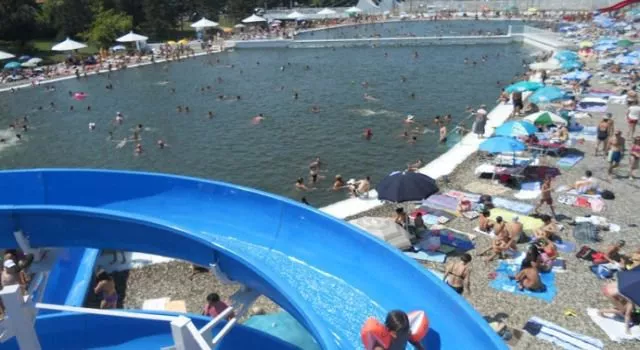
Not one, but three lakes and a pool were built, which were opened to guests in the summer of 2003.
Although it is an unmercifully hot July day, Imamović does not miss the opportunity to personally present the lake complex. The complex has a capacity of 9,000 people, there are cafes, restaurants, a children’s playground, a slide, waterfalls, and a museum of the geological history of Tuzla. Thousands of people are certainly here today, lying on the gravel and in the water, relaxing. The mayor walks ahead. After a few minutes, his shirt is wet with sweat. Greeted left and right, Imamović slowly moves forward, occasionally a swimmer rushes enthusiastically out of the lake towards the mayor, with an outstretched hand, completely wet, and wants to talk to him. Imamović seems to enjoy it.
“Look”, he says, pointing with his hand towards the city center, “the mosque, the Catholic church, the Orthodox church! They are all equidistant from the Pannonian Lake!“
A few minutes later, the clock strikes five. The muezzin calls to prayer, and his voice echoes over the lake complex where thousands of people in swim trunks and bikinis lie and sunbathe. “It is actually Ramadan”, says Imamović.
Later, when the sun sets, bathers will stroll through the city and, if they can afford it, eat something. They will be casually dressed, Mediterranean-style, as if they just came from the beach and are walking through Dubrovnik, the pearl of Dalmatia. Yet they are actually in Tuzla, and Tuzla is now also on the sea.
Komentari (0)
Prijavite se za komentiranje
PrijavaJos nema komentara. Budite prvi!
Minuta
Sve →Iz drugih kategorija

High Representative Not Elected: Germans, French and British Sabotaged Americans, New Attempt at End of June

ČOVIĆ WITHOUT MERCY: How Those Who Brought Ademović to Office Created a Political Hell for Him



Sunny Saturday, quite warm



Tragedy in Albanian resort: Two minors drown












