By Armin Sijamić
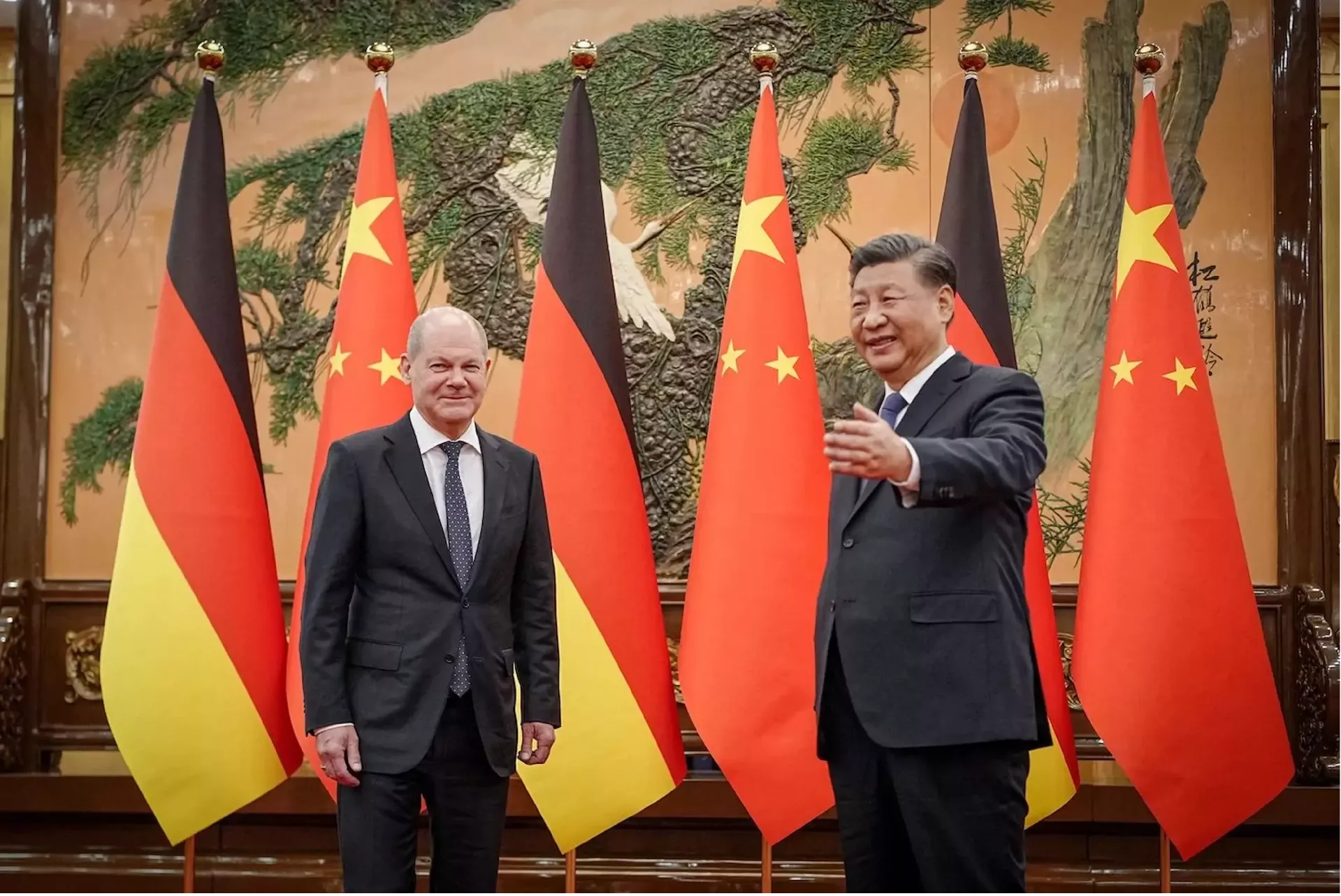
After adopting its first "National Security Strategy" last month, Germany yesterday, in a way, supplemented the document by releasing its China strategy. Last month's document aligns with known German policies, while yesterday's offers a perspective on China's future.
Russia's aggression against Ukraine prompted Germany to begin severing ties to an extent previously unimaginable. The separation between Berlin and Moscow was painful and costly, but the German government took the risk. The break is driven by the Greens' desire to follow Joseph Biden's policies, forcing German Chancellor Olaf Scholz, a Social Democrat, to yield to a junior coalition partner.
The power dynamic between Scholz and his Foreign Minister Annalena Baerbock, who belongs to the Greens, largely shaped the future relationship with China, which has been codified in the document. Baerbock wanted Germany to adopt a firmer stance towards China and consequently break economic ties, just as with Russia. She insisted that particular attention be paid to human rights in relations with Beijing. Xi Jinping would not agree to such conditions, leading to escalating tensions and severed ties.
Yesterday's strategy did not fully meet Baerbock's wishes, but it charted the course for relations with China, at least for the current government's term. "Our goal is not decoupling (from China). But we want to reduce critical dependencies in the future," Scholz wrote on Twitter after the strategy's adoption. Baerbock stated that the strategy is "realistic, but not naive," and in the document, China is described as a "partner," "competitor," "systemic rival," and increasingly "assertive," meaning more decisive and confident.
American Signature
China's assertiveness is a term that has been circulating in American policy, even domestic policy, for years. However, defining China as a "systemic rival" is a combination of the American and European perceptions of China. In early 2019, the European Union described China as a systemic rival, and Biden, in his doctrine three years later, stated that the country is "the only competitor with the intention to reshape the international order and with growing economic, diplomatic, military, and technological power to do so." In the same document, Biden says Russia should be "contained," which has been successfully achieved through Western sanctions, while China should be competed with.
The adopted China strategy, according to Berlin's announcements, is to be integrated into EU documents. Beijing attempted to soften Berlin's stance, even through negotiations with French President Emmanuel Macron, who stated from China that the EU must remain neutral in the conflict between the Asian country and Washington. Chinese Premier Li Qiang visited Berlin last month, marking his first foreign trip. He urged Berlin not to adopt measures that would harm China and its companies, calling on Brussels to improve ties with Beijing.
Evidently, he did not succeed, especially since the document reflects Biden's policy of decoupling from "dependency" on China. Biden wants to remove unreliable states from the American economy's "supply chain," meaning he does not want to depend on those who are not allies. In the past month, Biden has reached an agreement on this with Rishi Sunak and then attempted to involve India in Western plans.
In an earlier report, the German intelligence service identified China as "the greatest threat concerning economic and scientific espionage and foreign direct investment in Germany." The strategy adopted yesterday states that China is "Germany's largest single trading partner, but while China's dependence on Europe is constantly decreasing, Germany's dependence on China has gained increasing significance in recent years." Therefore, "risk reduction is urgently needed," as Beijing uses its economic power to expand its political influence.
The strategy states that economic espionage must be prevented, technology transfer to China controlled, and Chinese investments in Germany monitored through a security lens. Anything that poses a threat to German security will not be approved, and the list of what might lead Berlin to invoke this mechanism is long. In short, Germany will do business with China according to its own rules, and it is possible that entire sectors could sever relations. It is worth remembering that Donald Trump attacked China over technology, imposing sanctions on Chinese companies. Washington's assessment, and now Berlin's, is that the West's advantage over China can be maintained if Beijing is denied access to the most advanced technologies.
The adopted strategy also aligns with the American course in political terms. Berlin believes that the issue of Taiwan should be resolved through agreement and states that it will support the membership of the breakaway Chinese island in international organizations. Berlin will pay attention to the state of human and labor rights in China, but this is not how Baerbock wanted it. Germany seeks coordination with the G7, and in recent months, this forum has been trying to limit China's influence in Asia and the world.
Germany states that the war in Ukraine, and thus Beijing's ties with Moscow, can influence relations with China. Berlin dislikes China's "presence" in the Arctic and Antarctic and wants these to be conflict-free zones, while simultaneously announcing that Germany will expand military cooperation with countries in the Indo-Pacific. Berlin demands that China announce its military exercises.
Scenario for Divergence
Although Scholz said the strategy's goal is not to sever ties with China but to reduce German dependence, it is clear that the adopted measures go beyond economics. Therefore, we can confidently say that China will not agree to all of Germany's conditions, but it will do everything to maintain economic ties with Berlin and Brussels.
China's economy is the second largest in the world and is almost four times larger than Germany's. Agreeing to German conditions would mean a defeat in the confrontation with Washington, whose economy is almost a quarter larger than China's. China has been trying to resist American pressure for years and has done so quite successfully so far, but the battle is intensifying.
America's desire to compete with China is essentially a desire to contain China. The strategy adopted by Germany is proof that Berlin has chosen a side. China has been trying to find answers to these trends for years. Hence the Shanghai Cooperation Organization, BRICS, and other groups that primarily bring together Western rivals. Beijing's desire to establish a multipolar world is being fulfilled, but not as envisioned. China's plan was the division of spheres of influence and cooperation between centers of power. The moves made by the West indicate that such cooperation is out of the question, if they cannot stop the strengthening of their rivals.
At the beginning of the month, this division began to take shape. China banned the export of gallium and germanium, rare metals without which semiconductors, and thus the electronics, automotive, and military industries, are unimaginable. China is the largest producer of these two metals. The decision to cease their export from August cannot be compensated for in the short term, so price increases are possible. Previously, the Americans and the Dutch had restricted China's access to their semiconductors.
The strategy adopted by Berlin confirms that the conflict is not subsiding. An increasingly "assertive" China shows that it does not intend to abandon its positions, meaning it refuses to have its strength limited. Messages from Washington indicate that China must be contained. As neither side is backing down and negotiations are not yielding results, they are trying to gather as many countries as possible through formal and informal alliances. The outcome cannot be predicted, and the conflict is both ideological and economic. If a major power agreement is not reached and the conflict intensifies, the consequence could be a bloc-based division, different from anything we have seen so far.
Komentari (0)
Prijavite se za komentiranje
PrijavaJos nema komentara. Budite prvi!
Minuta
Sve →Iz drugih kategorija
High Representative Not Elected: Germans, French and British Sabotaged Americans, New Attempt at End of June
ČOVIĆ WITHOUT MERCY: How Those Who Brought Ademović to Office Created a Political Hell for Him

Sunny Saturday, quite warm

Tragedy in Albanian resort: Two minors drown