
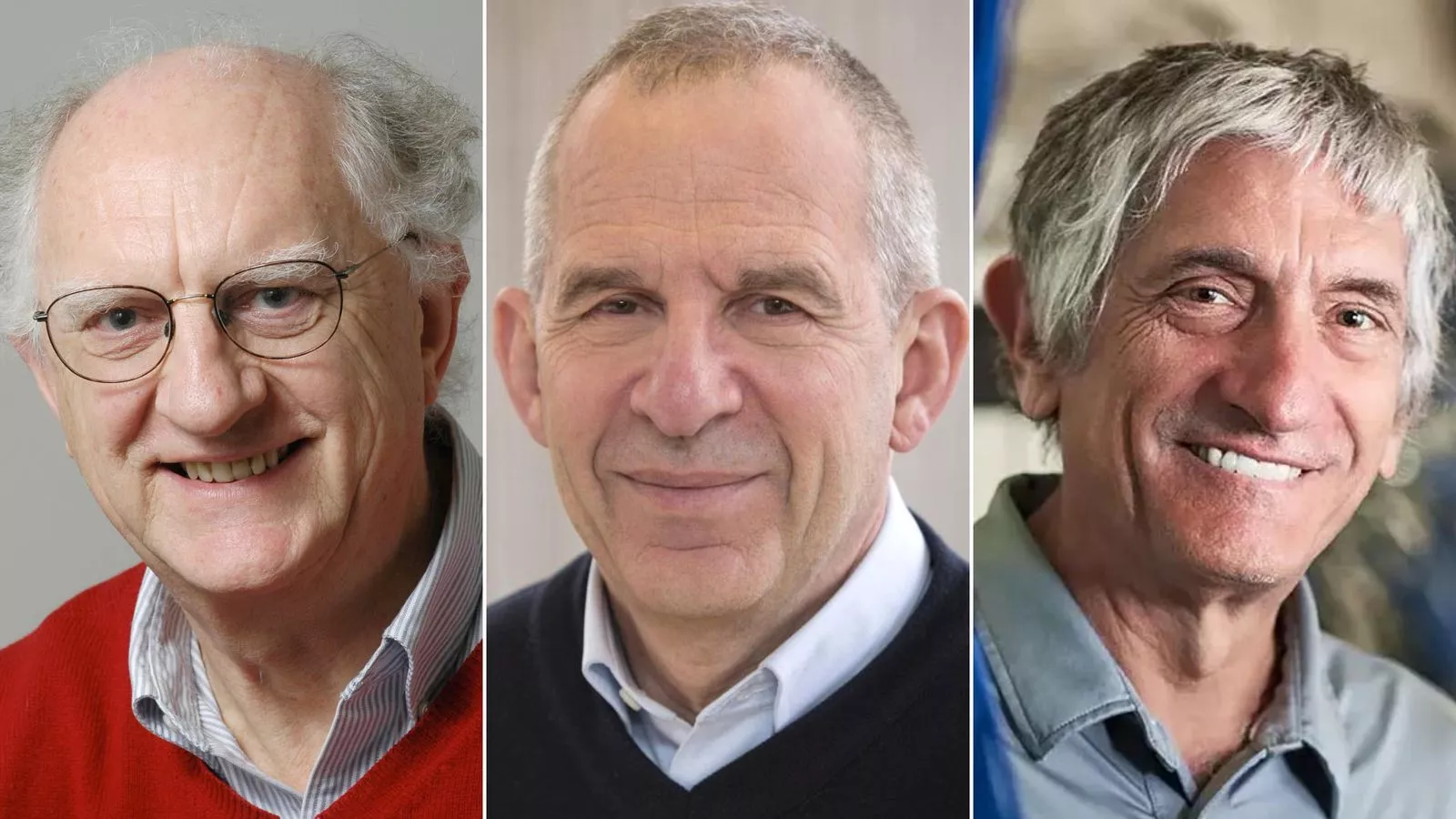
(Patria) - Scientists John Clarke, Michel Devoret, and John Martinis have won the 2025 Nobel Prize in Physics for "experiments that revealed quantum physics in action," enabling the development of the next generation of digital technologies.
- I am stunned. Of course, it never occurred to me that this could be the basis for winning a Nobel Prize. I'm talking on my mobile, I assume you are too, and one of the fundamental reasons why a mobile phone works is all this work," Clarke said today at a press conference by phone regarding the Nobel Prize award.
"This year's Nobel Prize in Physics has provided opportunities for the development of the next generation of quantum technology, including quantum cryptography, quantum computers, and sensors," the Nobel Committee for Physics stated, among other things.
Quantum mechanical behaviors are well-studied at the level of incredibly small atomic and subatomic particles, but are often considered bizarre and counterintuitive compared to classical physics and its much larger scales.
Quantum mechanics allows a particle to travel straight through a barrier using a process called tunneling. As soon as a large number of particles are involved, quantum mechanical effects usually become insignificant. The laureates' experiments showed that quantum mechanical properties can be realized on a macroscopic scale.
The Nobel laureates conducted experiments in the mid-1980s with an electronic circuit built from superconductors and showed that quantum mechanics can also affect everyday objects under certain conditions.
In 1984 and 1985, John Clarke, Michel H. Devoret, and John M. Martinis conducted a series of experiments with an electronic circuit built from superconductors, components that can conduct electricity without electrical resistance. In the circuit, the superconducting components were separated by a thin layer of non-conductive material, a setup known as a Josephson junction.
By refining and measuring all the different properties of their circuit, they were able to control and investigate the phenomena that occurred when they passed current through it. Together, the charged particles moving through the superconductor formed a system that behaved as if it were a single particle filling the entire circuit.
This macroscopic particle-like system was initially in a state where current flowed without any voltage. The system was trapped in this state, as if behind a barrier it could not cross. In the experiment, the system demonstrates its quantum character by managing to escape the zero-voltage state through tunneling. The changed state of the system is detected by the appearance of voltage.
The laureates were also able to show that the system behaves in a way predicted by quantum mechanics – it is quantized, meaning it absorbs or emits only specific amounts of energy.
It was highlighted at the press conference that the Nobel Prize in Physics is being awarded at a time when we are celebrating 100 years of quantum mechanics.
The United Nations officially declared 2025 the International Year of Quantum Science and Technology (IYQ) to mark the 100th anniversary of German physicist Werner Heisenberg's (1901-1976) efforts to develop a mathematical formulation of quantum phenomena.
In 1925, Heisenberg, along with Max Born and Pascual Jordan, published three papers considered the foundation of quantum mechanics.
- It is wonderful to be able to celebrate how century-old quantum mechanics continuously offers new surprises. It is also extremely useful, as quantum mechanics is the foundation of all digital technology," said the chairman of the Nobel Committee for Physics, Olle Eriksson.
Clarke, born in the UK, is a professor at the University of California, Berkeley. Devoret, born in France, is a professor at Yale University and the University of Santa Barbara, where Martinis is also a professor. Martinis, an American, led Google's Quantum Artificial Intelligence Laboratory until 2020.
At Google, Martinis was part of the research team that in 2019 claimed to have achieved "quantum supremacy," in which a computer using the properties of subatomic particles solves a problem far better than the world's most powerful supercomputer. In addition to his professorship, Devoret is also the chief scientist of Google's Quantum Artificial Intelligence.
Komentari (0)
Prijavite se za komentiranje
PrijavaJos nema komentara. Budite prvi!
Minuta
Sve →Iz drugih kategorija

High Representative Not Elected: Germans, French and British Against Americans, New Attempt at End of June

ČOVIĆ WITHOUT MERCY: How Those Who Brought Ademović to Office Created a Political Hell for Him



Sunny Saturday, quite warm



Tragedy in Albanian resort: Two minors drown












