
(Patria) - From one perspective, the Sun is a benevolent sphere of plasma whose heat makes Earth habitable and has enabled the survival of conditions necessary for the development of complex life forms like humans for billions of years.
From another perspective, it is a malevolent sphere that sends deadly ultraviolet radiation our way and occasionally ejects massive plumes of plasma towards Earth.
The truth lies somewhere in between, and NASA has launched the Parker Solar Probe mission to find out.
NASA launched the probe in 2018, and its mission is to study the Sun's coronal plasma and magnetic field. To achieve this, the probe must get very close. NASA describes this mission as "touching the Sun," and that is quite accurate.
During the mission, the probe has gotten progressively closer to the Sun, setting new records. On December 24, 2024, the spacecraft flew "only" 6.1 million kilometers from the Sun's surface. That is incredibly close, but fortunately, the probe has several layers of protection.
"Parker" is also the fastest spacecraft ever built. During its 2024 flyby, it traveled at a speed of 692,000 kilometers per hour and did not remain at such a close distance from the star for long. The result of this bold coronal navigation is the closest images of our Sun to date.
"Parker" carries four main instruments, one of which is WISPR (Wide-field Imager for Solar Probe). WISPR has two radiation-hardened cameras that can withstand the Sun's power.
Its role is to capture images of the corona, solar wind, and other phenomena near the Sun. During the latest flyby, WISPR showed us the solar corona and solar wind in a way we couldn't see before.
- The probe has once again taken us into the dynamic atmosphere of our closest star. We are witnessing the place where space weather threats to Earth begin - with our own eyes, not just through models.
This new data will enable us to make huge improvements in predicting space weather to protect astronauts and our technology on Earth and throughout the solar system, says Nicky Fox, Associate Administrator for the Science Mission Directorate at NASA Headquarters in Washington.
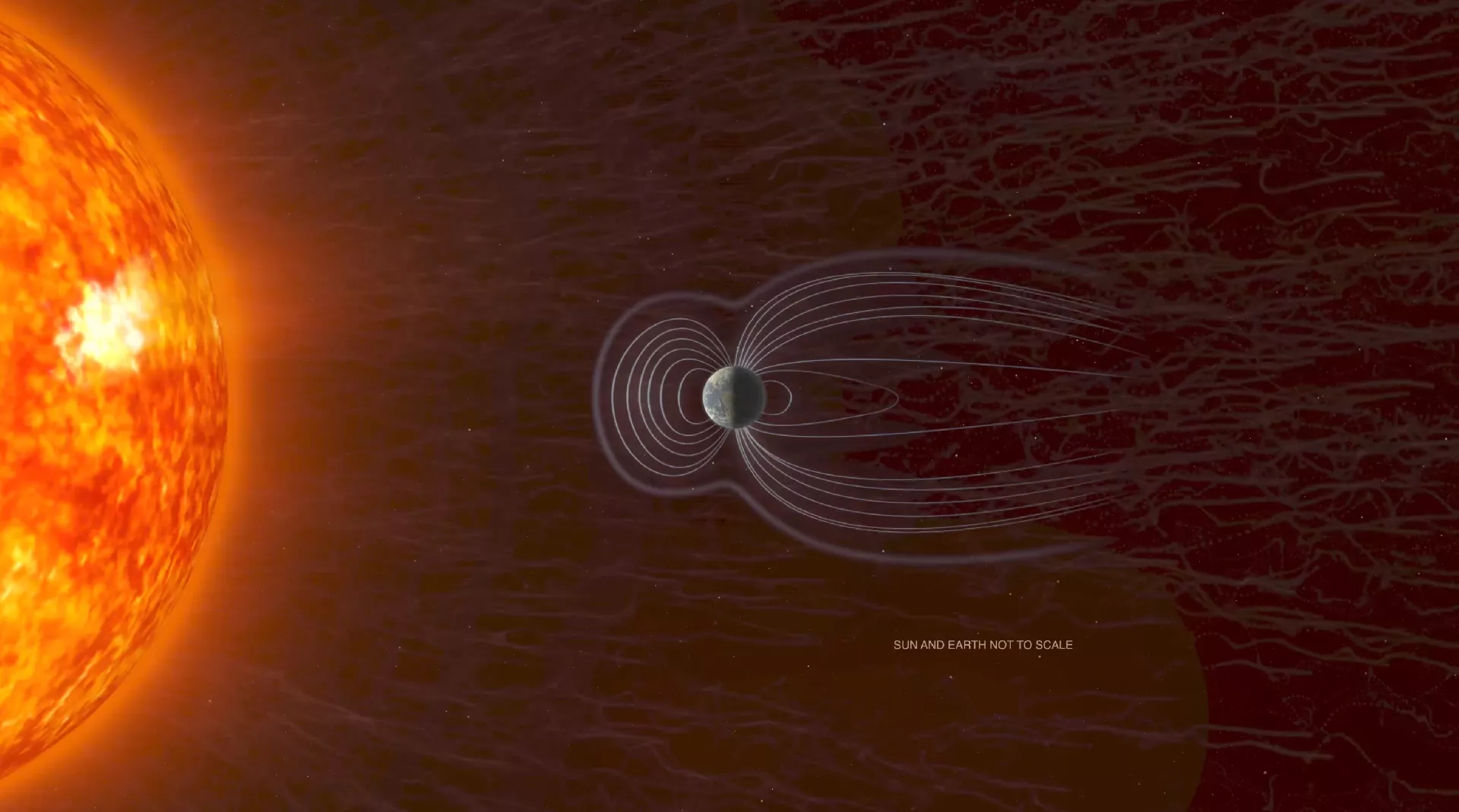
There are important consequences to correctly or incorrectly understanding solar wind and coronal mass ejections. These are constant forces in the solar system. Solar wind is a stream of charged particles that flows continuously from the Sun.
It is responsible for the beautiful auroras we love to observe, but also for damaging power grids and satellites.
As we expand further into the space between Earth and the Moon, and as more satellites are placed in orbit around Earth, it is important to understand not only the solar wind but also everything that comes from the Sun, including coronal mass ejections.
While solar wind is a continuous phenomenon, coronal mass ejections are episodic. These are ejections of plasma that can reach Earth.
Coronal mass ejections can contain billions of tons of plasma moving at high speed. Only a small number of these ejections reach Earth, but when they do, they can cause geomagnetic storms that damage power grids and other equipment.
The "Parker" probe is named after American heliophysicist Eugene Parker, who coined the term "solar wind" in 1958.
His theories, although initially met with great resistance, completely changed the scientific understanding of the Sun. More spacecraft have been launched to study the Sun and solar wind, but "Parker" has surpassed all previous missions.
Each mission brought new insights into the Sun and solar wind, but none approached the star as closely as "Parker." It also benefits from state-of-the-art technology and instruments. One of the discoveries is the so-called switchbacks.
When solar wind is measured near Earth, it is generally stable. But closer to the Sun, the situation is much more chaotic.
The Sun has extremely strong magnetic fields, and when the probe approached within 14.7 million miles of the Sun, it showed us that some of these fields bend and change direction.
Komentari (0)
Prijavite se za komentiranje
PrijavaJos nema komentara. Budite prvi!
Minuta
Sve →Iz drugih kategorija

High Representative Not Elected: Germans, French and British Against Americans, New Attempt at End of June

ČOVIĆ WITHOUT MERCY: How Those Who Brought Ademović to Office Created a Political Hell for Him



Sunny Saturday, quite warm



Tragedy in Albanian resort: Two minors drown












