
By Armin Sijamić
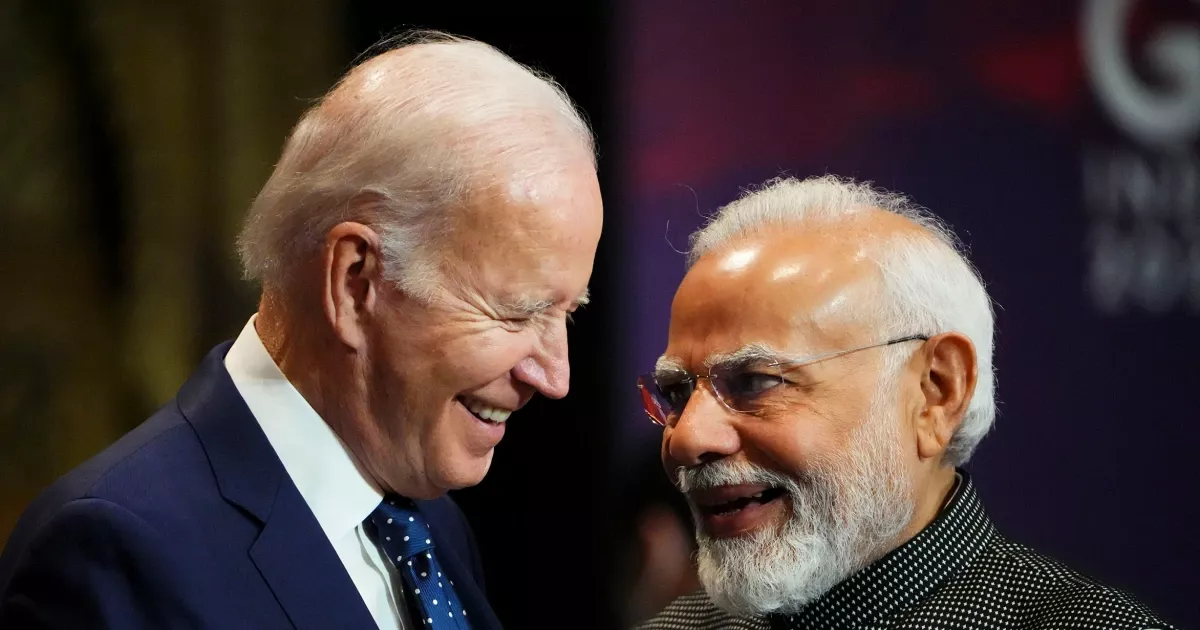
The United States' intention to curb China has been stated multiple times by US officials. One of the most important links in the chain with which Washington intends to encircle China is India. Indian Prime Minister Narendra Modi visited President Joseph Biden, and on that occasion, according to the guest, a "new chapter" has been openly written in the relations between the two powers, which are in a "strategic partnership".
India is the most populous country in the world (1.4 billion inhabitants) and holds the title of the world's largest democracy, as more people have the right to vote in that country than the US and the European Union have inhabitants combined. Therefore, it is symbolically important to have India on one's side, especially since it is a country that pursues an independent policy and refuses to align with blocs. As India is more than just a country, it is also an ancient civilization, offers of cooperation have been coming for decades. The upcoming global economic superpower (currently the fifth largest economy in the world) still has a constant in its policy – rivalry with China. Moscow and Washington have been counting on this fact in recent decades.
Yesterday, Biden hosted Modi with the highest honors. Previously, Modi had talks with some of the heads of the world's largest companies. Many American companies want to create a "new China" in India, meaning to transfer their businesses to a country with a numerous and educated workforce. Every year, about 1.5 million engineers graduate in India (mostly in the IT and mechanical engineering sectors), so since Modi came to power, India has produced as many engineers as the Netherlands has inhabitants. It is clear that educated young people, with the help of American companies, can revitalize the country. This is precisely the main card Biden has been playing since coming to power. To distance itself from Russia and continue to resist China, India is being offered investments and economic revival.
Important Agreements
If the results of the visit are anything to go by, Modi has decided to accept the offer, but the question is to what extent and at what price. India does not want to enter into agreements that will keep it in limitations and hinder its policy. Biden was aware of this and did not criticize Modi for the human rights situation in India, although some US congressmen demanded it. Particularly critical of India, due to the situation of Muslims there (who are a minority, although there are over 200 million of them), were Ilhan Omar, Rashida Tlaib, Alexandria Ocasio-Cortez, and Senator Bernie Sanders, who accused Modi of "aggressive Hindu nationalism." Modi rejected the accusations, and Biden, learning from the experience when he accused Mohammed bin Salman of the murder of Jamal Khashoggi, which later cost him when forming oil prices, did not criticize his guest.
The two countries signed important agreements in the fields of defense, economy, health, semiconductors, space program, technology (quantum computing and artificial intelligence), minerals, telecommunications, energy production, and trade. The goal is to diversify supply chains, i.e., reduce dependence on China and others, and then develop technologies that can be used on the battlefield. The opening of new consulates in both countries has been announced.
General Electric will produce engines for the Indian Air Force in India, semiconductor manufacturer Micron Technology will invest $2.7 billion, and qualified Indian workers will have easier access to the US to learn and work. Applied Materials, a company that produces tools for making semiconductors, will invest $400 million to open a center in India. New Delhi will purchase American MQ-9B SeaGuardian drones, considered among the best in the world. NASA will work with its Indian counterparts on developing the space program, and the US Navy will have access to Indian ports for ship repairs. At one of the aforementioned meetings with the economic elite, Modi discussed with Elon Musk the opening of a Tesla company in India.
Such agreements show Washington's intention to turn India towards itself, further binding it, as it is India's largest trading partner. Washington believes that relations could be better. Biden described it after the meeting as "unlimited potential." At the same time, the fields in which the two countries will cooperate can hint at the future development trends of India. Namely, India has relied on Russian military technology for decades, especially in aviation. It is estimated that India meets almost half of its defense needs in cooperation with Moscow. With the agreement to launch an engine manufacturing plant, India gains the opportunity to start producing its own fighter jets.
Strategic Partnership the Indian Way
Washington's generous offer to India is no coincidence. A geopolitical confrontation is taking place in the Indo-Pacific that could determine the fate of the world in the coming decades. India is one of the important players in this geopolitical puzzle. In constant opposition to China, India is forced into various arrangements. Thus, India has become part of the Quad (USA, India, Japan, and Australia), which opposes Chinese ambitions in the Pacific. After talks with Biden, Modi emphasized the importance of the Quad and the cooperation of the countries that comprise it.
Parallel to the Quad, India has joined organizations where China plays a leading role. It has become a member of the Shanghai Cooperation Organisation (SCO) and BRICS. Both of these organizations were conceived as groups of countries gathered around China and Russia. The reason why these groups have not grown into even stronger associations is also India's membership. After the start of the Russian aggression against Ukraine, BRICS held a meeting, and Modi spoke about everything else except the war, which did not please Moscow, which was seeking support.
The issue of Ukraine shows how difficult it is to work with India, regardless of who is on the other side of the table. India did not help Russia, but it did not condemn it for the aggression either, while simultaneously buying Russian oil at lower prices. At the meeting with Biden, Modi said that the best way to resolve the Ukrainian crisis is through "dialogue" and "diplomacy," after concluding lucrative deals with the country that is Ukraine's largest donor. However, great powers are accustomed to an independent India, which pursued a similar policy during the Cold War within the Non-Aligned Movement.
Modi stated yesterday that India and the US are "two largest democracies" and share "democratic values." He added that the world expects them to cooperate. Perhaps in those words lies India's message to other powers – cooperation only when it suits us. The agreements reached in Washington do not mean that India has chosen a side and will blindly follow the US in the confrontation with China and Russia, but it can be said that Biden has achieved significant success. Now, at SCO and BRICS meetings, India will defend its interests while also representing American positions.
When he spoke in October 2020 about reforming the United Nations and India's desire to become a permanent member of the Security Council, Modi made an interesting statement. "When we were strong, we were never a threat to the world, and when we were weak, we were never a burden to the world," he said then. India has not abandoned this worldview, meaning India's interest will be put first, even if all other powers are against it.
For the past four years, the Minister of External Affairs has been Subrahmanyam Jaishankar, a long-time diplomat and author of the book "The India Way: Strategies for an Uncertain World." A former ambassador to the US and China, he has become something of a star in India. He confronts foreign officials, trying everywhere to explain that the interests of others are not India's interests and that the positions of other countries do not bind them. In one of his appearances, Jaishankar says that India does not pursue policies against someone, but for something. Modi's visit to Washington demonstrates this. What should concern China is that such an Indian approach is currently unimaginable in Beijing, even though both countries are members of the SCO and BRICS, which, according to some estimates, were supposed to overthrow Western dominance.
Komentari (0)
Prijavite se za komentiranje
PrijavaJos nema komentara. Budite prvi!
Minuta
Sve →Iz drugih kategorija

High Representative Not Elected: Germans, French and British Sabotaged Americans, New Attempt at End of June

ČOVIĆ WITHOUT MERCY: How Those Who Brought Ademović to Office Created a Political Hell for Him



Sunny Saturday, quite warm



Tragedy in Albanian resort: Two minors drown












