
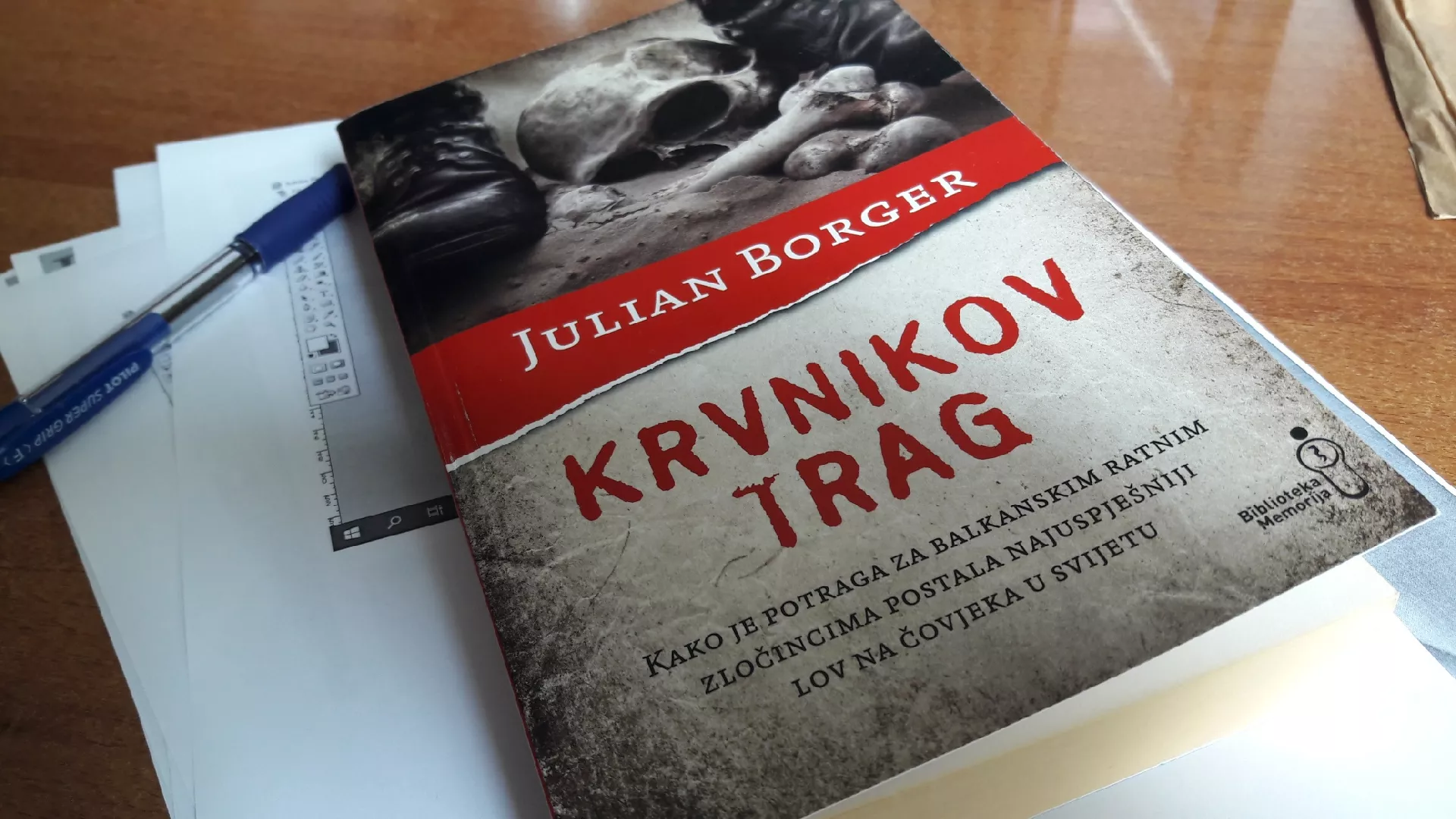
VLASENICA, (Patria) - The book „Krvnikov trag“ (The Butcher's Trail) by world-renowned journalist Džulijan Borger (Julian Borger), translated by Senada Kreso, has revealed many secrets of the war from 1991 to 1995.
This week, war criminal Dragan Nikolić Jenki died in Vlasenica at the age of 61. He initially pleaded not guilty before the Tribunal, but faced with numerous pieces of evidence, he admitted guilt for the persecution of non-Serb population on racial, religious, and political grounds, for torture, rape, and murder, crimes characterized as crimes against humanity. „Nikolić personally killed nine prisoners in the Sušica camp. His oldest victim was a sixty-year-old Bosniak, whom he tortured for a full seven days until he finally died. As he later admitted, many of his victims were „people who were once my friends, whom I saw in cafes, at sports fields, playgrounds for years, with whom I went on vacation“.
The most powerful aspect of Borger's investigation, as reported by the Patria agency, is the almost cinematic arrest of the Vlasenica butcher. Nikolić fled to Smederevo after the war. Borger writes: „He was also careless when talking on his mobile phone... On April 21, 2000, two men appeared at Nikolić's house, introducing themselves as local police officers. But as soon as he opened the door, he was thrown to the ground, tied up, shoved into the trunk of a car waiting outside, and driven to the Drina River. It was an almost perfect copy of operation „Todorović“ (the arrest of Stevan Todorović). Light signals were sent across the river, and the package was loaded into a small boat once again, to be transferred to American soldiers waiting on the Bosnian bank. Nikolić ended up in The Hague, but not everything went according to plan. Some of the mercenaries who carried out the operation against Nikolić were caught and tried in Serbia. When the details of the abduction were heard in the Serbian court, Nikolić's lawyers in The Hague argued that such an obvious abduction carried out on Serbian territory invalidated the tribunal's jurisdiction over the case“.
„The judges compared this case to the abduction of Adolf Eichmann by the Israelis in Argentina in May 1960, and concluded that the crimes committed by Nikolić were so grave that the law allowed a certain degree of flexibility in bringing him to justice... The Tribunal added in its verdict, within a broader legal framework that also includes UN Security Council Resolution 827, on the basis of which it was established and according to which its arrest warrants took precedence over domestic laws.“
Julian Borger provides answers to the key question: Who are the people who arrested several of the worst war criminals, such as Stevan Todorović the Monster, as the Serbs called him in Bosanski Šamac, and Dragan Nikolić, the butcher of the Bosniaks of Vlasenica.
Borger writes that „the CIA in Sarajevo hired a local arrest team. It initially consisted of four Serbs who remained in the Bosnian capital when the war broke out... These men fought for a multi-ethnic state alongside their Bosniak and Croat neighbors... They were given a clear task. Find the fugitive, grab him, and bring him to Bosnia where he could be legally arrested by SFOR peacekeepers. As one American official concisely explained: „We contracted the job, and they did what we agreed upon“.
According to information, the Serbs hired by the CIA were not only from Sarajevo but also from Tuzla and Zenica. They were members of the Army of BiH as well as police officers.
Borger writes: „Todorović would later claim that he recognized his attackers as members of the mercenaries whose pictures he had seen in the newspapers. The 'Spiders,' as they were called, were allegedly led by Jugoslav Petrušić, a man with dual French-Serbian citizenship, who had long been associated with both French and Serbian intelligence services. Petrušić led a unit of Serbian mercenaries who fought for Mobutu Sese Seko in Zaire in the mid-1990s. American intelligence sources claim that the 'Spiders' were not involved in these abductions and that their team consisted of Bosnian Serbs loyal to the government in Sarajevo. The next time the CIA-hired fugitive apprehension team went into action, in April 2000 (the Nikolić arrest operation), the 'Spiders' had an alibi. They were on trial for allegedly conspiring to assassinate Milošević.“
After Nikolić's arrest, Borger reveals that some of the people who carried out the „Nikolić“ operation were caught and tried in Serbia. „Eight people were sentenced to prison for participating in the abduction, some of whom were tried in absentia. Among them is Amir Mirankić, the alleged leader of the gang, who managed to escape“, Borger writes in his research. Even then, it was said that the trial was a farce and that people were picked up from the street and tried to calm the public.
The book „Krvnikov trag“ (The Butcher's Trail) presents the unknown part of the war, in which the incredible arrests of Krajišnik and Karadžić play a key role. It also reveals some incomprehensible facts about the secret power that Bosnia and Herzegovina possesses with its loyal people.
Komentari (0)
Prijavite se za komentiranje
PrijavaJos nema komentara. Budite prvi!
Minuta
Sve →Iz drugih kategorija

High Representative Not Elected: Germans, French and British Sabotaged Americans, New Attempt at End of June

ČOVIĆ WITHOUT MERCY: How Those Who Brought Ademović to Office Created a Political Hell for Him



Sunny Saturday, quite warm



Tragedy in Albanian resort: Two minors drown












