
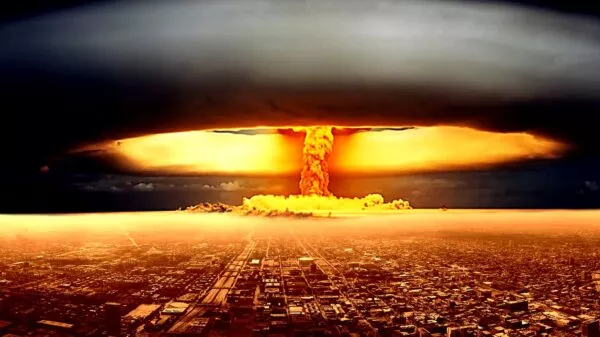
(Patria) - Since Russian President Vladimir Putin ordered the nuclear forces of the Armed Forces of the Russian Federation to be put on alert on Saturday afternoon, the world has been in turmoil!
Russia has the largest arsenal of nuclear weapons in the world, but it is aware that NATO could destroy them with its nuclear missiles. But what do "ordinary" citizens (not) know about nuclear weapons?
As early as 1939, immediately after the discovery of nuclear fission, a process in which the nucleus of one atom splits into the nuclei of two smaller atoms with the release of energy, a group of scientists wrote to President Roosevelt warning him that Germany could use this process to produce very powerful and dangerous weapons.
Two years later, the secret Manhattan Project began, aiming to develop the atomic bomb. About 150,000 people worked on the project, which cost about two billion dollars.
Four years later, a relatively small atomic bomb, 70 cm wide, three meters long, and weighing about 4 tons, was dropped over Hiroshima. It exploded 600 meters above the ground, creating a fireball about 300 meters in diameter, with a surface temperature of about 5000 °C.
80,000 people were killed, and about 70,000 were injured. Three days later, a similar scenario occurred over Nagasaki, with 75,000 killed and 75,000 injured.
Death for most was caused by the massive blast and extremely high temperatures, while survivors at that moment were exposed to high doses of radiation, dying soon after or living with severe health consequences and dying later from cancer. In addition to human casualties, significant environmental contamination also occurred.
To this day, the development of nuclear weapons has been accompanied by general technological development. Hydrogen bombs have been developed based on the principle of nuclear fusion – a process in which two lighter nuclei combine into a larger nucleus, releasing a large amount of energy.
It is very difficult to predict the exact scale of a catastrophe that would result from the use of such a bomb, but scientists confidently claim that these bombs are up to a thousand times more destructive compared to those used in Japan in 1945. Also, some special types of nuclear weapons have been designed that can have one of three basic effects to a lesser or greater extent: blast, thermal, and radiation.
Although, as a rule, data related to the range and power of developed nuclear weapons are secret, it is generally accepted that the range of nuclear weapons is over 10,000 km, which actually represents intercontinental distances and means that in the event of a nuclear war, no one is out of range.
The USA, France, Russia, Great Britain, China, India, Pakistan, and North Korea possess nuclear weapons, while this is also assumed for Israel, which has never officially confirmed it.
Interestingly, former Yugoslavia attempted to develop its own atomic bomb three times, allocating significant resources, but without success.
All reasonable people in the world hope that Albert Einstein was not right when he said that he did not know what weapons would be used in World War III, but World War IV would be fought with stones and slingshots.
(A.Č.Z.)
Komentari (0)
Prijavite se za komentiranje
PrijavaJos nema komentara. Budite prvi!
Minuta
Sve →Iz drugih kategorija

High Representative Not Elected: Germans, French and British Sabotaged Americans, New Attempt at End of June

ČOVIĆ WITHOUT MERCY: How Those Who Brought Ademović to Office Created a Political Hell for Him



Sunny Saturday, quite warm



Tragedy in Albanian resort: Two minors drown












