
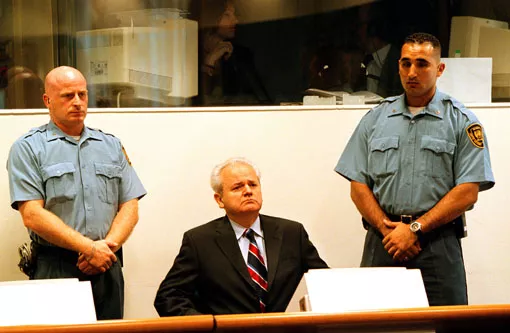
BELGRADE, (Patria) - On this day, June 28, 2001, long-time leader of Serbia Slobodan Milošević was extradited to the International Court in The Hague. It was 12 years after the rally at Gazimestan, when he spoke to over a million people at the height of his power.
His end began much earlier, in October 2000, after the unrest in Belgrade, but agreements on extradition had been underway since March 2001.
In her memoirs, Carla Del Ponte writes about her meeting with Vladimir Popović Beba, a close friend and associate of Serbian Prime Minister Zoran Đinđić:
“Đinđić called me on March 29, 2001, and told me he was sending his chief advisor who had an important message for me. Popović arrived at the 'Alexanderf Palace' hotel in Skopje in the early evening. The message was short and extremely sensitive: The investigation into Milošević for corruption and abuse of power had begun a few weeks earlier, and the investigating judge had already
concluded that there was sufficient evidence against him and ordered him to be questioned. 'Milošević did not respond to the summons,' Popović said. 'He will be arrested... We are starting the arrest operation tomorrow,' he told Del Ponte.
Court Registrar Hans Holthuis took the Court's indictment to Belgrade.
Florence Hartmann described the process of Milošević's arrest and extradition in her book "Peace and Punishment": "All ministers in Đinđić's government voted for the immediate extradition of Milošević. Đinđić informed Del Ponte: 'Milošević is leaving, urgently send someone to escort him to The Hague.'"
Court officer Kevin Curtis is in Belgrade, investigating a refrigerated truck that emerged from the Danube with 86 Albanian victims since March 2001. Curtis is described by Julian Borger in "The Executioner's Trail" as a red-haired, mustachioed British detective from Shakespeare's hometown of Stratford-upon-Avon.
Curtis wrote about Milošević's extradition: "On Thursday, June 28, 2001, at 6:30 PM, I was in the Security Institute building in Belgrade, behind which three helicopters were waiting. Slobodan Milošević arrived from prison in a van. He didn't seem to know he was going to The Hague, because as soon as he got out of the van, he started raising his hands to the sky and asking the prison warden, who was accompanying him, what was happening. The warden told him he was going to The Hague. Milošević snapped at him that he did not recognize The Hague, that he did not respect it, and that he would not go."
Milošević refused to take the papers. They boarded the helicopter, and the flight began.
Curtis recalls that during the flight, Milošević completely changed his mood and started talking to him in English.
They landed in Tuzla. Milošević was furious that they had landed in Bosnia and Herzegovina. Prosecutor Del Ponte notes that after the helicopter landed in Tuzla, Milošević asked Curtis to place a scarf on the ground so he wouldn't have to symbolically step on Bosnian soil.
A group of American soldiers from the NATO contingent met them there. At one point, Milošević tried to talk to the soldiers, but they refused. The entire operation was properly and thoroughly filmed.
After 10 PM that day, warned to remain silent, he was boarded onto a huge military transport plane, a C-130 belonging to the British Army, and taken to Eindhoven, a small airport near Rotterdam.
Milošević's first appearance before the International Court in The Hague lasted only 12 minutes. Del Ponte writes: "I remember that at that moment, I couldn't connect the 'Balkan butcher' Milošević with the image the media had created of him: a pot-bellied and bloated man who entered the courtroom with clumsy and heavy steps."
The judge was the honorable Richard May, whom Milošević would drive to rage with his actions, and who, some time later, fell ill with a brain tumor and soon died. When asked to enter a plea, Milošević recited the usual phrases of non-recognition of the court: he considered it illegal and the indictment false. In one sentence in Serbian, raw and in despair, he blurted out: "Fuck you and this court..."
"The mission is complete," Del Ponte was informed briefly at 1:30 AM. The first congratulations to the prosecutor came from US Secretary of State Madeleine Albright, the second from the office of Gerhard Schröder, the third from the then NATO commander General Wesley Clark... Moscow asked its ambassador to the UN not to express satisfaction with this event. Fidel Castro said he regretted this "political mistake." Gaddafi's Tripoli condemned the "double standards" of the international community. Florence Hartmann wrote: "It was a victory over the impunity of the powerful."
For the first time, a leader of a horrific and brutal regime, whose victims are still being exhumed and buried in Bosnia and Herzegovina, the key victim of his criminal Greater Serbia project, 25 years later, was brought to justice.
Komentari (0)
Prijavite se za komentiranje
PrijavaJos nema komentara. Budite prvi!
Minuta
Sve →Iz drugih kategorija

High Representative Not Elected: Germans, French and British Sabotaged Americans, New Attempt at End of June

ČOVIĆ WITHOUT MERCY: How Those Who Brought Ademović to Office Created a Political Hell for Him



Sunny Saturday, quite warm



Tragedy in Albanian resort: Two minors drown












