
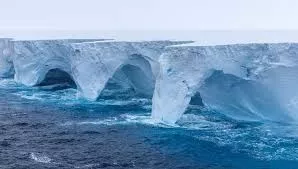
(Patria) - Scientists predict that the world's largest iceberg, A23a, will break apart within a month after escaping a vortex it was trapped in in January 2024 and was carried by it towards Antarctica.
A23a broke off from the Filchner-Ronne Ice Shelf in Antarctica in August 1986.
It was stationary for about 34 years, but in 2020, ocean currents began to move it, and it started to drift towards the western part of the Weddell Sea.
During its journey, the iceberg became trapped in a vortex and spun around it from January to mid-December of this year.
It is currently free from the vortex and is moving towards Antarctica.
Andrew Meijers, a member of the British Antarctic Survey (BAS) science team, told AA that they have not observed any external factors influencing the iceberg's escape from the vortex, but that strong currents and winds in the region most likely played a major role in it.
He added that this giant iceberg is now within the Antarctic Circumpolar Current and will continue to move northeast towards South Georgia.
As the iceberg moves north, rising ocean temperatures are expected, which will accelerate its melting process.
- This will significantly accelerate the melting rate, as well as the general rise in ocean surface temperatures as the Southern Hemisphere transitions into summer. Most previous icebergs have also broken up near South Georgia, and A23a is expected in that area in about a month - said Meijers.
However, some icebergs have previously moved much further north, so A23a could potentially approach South Africa.
Meijers also pointed out that A23a could make different contributions to the ecosystem in the region. Due to its significant size, the iceberg brings nutrient-rich waters from the deep ocean to the surface, including iron, zinc, and other micronutrients.
This process can stimulate phytoplankton growth, which in turn benefits predators that rely on this food source.
- The downside, if the iceberg is near South Georgia, is that it has the potential to make life difficult for penguin and seal colonies there. If it blocks access to feeding grounds, these animals have to swim much further to get food, which puts them under stress - explained Meijers.
He added that icebergs have caused the death of many marine creatures in the past.
An increasing number of iceberg fragments in the area could further restrict movement, making commercial fishing activities more difficult.
Meijers said that the process of iceberg formation is completely natural.
However, he noted a significant increase in the frequency of iceberg formation in Antarctica in recent years.
- This is primarily caused by increased melting of ice shelves from below, due to increased ocean temperatures. The exact driver of the increase in ocean temperatures is still being actively researched, but the main factor is human-induced climate change. We have also seen ice shelves collapse on the eastern side of the Antarctic Peninsula, particularly on the Larson A and B ice shelves, and these ice shelf collapses are also attributed to human-induced climate change - said Meijers.
Komentari (0)
Prijavite se za komentiranje
PrijavaJos nema komentara. Budite prvi!
Minuta
Sve →Iz drugih kategorija

High Representative Not Elected: Germans, French and British Against Americans, New Attempt at End of June

ČOVIĆ WITHOUT MERCY: How Those Who Brought Ademović to Office Created a Political Hell for Him



Sunny Saturday, quite warm



Tragedy in Albanian resort: Two minors drown












