
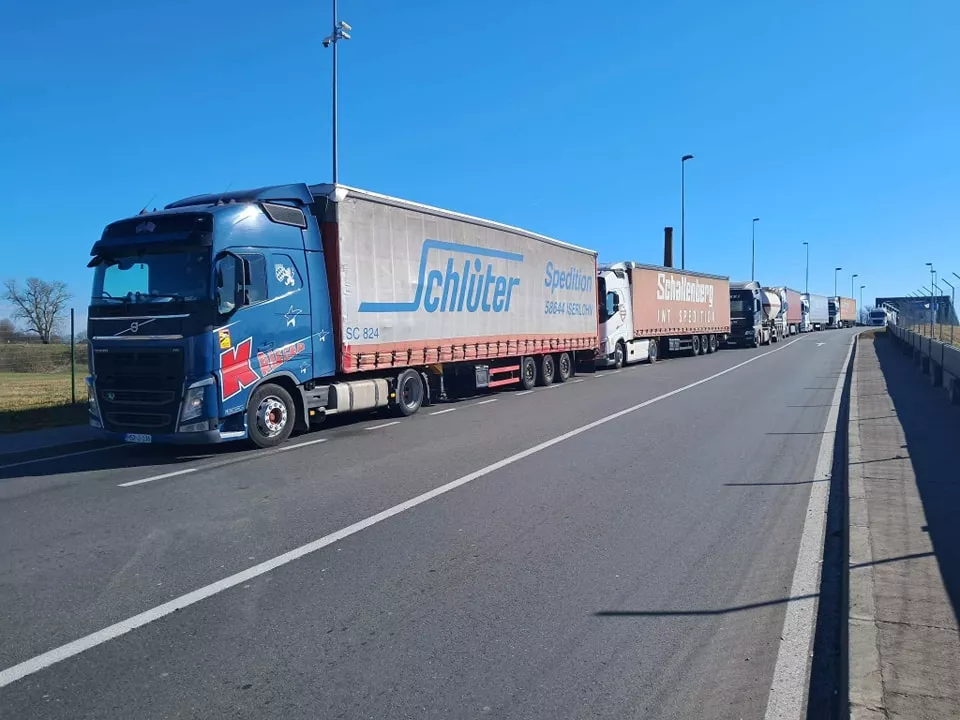
(Patria) - Kilometre-long queues, huge crowds, waiting for hours, sometimes days. Hunger, thirst, lack of restrooms, sleep deprivation, nervousness. Concern for goods, especially those that cannot stay in trucks for long. These are just some of the problems that Bosnian-Herzegovinian carriers face when they arrive at the doorstep of the European Union.
It is true that BiH regulations are not harmonized with those in the EU, but the lack of adequately equipped border crossings is a much bigger problem. However, from all indications, the biggest problem is the targeted policy of neighboring Croatia, which often leads to 'system failures' in the facilities where Croatian border control is located.

Endless queues of trucks at the Svilaj Border Crossing (Photo: HAK)
"National Bottleneck"
All of this presents an unsolvable enigma for those who live and earn their living on wheels, and who suffer great losses because of it. The system has failed, and it is the state system, more precisely the Council of Ministers of BiH and the Ministry of Transport and Communications, and the Ministry of Foreign Trade and Economic Relations.
The heads of these ministries are Edin Forto (Our Party) and Staša Košarac (SNSD). We tried to contact both of them, but we were denied answers.
Carrier associations have approached state institutions countless times, but they have largely remained deaf. A solution to the problem certainly exists, but how much does the state care about the hardships and losses of both carriers and producers?
Jovo Cvijić, a member of the Board of the Association of International Road Freight Carriers at the Foreign Trade Chamber (VTK) of BiH, says he doesn't even know where to start his conversation with Patria.
- Simply put, BiH institutions have failed. Our country has failed, whether due to the slowness of people in the Council of Ministers of BiH, or due to the failure to hold sessions where certain decisions would be made. Everything is probably stuck somewhere there - Cvijić points out.

Crowds also at the Gradiška Border Crossing (Photo: Facebook)
The association, of which he is a member, explains, has countless written requests, inquiries, and pleas addressed to the Council of Ministers of BiH. However, the state government remains silent.
Out of the 17 border crossings that Bosnia and Herzegovina has with Croatia for international road freight transport, only three are equipped with inspection controls, i.e., services where trucks with goods from our country are checked - Orašje, Gradiška, and Vinjani Donji.
- I even think Orašje doesn't have all those services, just some. The problem is particularly with the favoritism of the Gradiška Border Crossing, which is a 'national bottleneck'. You know that crossing involves a five-meter-wide bridge, and traffic goes in both directions across it. It's unbelievable.
This particular border crossing is favored, equipped with veterinarians, phytopathologists, and all those inspections that more than 50 percent of goods are subject to, even though we have other borders that are significantly more accessible, perhaps physically larger, wider. But they do not have the institutions that can allow goods of plant and animal origin from Bosnia and Herzegovina into the European Union - Cvijić tells us.
He provides a concrete example that proves that BiH's legal regulations are significantly behind European ones.
- Take, for example, a carrier who leaves Sweden with a single document drives all the way to the border of Bosnia and Herzegovina. But when he reaches our border, then the troubles and various problems begin - Cvijić emphasizes.
System Failure
Croatia has been in the Schengen area since January 1st, and BiH carriers are therefore subject to significantly more rigorous, detailed, and precise controls and inspections, including papers, goods, and the interior of cabins...
- Yes, that's true. But again, it's up to them, up to their law. They are now, practically, the filter for the EU. However, that is not the main problem for carriers. Simply, regulations must be respected - this and that must not be carried, this and that can be carried in certain quantities, etc. In the first year, these searches will probably take a bit longer.
But the fundamental problem that carriers from Bosnia and Herzegovina have is that truck and bus crews are subject to a law that, for example, does not apply to air traffic crews regarding their stay in the Schengen zone.
In practice, this means the following: Croatian authorities will start counting the stamps upon entry and exit from the EU, and summing up the days. For example, a truck or bus driver will have the right to spend three or four months in the Schengen area during one calendar year.
Imagine that after six months, he loses the right to go to Croatia, and then he has to take a break for six months. And what then? Instead of him, another person or another crew must be hired. And we already have a shortage of staff in this profession - Cvijić emphasizes.
He adds that this will be one of the main problems as long as the Council of Ministers of BiH does not try to resolve it with Croatia so that drivers of truck, bus, and all other crews are equalized in this regard with air crews.
On social networks, BiH drivers complain, among other things, that one of the rare reasons for their long delays at the borders with Croatia, which can last for several days, is a "system failure" in facilities on Croatian territory. Drivers from our country suspect that such an explanation from Croatian border police officers is fabricated.
- They joined the EU a long time ago, but they only recently joined the Schengen area, and I think they are also a bit unprepared. System failures at border crossings happen in Austria, Serbia, and all other countries - Cvijić notes.
Large crowds at border crossings are also a consequence of the limited working hours of phytosanitary inspectors on the Croatian side. This is the biggest problem for carriers transporting perishable goods, such as fruits and vegetables, because the phytosanitary inspection on the Croatian side works until 3 PM. This practically means that all drivers who arrive at the border crossing after 3 PM are forced to wait until the morning.
- This is a problem that has been ongoing for two years. As the Association of BiH Carriers, we have sent various requests, demands, decisions... But there has been no concrete solution. These sanitary and customs services exist at several border crossings that are favored, where they also have the excuse that they don't have enough staff, then corona, and when it's not corona, it's some other illness. They invent various things due to a lack of personnel and the lack of coverage at all borders. If all borders had such services, the delays would be significantly shorter - Cvijić concluded.
It is obvious that the competent institutions in Bosnia and Herzegovina do not prioritize carriers and exported goods, which Croatia uses and in a way punishes BiH exporters by holding their goods at the border for too long, after which they often become unusable. Especially in the case of sensitive goods, fruits, vegetables, milk, and the like.
(D. Kovač)
Komentari (0)
Prijavite se za komentiranje
PrijavaJos nema komentara. Budite prvi!
Minuta
Sve →Iz drugih kategorija

High Representative Not Elected: Germans, French and British Sabotaged Americans, New Attempt at End of June

ČOVIĆ WITHOUT MERCY: How Those Who Brought Ademović to Office Created a Political Hell for Him



Sunny Saturday, quite warm



Tragedy in Albanian resort: Two minors drown












