
(Patria) - The International Monetary Fund mission has published conclusions following consultations for 2026, warning that urgent reforms are needed for BiH to sustain economic growth and move closer to the European Union.
The International Monetary Fund (IMF) has warned that Bosnia and Herzegovina is facing a slowdown in economic growth, rising inflation and increased fiscal pressures, while without stronger reforms it will not be able to make significant progress towards the economic standard of the European Union.
In the concluding statement following consultations under Article IV of the IMF's Articles of Agreement for 2026, it is stated that economic growth is weakening under the influence of higher energy prices, weaker demand from the European Union and increased global uncertainty.
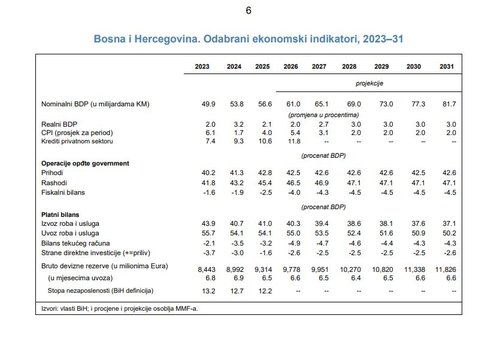
According to IMF estimates, BiH's economic growth slowed from 3.2 percent in 2024 to 2.1 percent in 2025, while a further slowdown to two percent is expected in 2026. At the same time, inflation rose from 1.7 percent in 2024 to four percent in 2025, and could reach 5.4 percent during this year.
The IMF states that growth will gradually recover to around three percent in the medium term, but that such dynamics will not be sufficient for a significant convergence of living standards with European Union countries without serious structural reforms.
Among the main risks are weaker growth of key trading partners, persistently high energy prices, tighter global financial conditions and political tensions within the country.
The IMF paid particular attention to fiscal policy, assessing that it remains expansionary and contributes to rising budget deficits, public debt and inflationary pressures.
The consolidated general government deficit has been continuously rising since 2022, and according to projections could reach four percent of gross domestic product in 2026. The main reasons cited are increases in pensions, social benefits and public sector wages.
The IMF warns that the increased deficits are being financed by record external borrowing. Republika Srpska has borrowed a total of 750 million euros, representing 7.3 percent of that entity's GDP, while the Federation of BiH has secured 800 million euros, or 3.9 percent of its GDP.
Therefore, the IMF calls on the authorities to refrain from new measures that would further increase the deficit and to use any revenue surpluses to rebuild fiscal reserves.
The report states that fiscal consolidation should begin no later than 2027 in order to reduce the need for new borrowing, rebuild fiscal reserves and ensure room for priority investments.
The IMF recommends limiting public sector wage growth, rationalising subsidies and transfers, more effectively targeting social assistance, and broadening tax bases by reducing tax exemptions and modernising property taxation.
The IMF mission emphasises that preserving the currency board arrangement and the independence of the Central Bank of Bosnia and Herzegovina is of key importance for the country's macroeconomic stability.
It is noted that the banking sector remains well capitalised, liquid and profitable, but that strong credit growth requires additional caution, especially regarding consumer loans and interest rate risks.
The IMF also warns of slow progress in addressing deficiencies in the area of anti-money laundering and combating the financing of terrorism, which increases the risk of BiH being placed on the FATF grey list.
The conclusions state that Bosnia and Herzegovina must accelerate the implementation of reforms to increase competitiveness and economic growth potential. The importance of the European Union's Growth Plan is particularly highlighted, which could help economic restructuring, strengthen integration with the EU and attract additional investments.
The IMF also warns of the consequences of introducing the EU's Carbon Border Adjustment Mechanism (CBAM), which from 2026 affects around 11 percent of Bosnia and Herzegovina's exports, particularly in the sectors of aluminium, cement, electricity, and iron and steel.
Therefore, it recommends accelerating decarbonisation, investing in renewable energy sources and aligning emission monitoring systems with European Union standards.
The IMF mission concludes that Bosnia and Herzegovina has the potential for stronger growth, but that achieving it will require reforms in the areas of public finances, energy, governance and the business environment.
According to IMF estimates, effective implementation of reforms related to European integration could increase GDP growth by between 0.5 and one percentage point annually in the long term.
Komentari (0)
Prijavite se za komentiranje
PrijavaJos nema komentara. Budite prvi!
Minuta
Sve →Iz drugih kategorija

High Representative Not Elected: Germans, French and British Sabotaged Americans, New Attempt at End of June

ČOVIĆ WITHOUT MERCY: How Those Who Brought Ademović to Office Created a Political Hell for Him



Sunny Saturday, quite warm



Tragedy in Albanian resort: Two minors drown












