
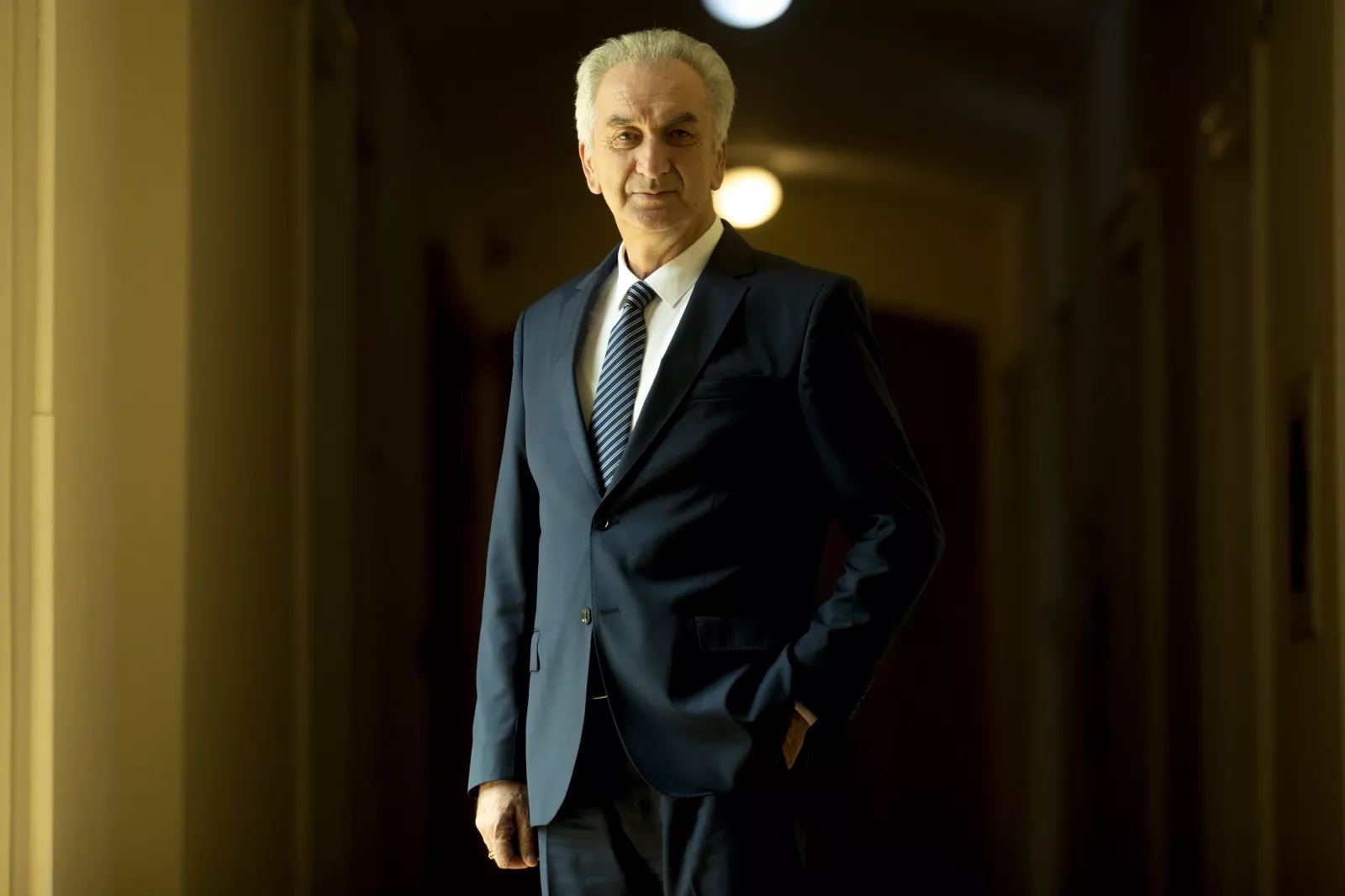
Interviewer: Armin Aljović
Mirko Šarović is considered the most successful minister in the current Council of Ministers of Bosnia and Herzegovina, with several adopted measures and laws that have strengthened the Bosnian economy.
At the end of June, he was elected president of the SDS, currently the largest opposition party to Milorad Dodik and his SNSD. Experts believe that Šarović's economic and political logic could reform that party and bring it back to leadership, and then accelerate reforms in a country striving to become a member of the European Union.
In an interview with the Patria News Agency, the Minister of Foreign Trade and Economic Relations of Bosnia and Herzegovina, Mirko Šarović, explains how to solve some political and historical problems that citizens in Bosnia and Herzegovina are trapped in through the economy.
The perception is that you are finishing your term as the most successful minister in the Council of Ministers of BiH. You have ensured that BiH can export chicken, eggs for processing to the EU, and increased meat export quotas to Turkey... You expect Russia to open up further for BiH products. Is there anything you planned to do but failed to achieve?
- Of course, there are still many things waiting for implementation. The ministry is like a factory that constantly produces various events, projects, laws, and decisions, but this is often not visible until they pass through the Council of Ministers and the BiH Parliament.
Our effort alone is not enough; some things often depend on other political and other factors. For example, some people do not want us to adopt a new Decision on the quality of liquid petroleum fuels because they have other interests.
Also, some unresolved issues still prevent us from finally acceding to membership in the World Trade Organization. We are on the verge of becoming a member of this global organization, but we have not yet reached an agreement, primarily with Russia in bilateral negotiations with this country on market access.
We often have problems with other levels of government, from which we sometimes cannot get the necessary consent, positive opinions, especially on issues where responsibilities are divided.
What does that Decision on the quality of liquid petroleum fuels mean, what would it mean for the citizens of BiH, and why would someone have an interest in blocking it?
- Whenever we propose a decision or law, we start from the premise that it is either an obligation of Bosnia and Herzegovina or in the general interest of the citizens, such as, for example, the Decision on the quality of liquid petroleum fuels. Specifically, that decision would bring better quality fuel for citizens, less air pollution, which affects the health of people and animals, longer-lasting cars, a more regulated market, and more money in the budget. Finally, with that decision, we would also fulfill our obligations to the Energy Community by adopting European standards in this area.
Conversely, there are also visible interests in keeping the existing outdated Decision from 2011 in force in Bosnia and Herzegovina, which does not support advanced European standards and allows for the import of lower-quality fuel into Bosnia and Herzegovina...
It is not enough to ensure exports; it must be accompanied by development within the country. Are you afraid that BiH might reach a point where it has nothing to offer the European Union, regardless of the export permits you have secured? Serbia has much better predispositions for agriculture, Montenegro invests in tourism... What is your vision for BiH's economy?
- Probably, due to our size, we are not a country that can boast of having a large quantity of goods for delivery. We have a smaller production of fruits, vegetables, a modest production of food of animal origin... that is completely clear and logical.
However, I must say that we export the most demanding quality products to the European Union, with a significant share of human labor and creativity, meaning we produce high-standard products – and not just agricultural products, as is often thought.
A good example for us is China, which has allowed us to export some products to their country. Of course, we should not even think that we can satisfy the huge Chinese market with quantity, not even some larger Chinese city, but we can send quality products to China, with a designated geographical origin from Bosnia and Herzegovina, produced and branded as "organic." Such products are always more expensive and always have their buyers.
Farmers from Republika Srpska and the Federation of BiH recently initiated the formation of a state association of farmers. Is this consolidation the right path to approach the international market?
- Europe usually requires a single point of contact for communication; of course, it is not always the case, and discussions can be held in different ways, but a single point of contact is a model that Europe prefers.
If the farmers have assessed that it is better for them, they should not be prevented from doing so. It is free, non-political association, and why would anyone hinder their intention to organize and make their voice stronger? They will achieve their goals more quickly and easily if they are stronger, rather than if they are divided into multiple associations.
What do you think of the idea of a common economic market for the Western Balkan countries, advocated by Serbian President Aleksandar Vučić? Could this be the first step towards strengthening the economy of these regions?
- It seems to me that President Vučić, at least in the initial phase, spoke about a customs union. Then it was accepted by some, but not by others. For some, it resembled a state union too much. Now, there is more talk in the region about a single regional market, which is essentially more than CEFTA. A kind of CEFTA plus. I think this is a measure that could be accepted at this moment in the region by most members.
A single regional market (in the Western Balkans, op.n.) would, as I see it, mean a free market for goods, services, and capital, a free labor market... A single regional market can also mean mutual recognition of university diplomas, professional qualifications, freedom of movement for people, for example, with an ID card... It can also mean that borders would no longer be barriers but would be fluid, as in EU countries. All of this would provide a strong impetus to economic and trade activities in the region... But these initiatives and ideas require a comprehensive agreement among regional countries supported by the EU.
Do you think this could also partially stop the emigration of people from the region?
- Absolutely, and that's how it should be viewed.
In one of your previous interviews, you said that citizens in BiH lack a sense of loyalty to domestic products. How can this be changed?
- Awareness needs to be developed among people in the country about buying and supporting domestic products. A sense of belonging to buy domestic products is not acquired in a day; it takes a lot of time for it to mature in our consciousness that when we go to the market, we should pick up a product, turn it over, and see where it was produced – if it's domestic, then we put it in the basket.
When you go to Switzerland, for example, you see what that kind of economic patriotism means. That's what we need. We tried this once when we had a dispute with Croatia over milk; many customers started buying only domestic milk. Increased purchasing of domestic products would significantly impact the country's economic growth. We cannot even imagine what would happen if more people started buying domestic products out of habit – and we have a domestic alternative for almost everything we consume.
The annual general meeting of the European Bank for Reconstruction and Development, recently held in Sarajevo, attracted around 3,000 participants. Is this a kind of message that foreign investors are indeed counting on BiH as a market?
- Certainly, although we must constantly change the country's perception in the eyes of investors who come to invest. We simply have to change the image of Bosnia and Herzegovina, make the country more desirable and attractive to investors. The European Bank for Reconstruction and Development has shown us that we can attract the most prestigious companies and ensure that the most important global financial institutions follow us.
Your stance is that some public enterprises, and even public goods, should be privatized or leased... Someone might accuse you of working in the interest of capitalism. What is your counter-argument?
- I am among those who believe that the state is the weakest employer, and that those who advocate for keeping key resources in state hands are promoting false patriotism.
In reality, it is a cover for the use and plunder of public resources for party purposes. As long as something is state-owned, public, it will be subject to corruption and plunder, and political elites desire exactly that. They do not want parts of the power industry to be privatized, for example, because then they will not be able to steal. I am not advocating – let's be clear – for the sell-off of public goods, but for public assets, a strategic partner must be found who will protect those assets.
Is that the case with Aluminij Mostar as well?
- For too many years, Aluminij was in some party and national hands, and less in the hands of those who would make Aluminij a regional giant, although Aluminij deserves exactly that.
In BiH, investments are also viewed through a national lens. Can Bosnia and Herzegovina unite rather than divide investors?
- Our people are prisoners of some incredible prejudices that are difficult to eradicate. Go to Dubai, for example, and look at those numerous skyscrapers. Do you think they were built by Emiratis? No, not at all; they were built by some Chinese, some English, some Americans, and the Emiratis simply created an environment where construction and investment could happen. As for Bosnia and Herzegovina, one day, when we stop thinking about where the capital came from, perhaps things regarding investment will turn in a different direction. We need to open the space for anyone who wants to invest (EU, Turkey, Russia, China...), of course, while respecting the country's rules. Whoever builds something here, it stays here. Buildings do not have wheels for someone to take them away.
Komentari (0)
Prijavite se za komentiranje
PrijavaJos nema komentara. Budite prvi!
Minuta
Sve →Iz drugih kategorija

High Representative Not Elected: Germans, French and British Against Americans, New Attempt at End of June

ČOVIĆ WITHOUT MERCY: How Those Who Brought Ademović to Office Created a Political Hell for Him



Sunny Saturday, quite warm



Tragedy in Albanian resort: Two minors drown












