
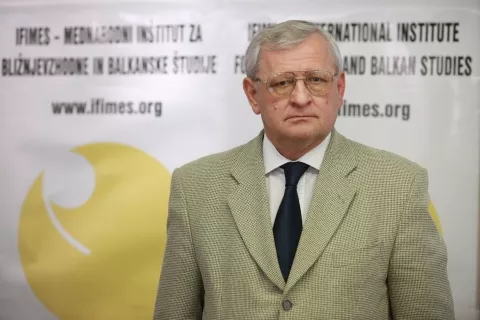
LJUBLJANA/SARAJevo, (Patria) - The International Institute for Middle Eastern and Balkan Studies from Ljubljana analyzes events in the Middle East and the Balkans. Academician Dr. Mirko Pejanović, Professor Emeritus of the Faculty of Political Sciences of the University of Sarajevo, in his article "Building peace in Bosnia and Herzegovina is significantly dependent on the acceleration of integration into the EU and NATO" writes about building peace in BiH and accelerating the process towards membership in Euro-Atlantic integrations. We publish his article in its entirety.
We publish excerpts from the article by academician Pejanović:
Bosnia and Herzegovina, during its medieval statehood and existence, was a multi-religious and multicultural community.
During its more than 400 years of rule over Bosnia, the Ottoman Empire allowed religious autonomy and diversity... Relations between members of religious communities were based on interfaith tolerance...
During the four decades of Austro-Hungarian rule over Bosnia and Herzegovina, the historical process of Europeanization of Bosnian society was carried out.
The territorial integrity and existence of Bosnia and Herzegovina in the Kingdom, actually the First Yugoslavia, from 1921 to 1941, was abolished by the agreements of the Serbian and Croatian bourgeoisie on the division of Bosnia and Herzegovina. This division is known as the Cvetković–Maček agreement...
During its existence within the Yugoslav socialist federation from 1945 to 1990, Bosnia and Herzegovina recorded a high level of development in economy, education, culture, and healthcare. It became a country of medium development on the Yugoslav and European level.
According to historians, Bosnia and Herzegovina experienced a golden age in its overall economic, social, and cultural development from the early 1960s to the 1990s. Large export-oriented economic systems were developed: Energoinvest, Šipad, Unis, Hidrogradnja, Famos, Metalurški kombinat Incel, Rudi Čajevec, and others. All children were covered by primary education. Secondary schools were established in all municipalities. In addition to Sarajevo, universities were opened in Mostar, Tuzla, and Banja Luka. An Academy of Sciences was formed.
Employment increased to one million people out of a population of four million and three hundred thousand according to the 1991 census. Interethnic relations were harmonious.
...The Serbian Democratic Party, led by ultra-nationalist Radovan Karadžić... advocated for the ethnic division of Bosnia and Herzegovina and its negation in its political stance. In fact, it decided to follow Milošević's political project of creating a "Greater Serbia".
In April 1992, the SDS unilaterally withdrew from the BiH Parliament and began military activities, including the siege of Sarajevo in April 1992. This was followed by the violent expulsion of the civilian population: Bosniaks and Croats from the territory of Bosnia and Herzegovina where the Republic of the Serbian People was to be formed.
II The Dayton Peace Agreement marked a historical turning point because its signing stopped the war in BiH and initiated peacebuilding... As a general peace agreement, the Dayton Peace Agreement contains military and civilian aspects. Furthermore, the Dayton Peace Agreement contains the Constitution of Bosnia and Herzegovina in the form of Annex IV. With this Constitution, Bosnia and Herzegovina became a dysfunctional state because all institutions are derived and formed on an ethnic basis, which leads to blockades in parliamentary decision-making... The military aspect of the Dayton Peace Agreement was implemented by international peacekeeping forces in the form of NATO forces' mandate to separate warring military forces on the ground and ensure freedom of movement and security for the citizens of Bosnia and Herzegovina.
Regarding the civilian aspect of the Dayton Peace Agreement, the institution of the High Representative of the international community was established. This institution was founded in the Dayton Peace Agreement as the supreme authority for interpreting the Dayton Peace Agreement in the process of its implementation. All previous holders of the role of High Representative of the international community in Bosnia and Herzegovina have been cadres from the European Union. From 1996 to 2018, the following served as High Representative of the international community: Carl Bildt, Carl Westendorff, Wolfgang Petritsch, Paddy Ashdown, Christian Schwarz-Schilling, Miroslav Lajčák, and Valentin Inzko, whose mandate is ongoing.
This concerns the stable development of the statehood of Bosnia and Herzegovina as one of the European states, whose development in peace is an integral part of preserving peace in the Western Balkans and the European Union as a whole.
III Stagnation in the process of BiH's integration into the EU from 2008 to 2015
Bosnia and Herzegovina defined its strategic commitment to integration into the European Union and NATO in the Parliamentary Assembly and the Presidency of Bosnia and Herzegovina from 1999 to 2000. Since then, reforms have been carried out to bring Bosnia and Herzegovina closer to membership in the EU and NATO. More reforms were implemented to meet the conditions for Bosnia and Herzegovina's membership in the European Union by 2008. In that year, Bosnia and Herzegovina signed the Stabilization and Association Agreement with the European Union. Among the most significant reforms are the establishment of the Indirect Taxation Authority, the establishment of the Court and Prosecutor's Office of Bosnia and Herzegovina, and the establishment of intelligence and security services at the state level. In terms of building the state institutions of Bosnia and Herzegovina, the expansion of the capacity of the Council of Ministers of Bosnia and Herzegovina stands out. From the three ministries that the Council of Ministers had in 1997, the Council of Ministers has had nine ministries since 2005. The strengthening of the institutional capacity of the state of Bosnia and Herzegovina was carried out through the engagement of the High Representative of the international community and the promulgation of laws based on the Bonn Powers.
The stagnation in the process of Bosnia and Herzegovina's integration into the European Union lasted from 2008 to 2015. In fact, at the general parliamentary elections in 2006, the nationalist rhetoric of political party leaders was renewed. The radical rhetoric of Milorad Dodik, leader of the Alliance of Independent Social Democrats in Republika Srpska, stood out. Within this nationalist rhetoric, the idea of a referendum of the citizens of Republika Srpska for secession from Bosnia and Herzegovina was launched. Although the possibility of Republika Srpska seceding from Bosnia and Herzegovina has no constitutional basis, it is renewed in the political actions of Milorad Dodik. At the same time, distrust in the state of Bosnia and Herzegovina and its institutions is also expressed. It is often claimed that Bosnia and Herzegovina is a construct of the international community and that it is not sustainable. In addition, the impossibility of coexistence between Serbs with Bosniaks and Croats is emphasized. Such an approach by Milorad Dodik, the leader of SNSD as the ruling party in Republika Srpska, created an atmosphere of distrust between parties in the Federation of BiH and parties in Republika Srpska. All of this led to a decrease in foreign investment and an increase in unemployment and poverty among citizens. At the beginning of 2014, citizens decided to revolt. The prime ministers of the governments of the cantons in Sarajevo, Tuzla, Zenica, and Bihać were dismissed. An attempt was made to set fire to the Presidency of BiH building in Sarajevo as a symbol of the state's existence of Bosnia and Herzegovina. A general concern arose about the situation in Bosnia and Herzegovina, including concern in the institutions of the European Union.
The British-German initiative enabled both ruling and opposition parliamentary parties to unite in supporting the Reform Agenda initiated by the European Union. After that, in 2016, Bosnia and Herzegovina submitted its application for membership in the European Union. At the end of 2016, Bosnia and Herzegovina was presented with the European Union's Questionnaire with over 3000 questions. For more than a year, the bodies of Bosnia and Herzegovina prepared answers to the EU questionnaire. It is expected that the European Commission will give its opinion on BiH's answers to the questionnaire during 2018. If the European Commission's opinion is positive, Bosnia and Herzegovina could receive candidate status for membership in the European Union at the beginning of 2019...
IV Possible dangers for BiH from the geopolitical influence of Russia and Turkey
New dangers due to Bosnia and Herzegovina's stagnation in the process of integration into the European Union and NATO alliance emerged in 2012 due to the increasing presence and geopolitical influence of the Russian Federation and the Republic of Turkey on social and political processes in Bosnia and Herzegovina. The Republic of Turkey carries out economic and cultural activities. The Russian Federation increasingly shows geopolitical pretensions for the Western Balkans region. The core of the Russian Federation's strategy is to hinder the successful integration of Western Balkan countries, and thus Bosnia and Herzegovina, into membership of the European Union and the NATO alliance. The Russian Federation, through its influence, has distanced the Republic of Serbia from possible NATO membership. At the same time, the Russian Federation has encouraged the leadership of Republika Srpska to adopt a Resolution on the military neutrality of Republika Srpska in the National Assembly of Republika Srpska in October 2017. This directly destroys the strategically established path of Bosnia and Herzegovina towards NATO membership. The Russian Federation achieves its influence on Republika Srpska through Milorad Dodik, the President of Republika Srpska, whose influence helps him to strengthen his power and remain in power. Furthermore, the representative of the Russian Federation on the Steering Board of the Peace Implementation Council expresses his opinion at all sessions due to disagreements with other countries. In this way, Republika Srpska is encouraged to destroy the building and functioning of the state institutions of Bosnia and Herzegovina.
The Russian and Turkish influence on the development process of Bosnia and Herzegovina will be even greater and with more consequences for Bosnia and Herzegovina's integration into the EU and NATO if the institutions of the European Union and NATO member states do not adopt a new strategy and policy to accelerate the integration of Bosnia and Herzegovina into the European Union and NATO alliance.
All disagreements and blockades in parliamentary decision-making were resolved by the High Representative of the international community with his decisions based on the Bonn Powers. From 1997 to 2009, the High Representative made 800 decisions. He also proclaimed 145 laws based on which reforms were implemented and conditions were met for Bosnia and Herzegovina to sign the Stabilization and Association Agreement with the European Union in 2008. This gave a new dimension to the integration process of Bosnia and Herzegovina into the European Union.
... It is predicted that Bosnia and Herzegovina could obtain candidate status for EU membership in 2019, after submitting answers to the EU questionnaire... If geopolitical and strategic solutions are not found to accelerate the integration of Bosnia and Herzegovina into the European Union, there is a danger that the geopolitical influence of the Russian Federation on the social development of Bosnia and Herzegovina will strengthen. Russian influence hinders the integration of Bosnia and Herzegovina into the European Union and NATO alliance by encouraging Republika Srpska towards separatist ideas and blocking the state institutions of Bosnia and Herzegovina in the process of Euro-Atlantic integration. It should be borne in mind that the geopolitical influence of the Republic of Turkey on the cultural and political development of Bosnia and Herzegovina is also gradually increasing.
The phenomenon of mass emigration of young educated people from Bosnia and Herzegovina poses a great danger to the destabilization of the economic and political development of Bosnia and Herzegovina and its geopolitical stability. Annually, tens of thousands of young people emigrate from Bosnia and Herzegovina to European countries due to unemployment.
These dangers for Bosnia and Herzegovina can be prevented by changing the strategy of the European Union institutions towards accelerating BiH's integration into the EU, because Bosnia and Herzegovina is not the same as Serbia, Montenegro, or Macedonia. Bosnia and Herzegovina is a post-conflict society. The war devastated the economic basis of its citizens' existence and made its state institutions fragile, which is why they are slow and powerless to implement reforms that meet the conditions for membership in the European Union.
The European Union, based on the Dayton Peace Agreement, through its special representative, has the authority and responsibility to ensure that peacebuilding in Bosnia and Herzegovina is carried out within the geopolitical framework of Euro-Atlantic integration.
Therefore, it is necessary to establish two prerequisites for accelerating the integration of Bosnia and Herzegovina into the European Union. The prerequisites arise in two directions. The first is: the institutions of the European Union: the Parliament, the Commission, and the Council of the European Union create political consensus on implementing reforms for EU membership through the mediation of the European Commissioner for Foreign Policy and Security. On this basis, the institutions of the European Union would effectively assist in implementing reforms.
The second prerequisite for accelerating the integration of Bosnia and Herzegovina into the European Union arises in the form of a strategic political project where parliamentary parties that receive 10% or more of the electorate's trust in the autumn 2018 elections would form a broad coalition for a European rule of law Bosnia and Herzegovina and achieve BiH's membership in the EU by 2026. This would unite political energies to realize the will of the citizens for their country to become an EU member. If the integration process of Bosnia and Herzegovina is not accelerated by a new approach from the European Union institutions and a new approach from parliamentary political parties, the state of Bosnia and Herzegovina will continue to move towards poverty economically and lose the basis for its successful development through economic emigration of the population. Because the integration of Bosnia and Herzegovina into the EU simultaneously means its internal integration and economic prosperity.
The European Union has economic and political power, it has a role in implementing the Dayton Peace Agreement, it has an interest in integrating the Western Balkan countries into the family of EU countries, but it also needs a new approach and a new strategy to accelerate the integration of Bosnia and Herzegovina into the EU because new conflicts in Bosnia and Herzegovina can destabilize peace in the Western Balkans and in Europe.
Komentari (0)
Prijavite se za komentiranje
PrijavaJos nema komentara. Budite prvi!
Minuta
Sve →Iz drugih kategorija

High Representative Not Elected: Germans, French and British Against Americans, New Attempt at End of June

ČOVIĆ WITHOUT MERCY: How Those Who Brought Ademović to Office Created a Political Hell for Him



Sunny Saturday, quite warm



Tragedy in Albanian resort: Two minors drown












