
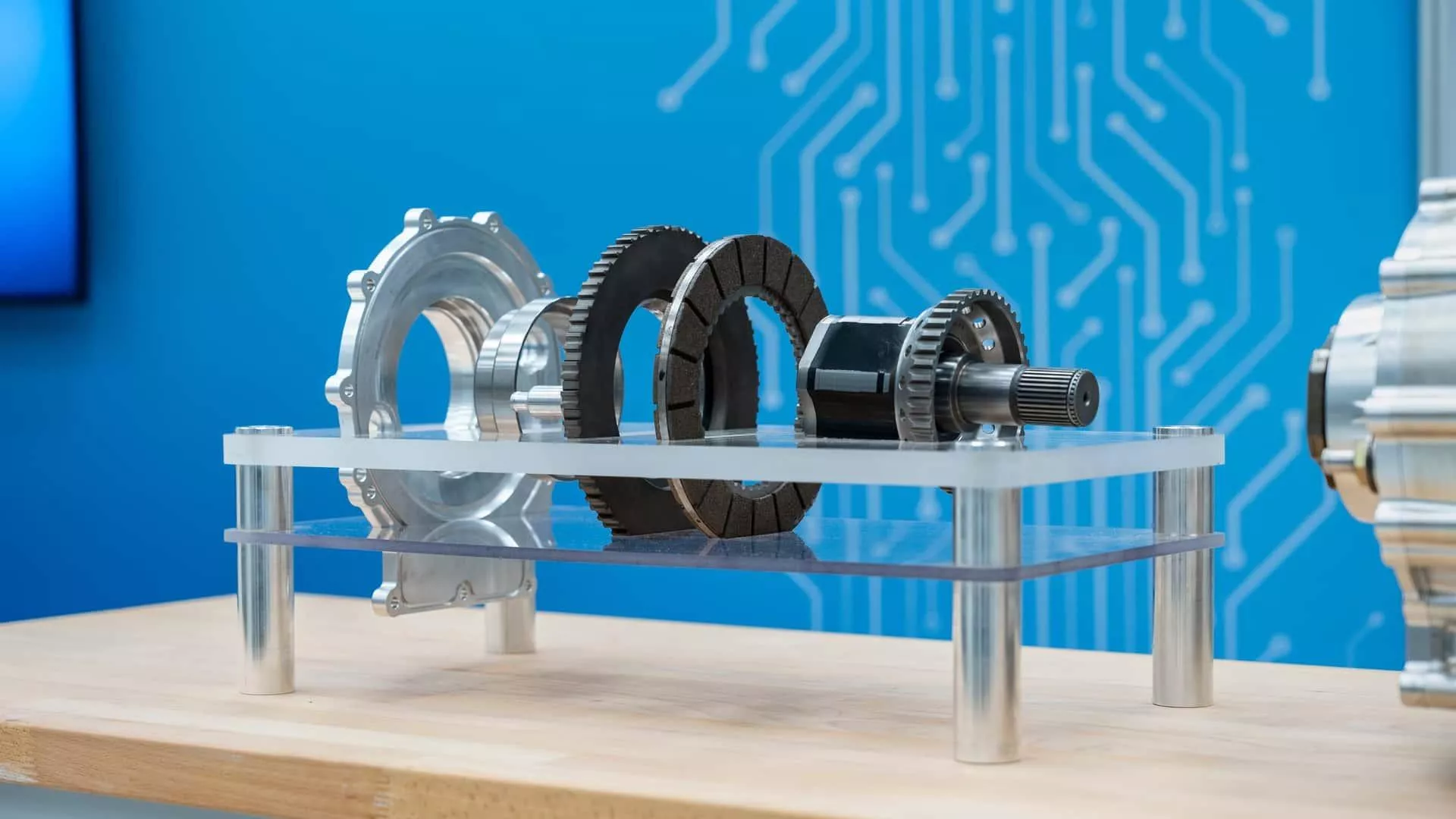
(Patria) - With the advent of hybrids, and especially electric cars, the regenerative power of the drivetrain has grown enormously in the last decade.
Increasingly powerful electric motors can also slow down cars with increasing force. This is beneficial in principle because you can generate electrical energy that you can send back to the battery, writes Autoklub.
But a side effect of this is that many electric cars can brake so strongly with their electric motors that conventional brakes are almost never needed. You brake so strongly with the electric motor that the brakes are only activated for sudden stops.
If we take the electric Mercedes EQS as an example, it can brake with up to 300 kW of power, solely thanks to its electric motor. This is power that you can send back to the battery with the braking effect thanks to the electric motors.
This is enough for most braking, but the brakes are still much more powerful; on this car, it's approximately equivalent to braking with an electric motor of 2200 kW. This is a huge amount of force needed to stop a heavy car as quickly as possible, which is why brakes are still necessary.
With regeneration, you can slow down at about 0.3G, which is sufficient in as many as 98 percent of cases. Of course, this will be somewhat different for sporty drivers, let alone for driving on a race track.
But in practice, it seems that electric vehicles with significant regenerative capacity barely use their mechanical brakes, yet they are still essential for strong braking.
For example, if you suddenly enter a traffic jam on the highway or have to stop urgently for a pedestrian crossing the road.
Because of all this, Mercedes is now working on a system in which the brakes are integrated into the electric drive. Instead of a disc, the brake pads rotate with the axle, allowing the disc to be cooled by water, so air is not needed.
The pads here can also cover the entire disc instead of about one-third on conventional brakes. This creates a larger braking surface, so less pressure is needed. This, in turn, results in less wear, so the brakes last as long as the car's lifespan, according to Mercedes.
There are also some additional benefits. By removing the brakes from the wheels, the unsprung mass is reduced because there are no longer 25 kilograms of braking components. This is very good for the car's driving characteristics.
Furthermore, the wheel can be completely enclosed, which is excellent for aerodynamics. Also, the front of the car can be more aerodynamic because the manufacturer no longer has to consider brake cooling.
In addition, the system is also good for the environment. All particles that are otherwise released due to the wear of the brake disc and brake pads are now trapped inside the brakes. In addition to protecting health, this also protects the wheels from getting dirty.
Although it seems to be a brilliant invention that could bring many advantages for electric and hybrid cars, it will be some time before we actually see this system on a production car.
The system cannot be applied to an existing model. The entire technical design of the car must be adapted to the new form of the brake from the very beginning, and the technology is not yet complete.
When the technology is finally ready for production, it will still take years to develop a car that can use it and leverage all its advantages.
Komentari (0)
Prijavite se za komentiranje
PrijavaJos nema komentara. Budite prvi!
Minuta
Sve →Iz drugih kategorija

High Representative Not Elected: Germans, French and British Against Americans, New Attempt at End of June

ČOVIĆ WITHOUT MERCY: How Those Who Brought Ademović to Office Created a Political Hell for Him



Sunny Saturday, quite warm



Tragedy in Albanian resort: Two minors drown












