
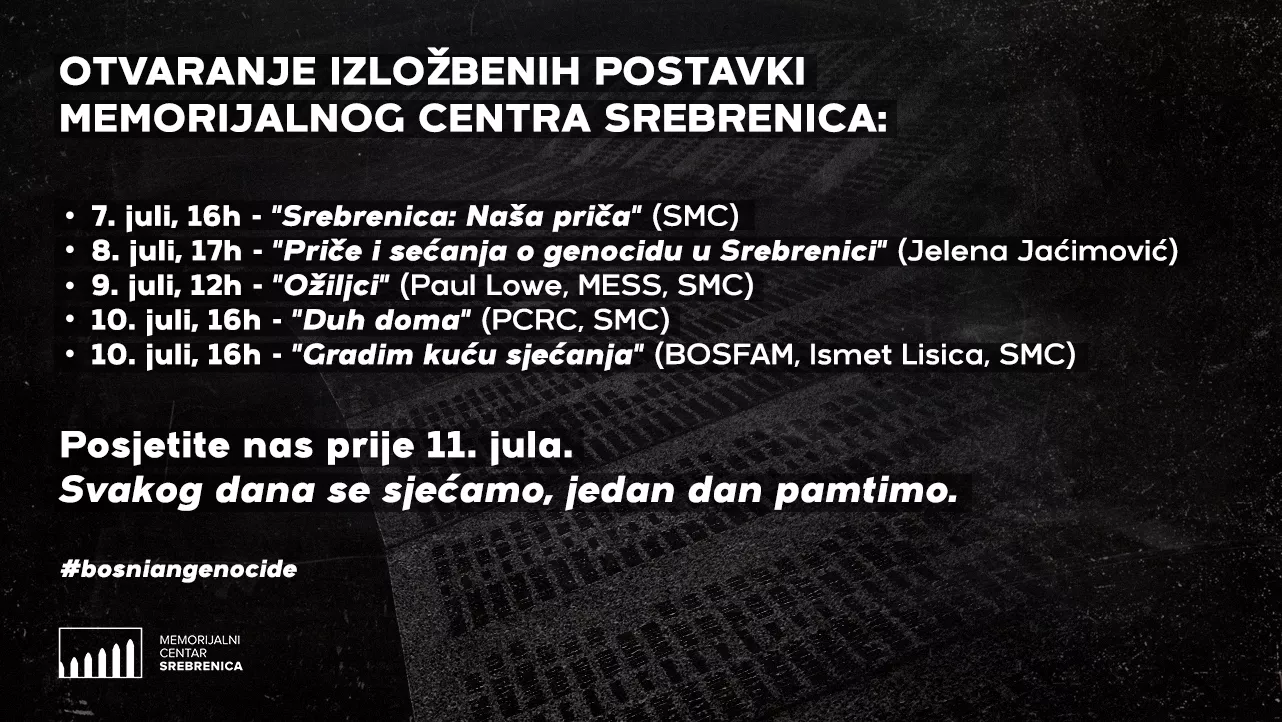
(Patria) - The Srebrenica Memorial Center will open four new exhibitions in July dedicated to the memory of the victims of the Srebrenica genocide, which will be part of the permanent exhibition in the future. This is the result of the valuable research work of this institution over the past year, as well as partnerships with organizations and artists from home and abroad.
"We invite all interested parties to take advantage of the less crowded period in the days before the Day of Remembrance of the Srebrenica Genocide and the funeral on July 11, and to visit Potočari and familiarize themselves with the new exhibitions that will be presented during that period," said the curator of the Memorial Center, Hasan Hasanović.
The first in a series of new exhibition openings is on July 7 at 4 PM, when "Srebrenica: Our Story" will be presented to the public, a display of comprehensive research, interviews, and oral history review – memories of the siege and genocide in Srebrenica.
"We are grateful to the Government of the United Kingdom, which, through the 'Truth, Dialogue, Future' project, supported the installation of this exhibition, thanks to which we now have a contemporary display and a combination of all memories into thematic units that bring the Srebrenica experience closer to visitors," said Hasanović, who is also the main author of the exhibition.
In addition to Hasanović, the research team for the exhibition "Srebrenica: Our Story" included Ahmedin Đozić, Ahmo Mehmedović, Mahir Omerović, Lamija Grebo, Redžep Ustić, Džanuma Džinić, Almasa Salihović, Asima Hodžić, and Lejla Avdić. The guide was designed by Dino Hujić.
"It was very important for us to complete the research in which we collected numerous testimonies. This is a generational project, it gives us insight into people's memories, into different perspectives, and will be the basis for research in the decades to come. I am especially proud that we have included a new generation of researchers and young experts in these activities, most of whom are part of the returnee community in Srebrenica. That is another message: we survived, the descendants of those killed in the genocide are now working to ensure that the truth is never forgotten," concluded Hasanović.
On July 8 at 5 PM, the opening of Jelena Jaćimović's exhibition "ArchiWar: Stories and Memories of the Srebrenica Genocide" is scheduled, which will be transferred from Belgrade to Sarajevo. The exhibition was created in cooperation with the Humanitarian Law Fund and follows the story of Amra Begić Fazlić.
"Jelena Jaćimović's exhibition sent a strong message last year in Belgrade. I am grateful that we now have the opportunity to bring this exhibition to the Memorial Center. It has never been more important to talk in the region, to include people, and for Srebrenica to be a place open to young artists who want to contribute to the culture of remembrance," said Amra Begić Fazlić.
The following day, July 9 at 12 PM, Paul Lowe's exhibition "Scars" will be opened, realized in cooperation with the Srebrenica Memorial Center and MESS.
"It is a great honor and privilege for me to be able to exhibit my landscapes of the Siege of Sarajevo at the Srebrenica Memorial Center. This location is full of memories and feelings, as a place of trauma, but also as a place of seeking justice for the genocidal campaigns that devastated Srebrenica, Sarajevo, Foča, Goražde, Prijedor, Banja Luka, and so many other communities across Bosnia and Herzegovina. I dedicate this installation to memory and in honor of all victims," added photographer Paul Lowe.
"We are very pleased that the cooperation between the MESS Festival and the Srebrenica Memorial Center continues this year and that we have the opportunity to participate once again in the most significant event related to the culture of remembrance in BiH. We are especially pleased that this year, as part of the commemoration of the anniversary of the genocide committed in Srebrenica, we are presenting the work of Paul Lowe, an extremely significant photographer and recipient of the Award for Contribution to the Preservation of the Culture of Remembrance awarded by the Memory Module," noted the Director of the MESS Festival, Nihad Kreševljaković.
Finally, on July 10 at 4 PM, the exhibitions "Spirit of Home" and "Building a House of Memory" will be presented.
"The exhibition 'Spirit of Home' was realized thanks to the support of the National Endowment for Democracy, the Rockefeller Foundation, the Sigrid Rausing Trust, and the Federal Ministry of Displaced Persons and Refugees. It follows the stories of destroyed and rebuilt houses in eastern Bosnia, as well as the stories of those who were killed and those who survived the genocide. The stories of the objects and the stories of the people are thus connected, which then transcends the context of the genocide and the war from 1992 to 1995, finding its way to describe the theme of return and the renewal of life in this part of the country," said Velma Šarić, president of the Center for Post-Conflict Research, with whom the Srebrenica Memorial Center prepared this exhibition.
In addition to the team from the Center for Post-Conflict Research, researchers from Srebrenica Enver Šečić and Valentina Gagić, as well as a group of Bosnian and international photographers including Aida Redžepagić, Denis Ruvić, Armin Gračo, Kemal Softić, Gabriele Zukauskaite, and Erin Brown, worked on the exhibition. The second exhibition, "Building a House of Memory," is based on Bosnian memory kilims made and donated by women from the BosFam association. The exhibition was curated by Ismet Lisica with a team consisting of Naida Lisica, Dunja Krvavac, Nedim Mutevelić, and Ahmo Mehmedović from the Memorial Center.
"The installation 'Building a House of Memory' features 12 Bosnian kilims that the BosFam association donated to the Srebrenica Memorial Center in 2020. The kilims, woven by survivors of the genocide, become sanctuaries of memory for all victims of the genocide and their lives. The archetype of the Bosnian house is a simple square structure with a pitched roof. That house is a synonym for family tradition. In it, one is born, grows up, lives, and dies. Thus, in this country, happy people should live and die archetypally. Anything outside that pattern is evil and misfortune. If war and genocide occur, the victims are brutally killed, and the survivors are left without their loved ones and without the memories that the house and everything in it represents. The symbolic construction of a house from kilims is a partial return to the basic archetype. But only in its construction and intention. Because the 'walls' of the house are made of kilims. Woven by the hands of genocide survivors, in memory of those killed in the genocide and in remembrance of their lives," said Lisica.
With these installations, the Srebrenica Memorial Center will double the number of permanent exhibition displays in this institution, making it one of the most richly arranged memorials and museums in the region. It is also worth noting that these activities are being carried out at a time when a large part of the complex is undergoing reconstruction, due to which several earlier exhibitions are temporarily closed.
Komentari (0)
Prijavite se za komentiranje
PrijavaJos nema komentara. Budite prvi!
Minuta
Sve →Iz drugih kategorija

High Representative Not Elected: Germans, French and British Sabotaged Americans, New Attempt at End of June

ČOVIĆ WITHOUT MERCY: How Those Who Brought Ademović to Office Created a Political Hell for Him



Sunny Saturday, quite warm



Tragedy in Albanian resort: Two minors drown












