
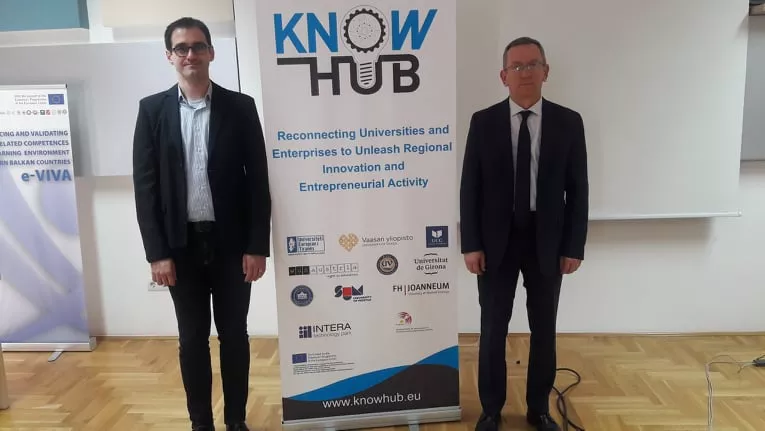
SARAJEVO, (Patria) - The KnowHub project was presented today at the Faculty of Mechanical Engineering. Implemented within the EU Erasmus+ program, with a budget of over 900 thousand euros, it aims to develop innovative capacities at Western Balkan universities. Three Western Balkan countries are participating in the project: BiH with three partners, Montenegro, and Albania, along with Austria, Spain, and Finland. The Dean of the Faculty of Mechanical Engineering in Sarajevo, one of the participants from BiH, stated that the goal of commercial hubs or technological innovation centers is to provide students with opportunities for innovative and entrepreneurial activities.
"The ultimate goal is to connect with the economy, which is the objective of technical faculties. The centers will be equipped with state-of-the-art technology. The reason is to interest the real sector so that they can collaborate. Students will have the opportunity within commercial hubs to develop their ideas and, if necessary, establish their own companies," said Bijelonja, adding that most students should graduate with an entrepreneurial spirit.
The project was initiated by the University of Applied Sciences from Graz, and Bojan Jovanovski, a lecturer at the University of Applied Sciences and KnowHub project manager, spoke about the project itself. It was emphasized that eleven partners are participating in the project.
"The project's focus is the development of three countries: Albania, Montenegro, and BiH. All other partners, Austria, Spain, Finland, and North Macedonia, are here to support development in these countries and to contribute their knowledge and experience to the project. From BiH, there are three partners: UNSA – Faculty of Mechanical Engineering, the University of Mostar, and INTERA Technology Park Mostar," said Jovanovski.
The project aims to connect the region and foster cooperation to develop existing capacities. Ten students each will visit the established centers to gain the necessary knowledge and experience. Furthermore, results of KnowHub will be measured through pilot projects.
"We will have at least three pilot projects each. Every university in the Western Balkans will have three companies that will come and present their problems as case studies. University professors, together with students, using the new equipment to be purchased within the project, will work to solve these real-world problems. Experience shows that such projects are significant for the development of industry, and even more so for the development of universities and students who acquire knowledge that they can implement after graduation," explained Jovanovski.
The project formally began in November 2019, and the first phase included an analysis of the situation at universities and their capacities and cooperation with the economy.
Dean Bijelonja emphasized that the current system starts teaching students about entrepreneurship too late.
"We believe that students should already know why they are going to school, and especially at the university, as it is the final stage of education before they enter the workforce. Our main goal is to restore the connections we had when the economy was strong, and we are doing this on an individual basis. We have introduced the subject of industrial practice into the curricula of some departments. The goal is for students to go into industry so that it is not something foreign to them and to test the knowledge they gain here," stated Dean Bijelonja.
The Faculty of Mechanical Engineering has about 110 graduates annually whose final theses are in areas of interest to the real sector.
"We are not satisfied because it is not a systematic solution; it is reduced to the individual efforts of our teachers who seek out their acquaintances, our former students, in those companies to arrange internships there."
He pointed out that efforts will also be made to provide opportunities for good students to do internships during the summer break.
"For technical faculties, our industry, or the economy, must be the teaching base," said Bijelonja, adding that the project's goal is to create an environment where students will be satisfied with the aim of them staying in BiH.
"It is up to the faculties to create good staff, and it is up to the governments how to retain them," concluded Bijelonja.
In the consortium of this project, the knowledge providers are the University of Applied Sciences from Austria (FH JOANNEUM), which is the project coordinator, the University of Girona (Spain), and the University of Vaasa (Finland), along with the World University Service (WUS, Austria) and the National Center for Development of Innovation and Entrepreneurship Education from Macedonia. From the Western Balkan region, the project includes the University of Sarajevo, the University of Mostar, the University of Montenegro, the European University of Tirana (Albania), and the University of Vlorë (Albania), as well as the INTERA Technology Park Mostar.
More information about the KnowHub project and its implementation can be found on the project website: www.knowhub.eu.
Komentari (0)
Prijavite se za komentiranje
PrijavaJos nema komentara. Budite prvi!
Minuta
Sve →Iz drugih kategorija

High Representative Not Elected: Germans, French and British Sabotaged Americans, New Attempt at End of June

ČOVIĆ WITHOUT MERCY: How Those Who Brought Ademović to Office Created a Political Hell for Him



Sunny Saturday, quite warm



Tragedy in Albanian resort: Two minors drown












