
By Armin Sijamić
Student protests in Serbia have been ongoing for almost six months and have so far brought down the government, but not the rule of Aleksandar Vučić. In defense of his power, which refuses to meet the demands of students and the citizens supporting them, Vučić has decided to form a new government of Serbia, to be led by Đuro Macut.
When citizens and students took to the streets, after fourteen people died in the collapse of the canopy of the renovated railway station in Novi Sad, and that number later grew, few could have imagined that it would threaten the position of Aleksandar Vučić and his Serbian Progressive Party (SNS).
Those who wished for the end of Vučić's rule were convinced that it would happen because of his policy towards Kosovo, or his (non)alignment in the conflict between the West and Russia. The opposition had been unsuccessfully trying to exploit the cracks in these Vučić policies for years.
Those who analyzed the situation in Serbia were convinced that the decisive moment for Vučić's fall would be external pressure and policy towards Kosovo. No one among them even thought of students.
In a few months, students have disrupted the plans of the authorities and the opposition. They toured Serbia, held rallies, protests, blockades, and awakened their sleeping fellow citizens, freeing them from the fear of the regime. The authorities' bewilderment in the case of the students is shown by the fact that they tried to copy the students' actions, which was an own goal. If Vučić could openly align with Russia, it would not be surprising if, copying students who cycle to Strasbourg, he ordered his supporters to walk to the Kremlin.
Endocrinologist in politics
The bewilderment of the opposition, and some claim that part of the opposition works for the authorities, gives Vučić room to receive support from the West and Russia. The opposition sometimes waves Russian flags, and sometimes seeks help from Brussels. The rally organized by students on March 15 was a message to the authorities and the opposition.
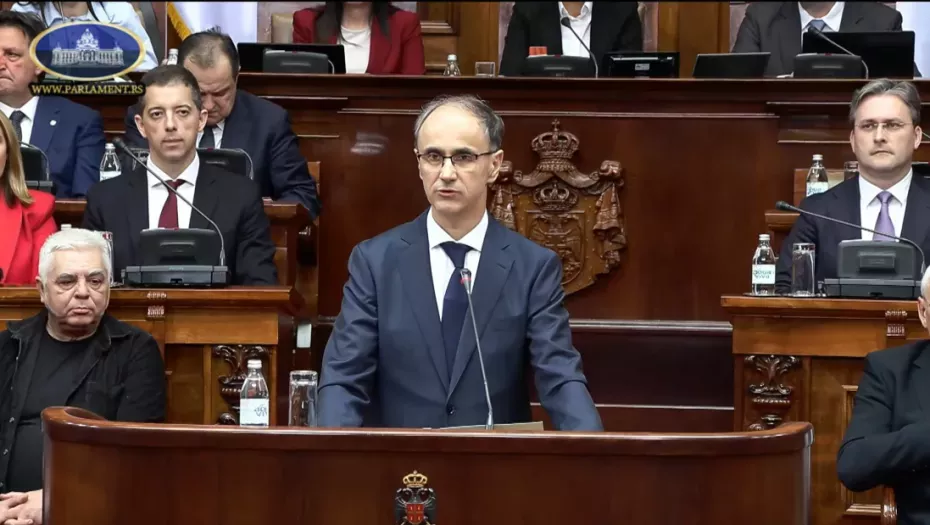
Therefore, the new government of Serbia is a forced maneuver by Vučić. Đuro Macut, a publicly little-known figure and a recognized expert in endocrinology, has been chosen as prime minister. Macut is also one of the founders of a movement that Vučić intends to activate, which could perhaps be a replacement for the SNS.
During the parliamentary debate on the appointment of the government, opposition leader Zdravko Ponoš said that Macut, with his credentials, is suitable to be a hospital or clinical center director, but not a prime minister. Ponoš is probably right. But that doesn't mean Macut will only deal with healthcare. Mandate holder Macut stated in his exposé that his priority will be to establish the normal functioning of schools and faculties, which is essentially an announcement of a showdown with students and their striking professors.
Proof that he has chosen a side is his appearance in the center of Belgrade in the camp of "students who want to learn", which, according to the opposition, has few students. This task alone is too much for someone who has dedicated his life to medicine, as Serbia is in a state of popular rebellion and on the verge of conflict.
New and old ministers: Stanković, Bratina, and students
Starting this week, students began blocking the public media service of Serbia, namely the television of Serbia and Vojvodina. They demand that the media operate professionally, or be shut down. Radio Television of Serbia (RTS) is particularly targeted, with its premises surrounded by police and students for days.
RTS has thus become an important battle in the war between the authorities and the students. It seems that the students have already won, as Macut, or Vučić, made a strange choice for the two relevant ministers – education and information.
The new Minister of Education is Dejan Vuk Stanković, who, as a political analyst, stated that he would use force against students. In addition, there have been accusations that Stanković, as a professor at the Faculty of Teacher Education and Educators in Belgrade, sexually harassed female students.
The new Minister of Information and Telecommunications is Boris Bratina, a professor at the Faculty of Philosophy of the University of Priština, which has been relocated to Kosovska Mitrovica. Bratina is publicly known as a member of the SNP1389 association, which recently merged with the Naši movement. SNP1389 advocates for the "unification of all Serbian lands", denies the genocide in Srebrenica, seeks an alliance with Russia, and views the West as the embodiment of evil. Videos circulating on social media show Bratina burning the flag of the European Union.
Although some believe that Bratina is a replacement for Aleksandar Vulin, who was removed from the government, and that this is another trick by Vučić to attract the right wing, it should be noted that the President of Serbia recently said that Macut's government will continue Serbia's European path, whatever that may mean.
Some ministers remained from the previous government. Marko Đurić will continue to be the Minister of Foreign Affairs, Ivica Dačić the Minister of Police, Dubravka Đedović Handanović the Minister of Mining and Energy, Bratislav Gašić the Minister of Defense, Zlatibor Lončar the Minister of Health, and Nikola Selaković the Minister of Culture.
Rallies in Belgrade and Novi Pazar – two policies
The formation of the government had a prelude. Vučić brought people from all over the Balkans to Belgrade, whose massive turnout was intended to demonstrate his popularity. Serbian media claim that some were paid to attend, and food, drinks, and concerts were provided... Nevertheless, the rally on April 11 was not Vučić's victory, as there were far fewer people than at the rally on March 15. In a kind of popularity contest, the students won, but Vučić again showed that he has a team that can gather diverse people.
It should be noted that Vučić admitted that stratification is occurring in Serbia and that he is looking for new voters. The fact that Baja Mali Knindža "entertained" the attendees and that Milorad Dodik gave a speech shows that Vučić is counting on the support of Serbs from Croatia, Bosnia and Herzegovina, and Montenegro. Since citizenship has been distributed to Serbs outside of Serbia in recent years, a large number of votes in the next elections may come from abroad. The title of the rally in Belgrade was "We will not give up Serbia".
The students, on the other hand, organized another rally. This time in the predominantly Bosniak city of Novi Pazar. The hosts warmly welcomed the students, and tens of thousands of people took to the streets. Another defeat for Vučić, or rather for the radical and nationalist policy that spread death and destruction throughout the region in the nineties, were the scenes from Novi Pazar – young people born shortly before Vučić left Vojislav Šešelj's party, trying with every move to erase divisions.
The fact that the students succeeded in this is also shown by the fact that there were not many reactions in Serbia to a banner that appeared in Novi Pazar, attributed to Bosniak "nationalists" and "autonomists". People from Pazar wrote on social media that the banner was placed near the police station.
Macut's task and the students' loneliness
Some see Macut's government as a continuation of the previous one. What he stated in his exposé proves this. However, Macut must resolve some things urgently. Student protests are ongoing, even though Vučić declared victory over the "color revolution". Their demands from November have not been met. The case of the public media service indicates that the list of demands can be expanded, and if the students are successful, it is only a matter of time before other dissatisfied groups join the strike and rebellion.
Vučić is counting on the protests to subside and for elections to be held at some point. Macut's task is to prepare for those elections, i.e., to lead the government until the elections. In elections under the current rules, no one has a chance against Vučić, so the question is whether the opposition will participate.
But, essentially, Vučić has no idea how to get out of the rebellion that began in November. It is completely clear that hundreds of thousands of people at the rallies have told the current authorities that they do not want them, which also applies to opposition parties. The lack of protest leaders allows Vučić to stay in power, and for his party to achieve good results in potential elections under the current rules.
Therefore, Vučić has resorted to the old recipe of the authorities in Belgrade – export and internationalization of the crisis. His relationship with Dodik and the attack on the constitutional order of Bosnia and Herzegovina indicate that this is another card in his hand. At the same time, the lack of a strong opposition in Serbia gives him room to present himself to foreign powers as a guarantor of stability in the Balkans. The recently elected European Commissioner for Enlargement, Marta Kos, has taken the bait.
At the end of last month, Kos defended Brussels' approach to Serbia. "Who should I talk to then..., ...that Serbia remains on the European path," Kos replied to a journalist's question about meeting with Vučić four days after the March 15 protests, during which, according to participants and the opposition, some kind of sonic weapon was used against those present.
In that interview, Kos said that "what the demonstrators and students are asking from Serbia is the same as what the European Commission is asking from Serbia" and that Belgrade, among other things, must urgently move to change the situation in the media. This means that Bratina will be a conversation partner for the European Union, after the Chetnik duke Andrija Mandić had previously become acceptable on Montenegro's path to Brussels.
The West's silence on the protests in Serbia pleases the Kremlin. Vučić involved the FSB in the investigation of the alleged use of the aforementioned sonic cannon. The Russians concluded that nothing similar was used on March 15. Russia is not entirely satisfied with Vučić's policy, so it uses opportunities to get even closer to him.
Students have not forced Brussels to get closer to them. It seems that Brussels is again choosing leaders over citizens in the Balkans. The students' loneliness helps Vučić. The fact that Vučić has not broken them in almost six months speaks to the decline in popularity of a politician who has ruled Serbia for thirteen years with the help of the West and Russia.
Komentari (0)
Prijavite se za komentiranje
PrijavaJos nema komentara. Budite prvi!
Minuta
Sve →Iz drugih kategorija

High Representative Not Elected: Germans, French and British Sabotaged Americans, New Attempt at End of June

ČOVIĆ WITHOUT MERCY: How Those Who Brought Ademović to Office Created a Political Hell for Him



Sunny Saturday, quite warm



Tragedy in Albanian resort: Two minors drown












