
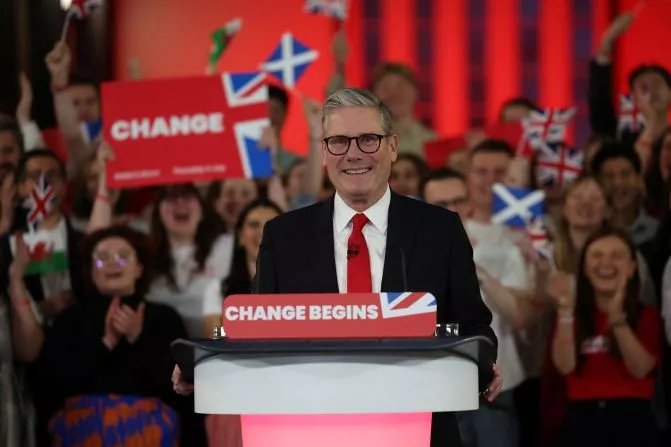
By Armin Sijamić
After fourteen years, the Labourists will return to power in the United Kingdom, and Keir Starmer is likely to be the new Prime Minister. The poor result for the Conservatives is not surprising. It is a consequence of events in the last ten years, which include Brexit, coronavirus, and numerous government changes.
The Conservatives performed so poorly in the polls that it was only a question of by how much they would lose. Since May 2021, polls have shown that the opposition Labourists are significantly more popular than the ruling Conservatives. In addition, it was a question of whether the Labourists would need a coalition partner to have a majority and how many votes other parties would receive, including Nigel Farage and his Reform UK party.
The Labourists, who in recent years have been wavering between the legacy of Tony Blair and his “Third Way” and the legacy of Jeremy Corbyn, the party leader from 2015 to 2020, only had to wait for the collapse of the Conservatives, whose governments over the past fourteen years were led by David Cameron, Theresa May, Boris Johnson, Liz Truss, and finally the current Prime Minister Rishi Sunak.
The Conservatives led the country out of the European Union after the 2016 referendum, and then-Prime Minister David Cameron was probably the only British official who changed his stance on Brexit from month to month. After that, the Conservatives stumbled from one mistake to another, but the divided and lost Labourists did not capitalize on it.
Four years later, Theresa May finalized Brexit with numerous economic difficulties and political consequences, only for Johnson to fall from one scandal to another, leading the country through the coronavirus pandemic and the beginning of the war in Ukraine, which, according to some claims, could have ended very quickly if the British Prime Minister had not convinced the official Kyiv to abandon that plan.
The policy pursued by the Conservatives is also indicated by the fact that Truss was at the head of the country for less than two months, and twenty months ago Sunak came to power to save what could be saved, especially focusing on the state of the economy and illegal immigration. Local elections this year showed that this would be very difficult, as the Labourists also showed they were stronger in them compared to previous elections.
Historic Result
Sunak failed, as preliminary results show, according to which the Labourists won as many as 410 seats in parliament out of a possible 650. Sunak's Conservatives won only 131, which is the worst result for the party since World War II, a party that was characterized by a stable voter base for years. Compared to the last elections, the Labourists gained 209 seats, and the Conservatives lost 241.
In addition to the two largest parties, the Liberal Democrats won 61 seats, Reform UK 13, and the Scottish National Party (SNP) ten. The Liberals gained 53 more seats than in the previous elections, the right-wing Reform UK gained 13, and the SNP lost 38 seats. Farage assessed his party's result as good and as a “revolt against the establishment.”
The convincing victory of the Labourists is even more impressive given that five years ago, Conservative Prime Minister Johnson defeated Corbyn by the largest margin since 1987. And Corbyn ran in these elections as an independent candidate, suspended from the Labour Party in 2020 due to antisemitism, and convincingly won in his constituency, winning 49 percent of the vote.
New Prime Minister and Not So New Policy
Although in British politics the Labourists are considered the left, as their name suggests, Starmer's Labourists are not. This former lawyer, who was part of the Croatian team before the International Court of Justice in The Hague in the lawsuit against Belgrade for genocide, has moved the party towards the center, essentially aligning with Blair's ideas, which some see as the end of European social democracy. Starmer has completely neutralized the left wing of the once left-wing party.
But it should be noted that at a time when right-wing parties, even extreme ones, are strengthening in the rest of Europe, in the United Kingdom, the center-left is achieving victory with excellent results from the liberals.
Starmer, who holds the title of “Sir” bestowed upon him by Queen Elizabeth II, is a proponent of the middle way, and the main British policies will not change. What Starmer has changed is the party he leads, and his statement after the announcement of the first exit poll results last night confirms this: “To everyone who worked for the Labour Party in this election, to everyone who voted for us and placed their trust in our reformed Labour Party. Thank you.”
In recent years, Starmer has suppressed the influence of Corbyn's faction and his policies, which the media have labeled with terms such as radical left, populism, and antisemitism. British commentators say that Starmer has dealt with antisemitism in the party, which is particularly important for a party that has had such incidents associated with it in the past. However, conflicts over Israel and Palestine have continued within the party, leading Starmer to suspend some members.
At the same time, Starmer has moved the party closer to Israel, giving support in the war against Hamas, even the right to cut off electricity and water supply in the Gaza Strip “in accordance with international law.” The issue of Palestine in November led to divisions in the party when 56 Labour members supported the SNP's motion for a ceasefire in the Gaza Strip. Starmer sided with Sunak, arguing that Gaza needs a “sustainable truce.” Gaza, according to the BBC, affected Labour's results, as they received seven percentage points less in some areas with more than ten percent Muslim population.
Starmer has focused criticism on economic problems. He addressed the state of public healthcare, which suffered under the Conservatives, green and sustainable energy, with rising energy prices due to Russian aggression in Ukraine providing a tailwind, then education, infrastructure, workers' rights, reform of the House of Lords, crime... All of this policy is framed in several short messages, such as “stop the chaos,” create “opportunities for change,” and “renew Britain.”
Everything indicates that there will be no changes in the United Kingdom's foreign policy, although Starmer previously stated that a new referendum on Brexit should be held. In the coming months, he and his government must act urgently and justify the enormous trust of the citizens, who voted for them out of revolt and against the Conservatives.
Komentari (0)
Prijavite se za komentiranje
PrijavaJos nema komentara. Budite prvi!
Minuta
Sve →Iz drugih kategorija

High Representative Not Elected: Germans, French and British Sabotaged Americans, New Attempt at End of June

ČOVIĆ WITHOUT MERCY: How Those Who Brought Ademović to Office Created a Political Hell for Him



Sunny Saturday, quite warm



Tragedy in Albanian resort: Two minors drown












