
By Armin Sijamić
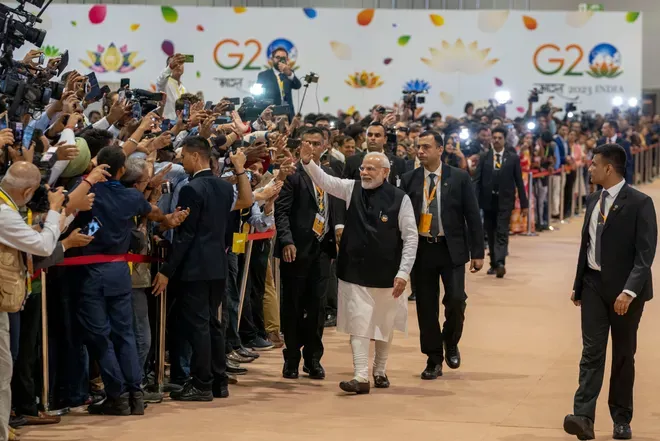
At the G20 summit held in India at the beginning of this month, the idea of establishing an economic corridor connecting the world's most populous country, via the Middle East, to Europe was announced. Although it is not yet clear what the project will look like, there are already those who see it as a threat. The announcement of the project made it clear that it would be a competitor to two other similar projects that are in advanced stages of implementation.
The President of the United States of America, Joseph Biden, announced at the G20 summit that the project for rail and maritime connection between India and Europe is moving forward, with Saudi Arabia being one of the key links. India and Saudi Arabia discussed this separately, and later the European Union came out in support of the project. The agreement has already been named IMEC, as an acronym for India, Middle East, Europe, and Corridor.
The cost of the corridor and the time it will take to establish it are unknown, but its contours, i.e., its geopolitical character, are already almost entirely known. American strategists intend to connect Europe and India, and consequently their numerous allies. The envisioned corridor should run from Greece, through Cyprus, Israel, Jordan, Saudi Arabia, the United Arab Emirates, and the Arabian Sea to the coasts of India.
Riyadh announced that it will invest twenty billion dollars in the corridor, and the President of the European Commission, Ursula von der Leyen, said that the corridor would speed up trade between Europe and India by forty percent, calling it a "green and digital bridge across continents and civilizations".
American Settings
In this way, American strategists want to strengthen the positions of their allies, further tie India to the West, and "force" Saudi Arabia to normalize relations with Israel, which is simultaneously trying to implement joint projects with Cyprus and Greece and thus connect with Europe.
All countries that would be part of the corridor would benefit significantly, as in addition to transport fees, they would have the opportunity to connect economically, open new companies closer to large markets, and increase their geopolitical importance. Along the railway route, a hydrogen pipeline, electricity infrastructure, and telecommunications are planned, which practically means that even the most remote points could become economically attractive.
In addition, this is a blow to China's "Belt and Road" initiative, which aims to connect Europe and the world's second-largest economy, and to Beijing's desire to establish itself as an important factor in the Middle East through ties with Riyadh and Tehran. At the same time, it is a blow to the Russian-Iranian "North-South" corridor, which aims to connect Russia, via Iran, to the Persian Gulf and further to India.
Saudi Arabia and the UAE would not agree that this is a blow to the "Belt and Road", as they are envisioned as central points in connecting Europe and China in the Chinese initiative. However, if the West refuses to participate in that project and IMEC continues to develop, then the two Arab countries will become the "terminal stations" of that corridor and will have to redefine its purpose.
In past times, such corridors would have been considered, above all, an opportunity for economic development. Today, when the West and Russia are clashing in Ukraine, and the West and Beijing are clashing in China's backyard, the announced connection between India and Europe is a blow to competing projects, but of course also an important economic initiative that will contribute to the development of the interested parties.
"This is a big deal, a really big deal," Biden said, adding that the world is at a "historic turning point," and the decisions made regarding the corridor "will shape our future for decades to come."
Resistance and Obstacles
In all three envisioned corridors, except for the Chinese one, India is gaining, and will likely work on implementing both. India wants to become the "factory of the world" and take that position away from China, which will face a huge decline in its working-age population. In addition, China's economy is changing and increasingly moving into the field of high technologies, so this opportunity is opening up for India.
The West's desire to discipline China is an opportunity that India does not want to miss. The agreement signed this summer by Biden and Indian Prime Minister Narendra Modi indicates that New Delhi wants to play that card, despite cooperation with China through several organizations led by Beijing and Moscow.
The collapse of the "Belt and Road" would not be good news for China, and Beijing will oppose it in various ways. However, China is not the only one that the connection between India and Europe could harm.
One of the countries for which this project is a problem is Turkey, although Ankara's objections are of a different nature. Turkey wants not to be bypassed and is ready to participate. Turkish President Recep Tayyip Erdogan stated that "there can be no corridor without Turkey" and added that his country has been the most suitable route for connecting east and west for centuries.
Speaking to the Financial Times, Turkish Foreign Minister Hakan Fidan pointed out that experts doubt that the primary goal of this corridor is rationality and efficiency, suggesting that "more geostrategic concerns" are at play. Fidan believes that this "trade route is not just about trade. It is also a reflection of geostrategic competition."
In response, according to Turkish officials, Turkey will soon present its corridor that will connect the country, via Iraq, with Qatar and the United Arab Emirates.
This is practically the fourth corridor offered to the countries of the Middle East, and its route shapes regional geopolitical blocs. Thus, one of the biggest losers could be Egypt, whose Suez Canal loses importance with the realization of any of these four corridors.
Growing Divisions
So many rival projects in the economic sector in just one region (the Middle East) shows that the rivalry between the West and rising powers is spreading to all areas, similar to the Cold War when ideological, economic, cultural, and military clashes were fought through proxies.
This proves the importance of the statement by United Nations Secretary-General Antonio Guterres from the G20 summit, who said that the future of the world is multipolar, which he finds worrying.
Just thirty years ago, the world witnessed the triumph of one power (the United States of America) after the collapse of the USSR; just twenty years ago, it witnessed calls from all sides to build the future on new foundations and in cooperation among all states, and in recent years, major powers have been working to align themselves into blocs. It is clear that the world is changing rapidly and that major powers have different plans that make even the near future increasingly difficult to predict.
Komentari (0)
Prijavite se za komentiranje
PrijavaJos nema komentara. Budite prvi!
Minuta
Sve →Iz drugih kategorija

High Representative Not Elected: Germans, French and British Against Americans, New Attempt at End of June

ČOVIĆ WITHOUT MERCY: How Those Who Brought Ademović to Office Created a Political Hell for Him



Sunny Saturday, quite warm



Tragedy in Albanian resort: Two minors drown












