
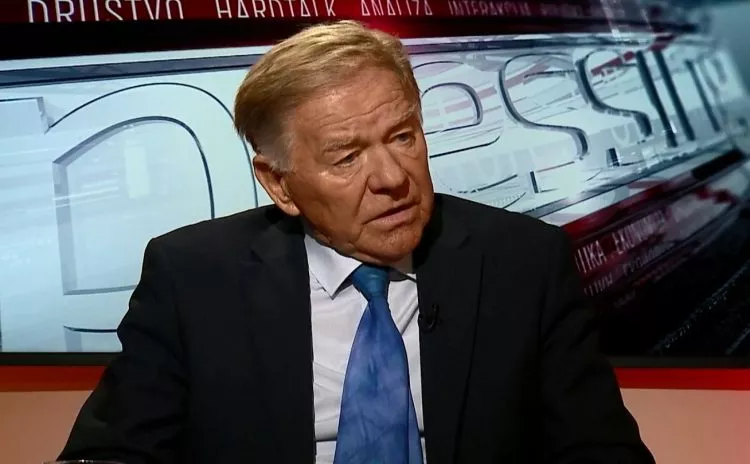
SARAJevo, (Patria) - Ivo Komšić, Doctor of Philosophy, former Mayor of Sarajevo, has analyzed the media appearances of the Russian Ambassador to BiH, Igor Kalabukhov, who, as a kind of spokesperson for the Kremlin, announces how far Putin will go in the war in Ukraine. In this context, assessing the impact on BiH and the Balkans is inevitable.
In BiH, a country within Russia's zone of influence, but still on the periphery of the aggression against Ukraine, Putin's ambassador, Igor Kalabukhov, gave an interview to the local television station FACE TV, hosted by Senad Hadžifejzović. Kalabukhov clearly underestimated the experienced journalist who, in a relaxed atmosphere, as if at a casual gathering, stated things he might not have intended to. In fact, he provided answers to the most important questions being asked today. Let's start with why BiH and Croatia are in the spotlight, even though they are on the periphery of the conflicts and do not belong to the 'Russian world'.
The answer to this question is understandable only from the perspective of Putin's war ideology. Both countries are in the same geopolitical space as Serbia, a country of Orthodoxy, and Orthodox Christians live in both. They are part of the 'Serbian world', and that is the 'Russian world'. According to the latest memorandum of SANU, the western borders of that 'world' are those from the last war, Virovitica-Karlovac-Karlobag. The 'Russian soul' is being saved there too.
Therefore, the thesis that Ukraine was attacked because it wants to join NATO, or because it wants to join the EU, is false. That is just a pretext. In Ukraine, the 'Russian soul' is being saved, and that is much more than membership in some alliance or any pragmatic-political gain.
The soul cannot be quantified, nor can it even be politicized because it is above any political idea. When the soul is invoked in Slavic tradition, as in phrases like 'I swear on my soul', 'my soul', 'of good soul', it signifies more than goodness and morality, more than an oath, more than devotion, more than trust. The same applies to opposites: 'enemy' (dušmanin), 'soulless' (bezdušan) – this is more than enmity, because an enemy with a soul can be less dangerous than a friend without one. Especially when 'soul' takes on a special meaning if it is a national soul, if it contains the historical-cultural substance of a nation. This is about the 'Russian soul'. According to Kalabukhov, Putin is saving the 'Russian soul' with the 'special military operation' in Ukraine; Ukrainians are Russian brothers, along with Belarusians – they are the same souls. It's about the soul, and it must be saved. The ambassador persistently repeated in his statement: 'Russia is not waging war in Ukraine, it is liberating the Ukrainian people', liberating the 'Russian soul' of the Ukrainian people because that 'soul' is possessed by the values of Western civilization.
For Putin, the problem is that Ukrainians have lost their soul, which is not just theirs, it is also Russian, it is the same soul. Russia cannot allow the Russian soul to disappear, to dissipate, to lose its substance. If a people loses its soul, it loses itself, it has no future. The task of Putin's generation is to save the 'Russian soul', to ensure its future. According to the ambassador, 'we cannot overcome the Russian soul', which means it must be saved at all costs. This is the 'historical task of a generation', i.e., the current leaders of Russia, led by Putin. An entire generation must commit itself, it must sacrifice itself for future generations – Kalabukhov constantly emphasized this generational historical task.
The 'Russian soul' is, according to the ambassador, the foundation of Russian civilization, and it is being saved in Ukraine. The Ukrainian soul is in 'foreign hands', it needs to be torn from them and returned. This issue 'must be cleared up', Putin has taken on 'historical and human' responsibility to 'clear up this issue for future generations'.
The West, which wants to 'culturally destroy Russia', must be stopped, claims Kalabukhov. When this is 'cleared up', when this is resolved, 'new impetus will be given to establishing a new system'. This will be a 'new structure' from which Russia's relationship with the world will be determined. That 'new structure' is a new Russian civilization, with a new 'Russian soul'. Therefore, Putin is not waging war against Ukraine and the Ukrainian people in Ukraine; they are merely collateral victims. The war is being waged against Western civilization, embodied in the EU and NATO. Both of these associations are enemies that must be destroyed.
The answer to the question of how far Putin will go in Ukraine is clear. Until NATO and the EU are destroyed. That is what Putin's ambassador said, and that is the real information for NATO and the EU. From that intention, an answer to Putin's aggression against Ukraine should also be given. The 'Russian soul' is threatened as long as NATO exists and its pretensions to Russia's surroundings. And that includes all 'Soviet states', which is the framework Putin has outlined. According to the ambassador's statement, Ukraine is merely a platform for 'saving' other 'Soviet states' from the West and its civilization. Because, as the ambassador said: 'What culture does NATO give you?', 'it brought you corruption and crime through Western investments'. All those under that influence remain 'soulless', they need to be liberated.
Putin will determine the order of liberation. Now it is Ukraine's turn. 'How do you know we don't have plans for Croatia, Poland, and Hungary?', the ambassador blurted out with a counter-question to the host. He then corrected himself and softened his stance by saying that NATO is the enemy and that Russia has a plan for NATO. Therefore, Putin knows what to do with NATO, but does NATO know what to do with Putin? NATO has surrounded Russia and is carrying out 'de-Russification' of these countries, and that is dangerous, it must be prevented. The conflict is a conflict of civilizations, and such conflicts in the past were waged until extermination. Sanctions imposed by the West are also part of the attack on Russian civilization. For Putin, therefore, the West is already at war with Russia, but it does not yet know or take it seriously. Putin understands. 'The entire Europe is on Russia's enemy list because it imposed sanctions,' the ambassador will state. Moreover, Europe is not as responsible for this as Washington is. According to the ambassador, Washington is preventing the development of a strong Europe, it does not allow Europe to be tied to Russia; that is the strategy of the USA. The USA wants to tie Europe to itself, it wants to isolate Russia and surround it with NATO forces.
Thus, in a few steps, Russia's goals are clear.
First, Kalabukhov revealed that Putin will carry out his 'special military operation' in Ukraine until final victory. That victory means forcing Ukraine to negotiate through a 'scorched earth' strategy, where it will accept capitulation and the independence of the self-proclaimed republics of Donetsk and Luhansk. As for Crimea, according to the ambassador, there are no negotiations about it; Crimea is definitively Russian.
Second, Putin will wage war until he brings former 'Soviet states' (Kalabukhov's term) back under Russian control. In other words, the war will not end in Ukraine. Putin wants to restore the borders of Soviet Russia, a powerful empire of the 'Russian world'.
Third, Ambassador Kalabukhov revealed what had been suspected behind all of Putin's 'special actions' so far, and that is their legitimizing ideology. The ideological basis and its breadth reveal the breadth of the 'special military actions' through which it is being realized. Therefore, it is not a war for territories, natural resources, economic dominance, some prestige, or domination. It is about something higher, and all these pragmatic-political reasons are merely pretexts. The ambassador formulated that ideology simply, without extensive theoretical explanations, as saving the 'Russian soul'. With this synthesizing and understandable term, he avoided a broad discussion about the 'Russian world', about the 'holy Russia' of Orthodoxy, about the divided Russian people, about 'Novorossiya', about a unified Russian culture, Russian civilization, etc.
Komentari (0)
Prijavite se za komentiranje
PrijavaJos nema komentara. Budite prvi!
Minuta
Sve →Iz drugih kategorija

High Representative Not Elected: Germans, French and British Sabotaged Americans, New Attempt at End of June

ČOVIĆ WITHOUT MERCY: How Those Who Brought Ademović to Office Created a Political Hell for Him



Sunny Saturday, quite warm



Tragedy in Albanian resort: Two minors drown












