
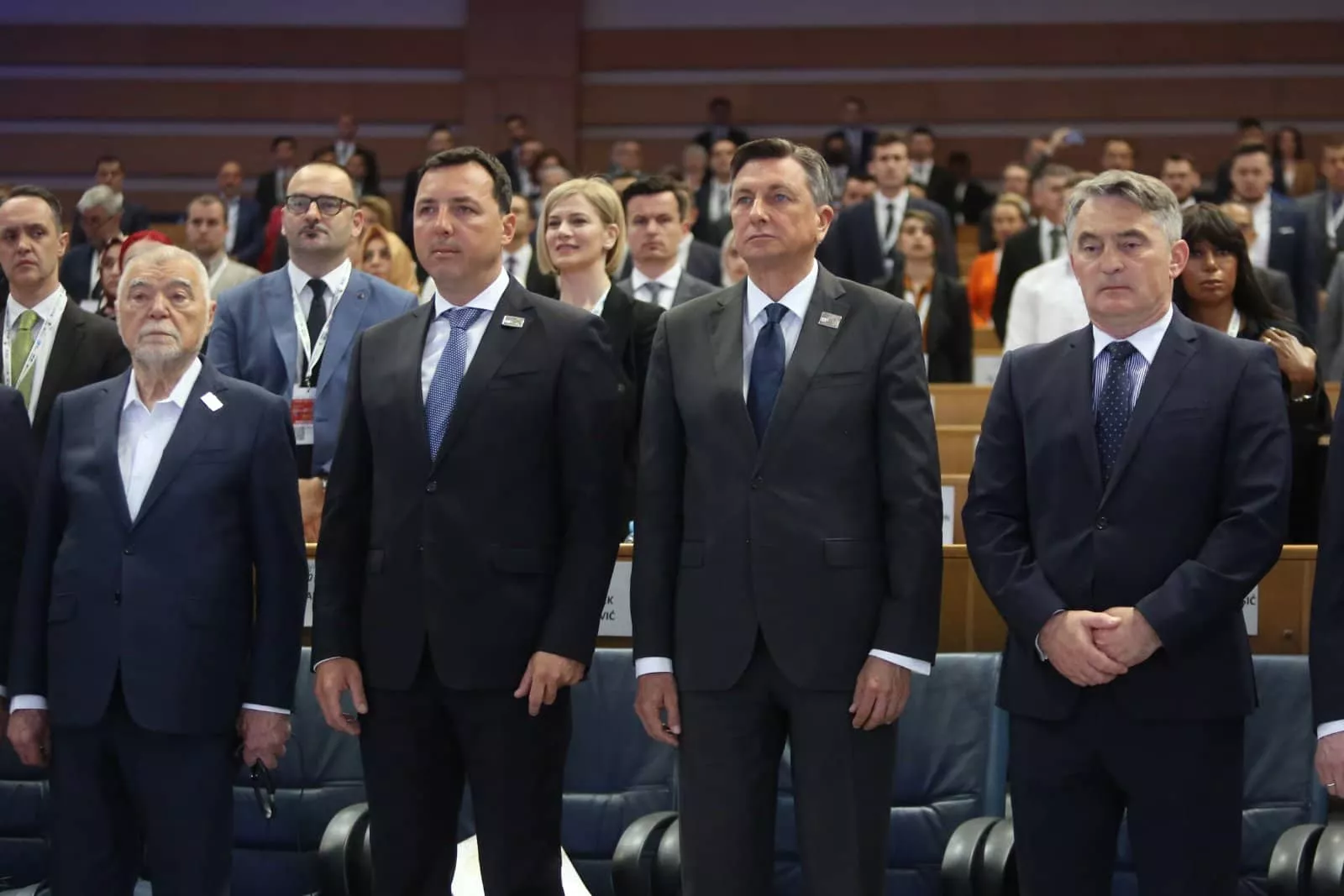
SARAJEVO, (Patria) - Member of the Presidency of Bosnia and Herzegovina Željka Komšić addressed guests and high dignitaries at the opening of the 11th Sarajevo Business Forum, who are staying in Sarajevo on the occasion of this business event.
"I am pleased that we have the opportunity, two difficult years after the outbreak of the COVID-19 pandemic, to gather businessmen and government representatives at the Sarajevo Business Forum, in order to jointly find answers to the challenges that have emerged before us in the new circumstances. I am very glad that the tradition continues, as the Sarajevo Business Forum has positioned itself as one of the most important business and investment events in Southeast Europe.
My colleague, the Chairman of the Presidency of Bosnia and Herzegovina, Mr. Šefik Džaferović, was scheduled to address you at today's meeting. However, due to an urgent trip to New York and attendance at a UN Security Council session, we agreed that I would address the gathering on this occasion.
I will not talk to you about economic parameters and business trends, because you, who are directly involved in economics and investments, know more about them. Therefore, with this address, I want to present some key commitments and priorities of Bosnia and Herzegovina, which arise from our international obligations. I also want to touch upon some global challenges that we must consider.
The European perspective of the entire region and our desire to align our economic and administrative systems with the standards of the European Union have set a framework within which we have chosen to implement reforms and build the foundations of stability and prosperity. Creating an investment-friendly environment must necessarily rely on eliminating superfluous bureaucratic procedures and effectively fighting corruption.
However, in addition to these key elements, I am convinced that the entire region must overcome irrational political aspirations from the past that lead to destabilization and turn towards the future, increasing economic growth, social standards, and thus preventing the departure of the active workforce. The path that is necessarily imposed as the only logical one is the path of regional cooperation and bringing standards closer to the largest and closest market, the European Union. I believe that in this way we can be more competitive and attract companies from around the world that want to have their springboard to the EU market in Bosnia and Herzegovina and the region. I believe that this region can be a bridge between the large markets of Europe and Asia. Several steps have been taken in this direction.
Bosnia and Herzegovina actively advocates for the Common Regional Market (CRM), established within the framework of the Berlin Process and elaborated at the Sofia Summit. Within this common regional market, we already have existing regional institutions that help the countries of the region apply the best EU practices and standards at the regional level, thus preparing for our further path of economic integration of the Western Balkans into the European market. I respect other initiatives, but I believe that priority should be given to those that have a structure, expertise, and an official coordination role.
Sarajevo is the headquarters of the Regional Cooperation Council – RCC, which actively provides planned support for linking the region in the areas of freedom of movement of people, research, development, and innovation. Also, the Central European Free Trade Agreement – CEFTA is actively working on harmonizing trade practices and eliminating barriers to trade and the provision of services. The Transport Community of Southeast Europe coordinates activities for the renovation and construction of the region's road and rail infrastructure, so that better connectivity facilitates the movement of labor and goods, but also improves traffic safety standards.
Finally, the Energy Community of Southeast Europe is there to coordinate activities on the implementation of obligations from energy reform packages on the liberalization of the energy market and the improvement of energy infrastructure, as well as the Green Agenda, which leads us towards the decarbonization of the energy sector. I want to dwell on this point for a moment and draw attention to the necessity of aligning strategic development goals and our obligations in the fight against climate change. In October last year, I participated in the COP 26 Climate Change Conference in Glasgow. In preparation for that conference, specialized teams for developing an energy transition plan, under the auspices of the Ministry of Foreign Trade and Economic Relations of BiH, estimated that approximately 17 billion KM needs to be invested in the energy transition by 2050, which is the deadline for decarbonization. I invite you, investors and businessmen, to participate in this major energy transition project in cooperation with our institutions. This amount of 17 billion KM represents a significant challenge, but also an opportunity for all investors in this sector. This includes investments in energy efficiency, development of the energy market, development of smart digital networks for managing electricity consumption, and increasing the construction of capacities and the use of renewable energy sources.
With the Sofia Declaration on the Green Agenda for the Western Balkans, we expressed a strong commitment to work together with the EU to create a climate-neutral Europe by 2050, as well as sustainable agriculture and food production.
However, we need a just energy transition that includes the shift from fossil fuels to sustainable and renewable energy sources, in a way that takes into account the rights and survival of workers who earn their living in this sector. Bosnia and Herzegovina is precisely such a country where an unprepared and rapid energy transition can create major social and economic problems. Therefore, it is important that the energy transition is accompanied by gradual programs for social protection, retraining, and ecological remediation of abandoned coal mines and pits.
In March 2021, the Council of Ministers of BiH adopted the Nationally Determined Contribution (NDC) of Bosnia and Herzegovina for the period 2020-2030. According to this plan, the unconditional target for reducing greenhouse gas emissions by 2030 is 12.8% compared to 2014, or 33.2% compared to 1990. As for coal exploitation, the conditional target for 2030 is a reduction of 17.5% compared to 2014, or 36.8% compared to 1990, with an emphasis on a "just transition" in mining areas.
Unfortunately, in addition to problems with the decarbonization of the energy sector, we are also facing an energy crisis and a food industry crisis, caused by Russia's aggression against Ukraine. Therefore, we must also consider that the war in Ukraine will further complicate relations in the global economy, especially in the energy and food industries. Therefore, we should also consider new energy routes and LNG terminals for liquefied natural gas in order to diversify supply.
In addition to the aforementioned two sectors, it is important to mention the potential of the defense industry in Bosnia and Herzegovina, and to support the film industry and the revival of tourism in Bosnia and Herzegovina and the region after the easing of health measures caused by the COVID-19 pandemic.
Finally, I would like to thank the organizers and strategic partners of the Sarajevo Business Forum for their determination to hold this event. I wish you successful work and many new business contacts and ideas," said Komšić.
Komentari (0)
Prijavite se za komentiranje
PrijavaJos nema komentara. Budite prvi!
Minuta
Sve →Iz drugih kategorija

High Representative Not Elected: Germans, French and British Against Americans, New Attempt at End of June

ČOVIĆ WITHOUT MERCY: How Those Who Brought Ademović to Office Created a Political Hell for Him



Sunny Saturday, quite warm



Tragedy in Albanian resort: Two minors drown












