
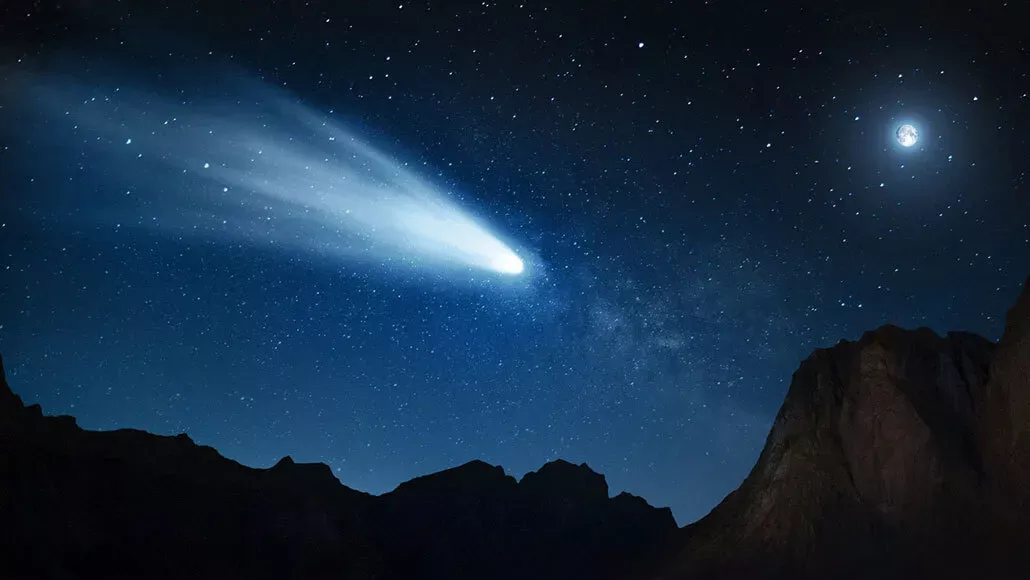
(Patria) - A comet not seen from Earth since Neanderthals inhabited the planet has reappeared in the sky, and astronomers say it could be visible to the naked eye.
Comet C/2023 A3 (Tsuchinshan–Atlas) was discovered by astronomers early last year and is thought to orbit the Sun every 80,000 years on a highly elongated path.
Dr. Gregory Brown from the Royal Observatory Greenwich says the comet is believed to originate from the Oort Cloud, located beyond Neptune's orbit.
"This is a huge, roughly spherical region around the Sun, containing icy remnants from the time the Solar System formed," the astronomer explains, as reported by RTS.
But now the comet is in our part of the universe. After approaching the Sun late last month, it is expected to approach Earth around October 13.
"The thing about comets is that the closer they are to us, Earth, the brighter they are, but also the closer they are to the Sun, the brighter they are.
So, when it's closest to Earth doesn't necessarily mean it will be best seen," Brown notes, adding that it could be closest to Earth around October 9.
#CometC2023A3 from Corpus Christi, Texas this morning. Such a beautiful comet I hope the brightness predictions come true!!#Comet #TsuchinshanATLAS @C2023A3 @BMcNoldy @SimonStormRider @NWSCorpus @TxStormChasers pic.twitter.com/8lVSA8Hoju
— Isaac G. (@Storm_Chaser_75) October 2, 2024
At that moment, however, the comet will be almost directly between Earth and the Sun. Because of this, the astronomer advises that the best time to look for the comet in the sky is a few days before and after that date.
"Naked-eye comets are rare enough, and this one has the potential to be among the brightest we've seen in decades. So it's definitely worth a try," says Brown.
Although, he adds, it is difficult to say with certainty how much brighter the comet will become as it approaches us.
"Visually, it should be visible to the naked eye in good conditions, and there's a chance it will become significantly brighter. But how bright? Honestly, we don't know," Brown states.
He also points out that stargazers in both the Northern and Southern Hemispheres have had the opportunity to see the comet already.
At this moment, he added, interested individuals should look east in the early morning before sunrise, towards the constellation Sextans.
But over the next few days, it will move to the other side of the Sun, so from October 13, there will be the best chance to see the comet late in the evening, after sunset, in the west, in the direction of the constellation Boötes.
Brown notes that the comet will likely appear as a smudge in the sky if viewed with the naked eye – although its tail should be visible with binoculars or a small telescope.
Even if its appearance isn't as spectacular as experts hope, stargazers can enjoy the knowledge that they are among the first to see a comet from the Stone Age with their own eyes.
Komentari (0)
Prijavite se za komentiranje
PrijavaJos nema komentara. Budite prvi!
Minuta
Sve →Iz drugih kategorija

High Representative Not Elected: Germans, French and British Against Americans, New Attempt at End of June

ČOVIĆ WITHOUT MERCY: How Those Who Brought Ademović to Office Created a Political Hell for Him



Sunny Saturday, quite warm



Tragedy in Albanian resort: Two minors drown












