
Written by: Mufid Garibija, graduate architect and connoisseur of Sarajevo's history
With the arrival of the Austro-Hungarians in Sarajevo in 1878, the Catholic community began to strengthen and grow. Although they also resided in the Ottoman era on the right bank of the Miljacka in a neighborhood called „Latinluk“ with their central parish church. The increase in the Catholic population prompted the then Sarajevans, along with the Austro-Hungarians, to build a new main parish church in Sarajevo. For this purpose, the authorities chose a location that would not in any way endanger other religious buildings, which were in close proximity due to the multi-religious mosaic of our city. Sarajevo was known for this then, and still is today. The site of the former Janissary military camp was chosen as the ideal location.
Before this, the current Cathedral, there was another one in Sarajevo, its ancient predecessor: St. Peter's Cathedral, founded in 1238.
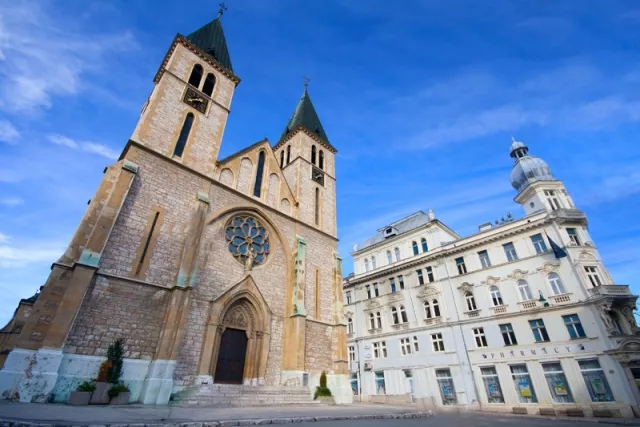
The construction of the new, large parish and at the same time the cathedral church - the Cathedral of the Sacred Heart of Jesus, was entrusted to architect Josip Vancaš, who built it in the early Gothic style, from hewn stone. Its pyramidal elongated roofs are covered with copper, and the two large towers of the Cathedral reach a height of 43 meters. The western tower houses a large bell weighing 2.5 tons, and the eastern tower has five smaller bells. Combined, they produce a sound well-known to every Sarajevan's ear.
The church can accommodate 1,200 believers
The Cathedral is 42 meters long and 21 meters wide, in plan it has the shape of a cross, and the vault in the main nave is 13.5 meters high. The church can accommodate 1,200 believers during mass. The facade of the Cathedral is dominated by a large rose window with decorative stained glass. The recognizable eight-petal rose window is also found on the coat of arms of the Canton of Sarajevo.
The main altar is made of marble, built by a company from Trieste, Italy. In addition to it, there are two side altars in the Cathedral: one dedicated to Saints Cyril and Methodius, and the other to the Immaculate Conception of the Blessed Virgin Mary. The frescoes were created by famous Roman masters who also decorated churches and chapels in the Vatican.
The church is richly decorated with statues, crucifixes, stained glass, frescoes, and other ornaments. These were donated by Catholics from many Bosnian cities, as well as from Croatia, Bohemia, and other countries.
It was precisely for the needs of the construction of this church that a horse-drawn tram was built from the railway station in 1884. This would also be the precursor to the famous Sarajevo tram, and the original route has been partially preserved to this day and is still in use.
Štrosmajer was a great donor
The Cathedral was completed and consecrated in 1889, and its great donor, Bishop Josip Juraj Štrosmajer, was present at its consecration. The popular street leading to the Cathedral square and the main entrance was named after this bishop. The Štrosmajer family had roots in Germany, and Josip was born in Osijek. He earned doctorates twice, in psychology in Budapest and in philosophy and canon law in Vienna. The well-known Sarajevo street leading to the facade of the Cathedral is named Štrosmajerova after him today.
The first major reconstruction of the Cathedral was carried out in 1932, on the fiftieth anniversary of the restoration of regular church administration in Bosnia and Herzegovina. The focus was on restoring the frescoes that had darkened due to oxidation. The second major renovation took place at the end of the eighties of the last century, and repairs were also carried out after the aggression against Bosnia and Herzegovina, as the building suffered some damage.
The Sarajevo Cathedral is the cathedral church where the Archbishop of Vrhbosna celebrates Mass for Christmas and other major holidays. In its immediate vicinity are the Catholic Faculty of Theology and the seminary, as well as the Archbishop's Residence, where Pope John Paul II stayed during his visits to Sarajevo in 1997 and Banja Luka in 2003. In his memory, his statue was erected in front of the Cathedral in 2014.
Komentari (0)
Prijavite se za komentiranje
PrijavaJos nema komentara. Budite prvi!
Minuta
Sve →Iz drugih kategorija

High Representative Not Elected: Germans, French and British Against Americans, New Attempt at End of June

ČOVIĆ WITHOUT MERCY: How Those Who Brought Ademović to Office Created a Political Hell for Him



Sunny Saturday, quite warm



Tragedy in Albanian resort: Two minors drown












