
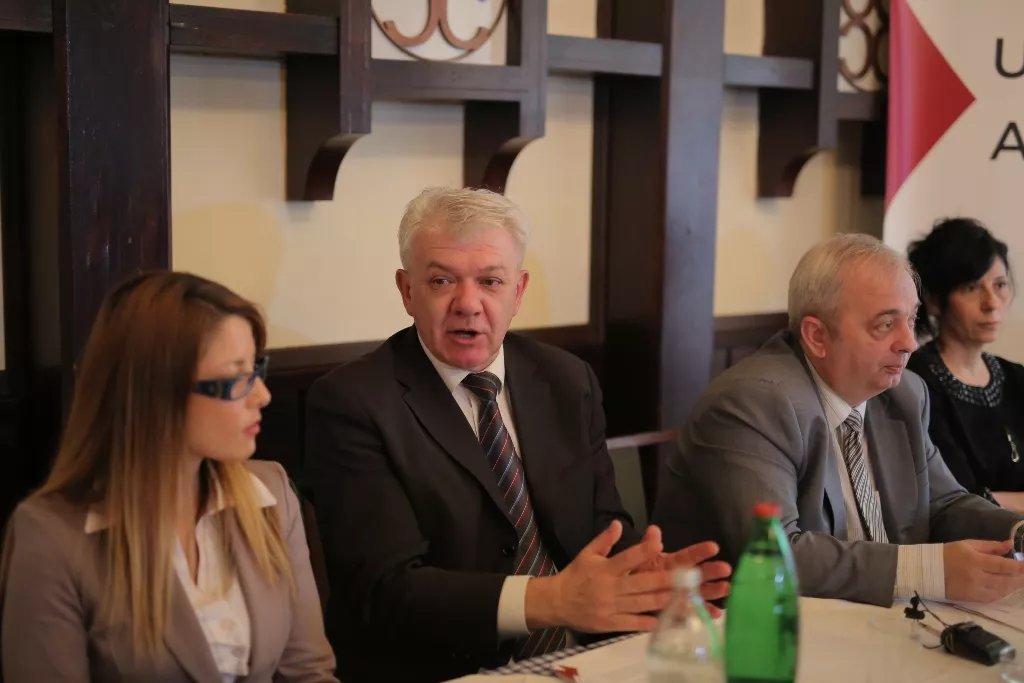
If the Federation adopts the amendments to the Law on Games of Chance as currently proposed, the FBiH budget will face significant negative consequences. First, there will be a decline in players' interest in playing at domestic legal betting shops, and they will turn to black market betting shops and foreign online betting shops where they will continue to play without paying any taxes.
This was warned by the director of the Association of Games of Chance Organizers from Serbia, Rade Karan.
The Law on Games of Chance in FBiH will be on the agenda of the House of Peoples of FBiH on September 15. It was previously adopted by the House of Representatives by a majority vote.
With the amendments to the Law on Games of Chance, the SDA wants to tax all players of games of chance at 10 percent upon deposit and 10 percent upon payout of any winnings. This taxation would apply to all players of games of chance, except for those who play on slot machines. Slot machines are only operated by Lutrija BiH. This will put domestic games of chance organizers, according to the owners of domestic betting shops, at a disadvantage compared to slot machines, which are owned by the Austrian company Novomatic, and which Lutrija BiH only rents.
- It is best to withdraw this extremely harmful and retrograde Bill on Amendments and Additions to the Law on Games of Chance in FBiH from the procedure - Karan believes.
What effects can private organizers expect if the proposed amendments and additions to the Law on Games of Chance are adopted in FBiH?
Karan: The essence of the announced amendments to the current Law on Games of Chance lies in the fact that taxation of all deposits at a rate of 10 percent, as well as taxation of all betting winnings, also at a rate of 10 percent, is being introduced. If such amendments are adopted, private organizers in FBiH, as well as the FBiH budget, will face significant negative consequences. First, there will be a decline in players' interest in playing at domestic legal betting shops, and they will turn to black market betting shops and foreign online betting shops where they will continue to play without paying any taxes.
This will inevitably lead to the closure of numerous betting shops, and even the cessation of operations of certain organizers, and ultimately to the loss of several thousand jobs.
There will be no increase in budget revenue from games of chance. On the contrary, the model of taxing games of chance as proposed in FBiH will lead to a drastic drop in budget revenues. Because it is harmful, such a taxation model is not applied almost anywhere in the world.
What are the European experiences with taxing games of chance? How is it regulated in EU countries?
Karan: When it comes to taxing betting winnings at a rate of 10 percent, we must emphasize that a similar tax does not exist anywhere in the world. For example, taxation of betting winnings does not exist at all in Great Britain, Germany, France, Italy, Austria, the Czech Republic, Estonia, Lithuania, Slovakia, Spain, Denmark, Ireland, Finland, Norway, Sweden, Belgium, etc.
The introduction of a 10 percent tax on all deposits is also contrary to European practice. Almost all European countries, when it comes to this tax, have adopted a model where gross income, i.e., the difference between total deposits and total payouts, is taxed at a certain rate. The model of taxing all deposits, i.e., taxing the entire turnover, has been abandoned because it simply does not function in the games of chance organizing business and is harmful to budget revenues.
From the total deposit, organizers are left with about 10 percent after paying out winnings, and this represents gross income from which taxes, salaries, rent, suppliers, utilities, telecommunications, etc., are paid. That is why developed countries have abandoned the tax on deposits, i.e., the turnover tax. Simply put, organizers do not live off deposits but off the difference between deposits and paid-out winnings. That is why the stories about enormous turnover in betting shops in FBiH are absurd.
In practice, it would be the same as if we collected all deposits in banks and arrived at a figure of several hundred billion and then applied a tax rate of 10 to 15 percent. Then FBiH or the state that applies such a model would be the richest in the world. However, the question arises whether anyone would pay through the bank at all? The answer is simple - no!
Citizens would not be able to pay a 10-15 percent tax on every transaction and would quickly abandon banks, just as will be the case with betting shops if the proposed legal measures are adopted.
The nature of the business in banks, insurance companies, or betting shops is such that the "same" money is turned over many times during the day or month, so the actual turnover in betting shops in FBiH is ten times lower than what some politicians present it to be.
Does a taxation model similar to the one advocated in FBiH exist anywhere?
Karan: Unfortunately, a similar model exists in Croatia. With amendments to the Law on Games of Chance in Croatia, a tax on all betting winnings was introduced less than two years ago. The consequences of applying that solution have been catastrophic. There has been an enormous drop in turnover in betting shops and, as a consequence, a drop in Croatia's budget revenues. Simply put, players have turned to places where there is no tax, i.e., foreign online betting shops, slot machines, and the black market. Croatia has recognized its mistakes and is preparing amendments to the law according to which it will better regulate its market, increase budget revenues, develop principles of competition without monopolies, prevent capital flight from the country, and increase jobs.
Unlike Croatia, where the legislator has not yet corrected its mistakes, we have the example of Montenegro. A little over a year ago, a legal solution was adopted there whereby all winnings from games of chance were taxed. After less than a year of its application, which led to a drastic drop in budget revenues, the Montenegrin Ministry of Finance admitted its mistake and sent a proposal to Parliament to abolish the harmful law. The Parliament of Montenegro abolished the provision on taxing all winnings on December 29, 2015.
Serbia, like almost all European countries, opted for a tax on gross income, i.e., a tax on the difference between total deposits and total payouts, at rates of 5 and 10 percent depending on the type of game of chance.
We want to reiterate that a turnover tax, i.e., taxing all deposits, no longer exists anywhere in the world. Returning to an old and bad solution, which is introducing a tax on all deposits, is completely irrational because everyone who had a turnover tax has abandoned such a taxation model. That model is extremely harmful, first to the state budget, and then to the entire games of chance industry.
The lesson from regional experiences is simple: "FBiH should learn from others' mistakes, not its own."
In your opinion, what is the best solution in this situation in FBiH regarding the proposed amendments and additions to the Law on Games of Chance?
Karan: We expect the authorities in FBiH to take into account both European and regional experiences when it comes to taxing games of chance. It is best to withdraw this extremely harmful and retrograde Bill on Amendments and Additions to the Law on Games of Chance from the procedure. If the Law on Games of Chance needs to be amended, then it should be done in a normal, regular, and prescribed manner. Passing laws overnight in a narrow circle of people has never brought good solutions anywhere.
We say, it is best to withdraw this proposal and for the Federal Ministry of Finance to form a working group composed of tax and financial experts, as well as organizers. The working group would draft a Bill on which a comprehensive public debate would be held, and an analysis of the effects of the proposed solutions would be carried out.
We are convinced that in this way we would arrive at legal solutions that would be in the interest of the state, organizers, and players. Laws should be made by experts, not politicians, and in the interest of the state and the people.
Komentari (0)
Prijavite se za komentiranje
PrijavaJos nema komentara. Budite prvi!
Minuta
Sve →Iz drugih kategorija

High Representative Not Elected: Germans, French and British Sabotaged Americans, New Attempt at End of June

ČOVIĆ WITHOUT MERCY: How Those Who Brought Ademović to Office Created a Political Hell for Him



Sunny Saturday, quite warm



Tragedy in Albanian resort: Two minors drown












