
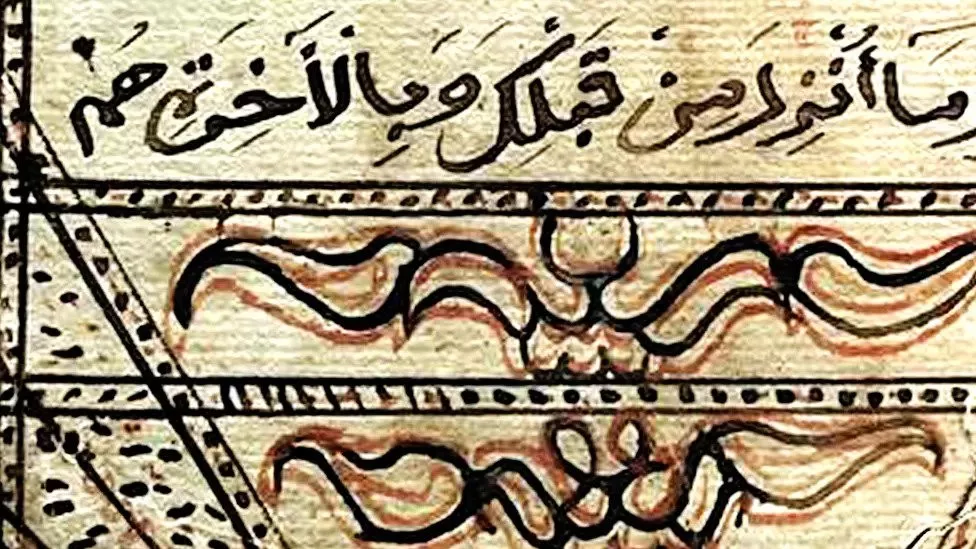
(Patria) - The Quran - neatly handwritten over 200 years ago by an Indonesian imam exiled to the southern tip of Africa by Dutch colonizers - is the pride of Cape Town Muslims who jealously guard it in a mosque in the city's historic Bo Kaap neighbourhood.
Builders found it in a paper bag in the attic of the Auwal Mosque during renovations in the mid-1980s. Researchers believe that Imam Abdullah ibn Qadi Abdus Salaam, affectionately known as Tuan Guru, or Master Teacher, wrote the Quran from memory after being sent to Cape Town as a political prisoner from Tidore Island for joining a resistance movement against Dutch colonizers. "It was extremely dusty, it looked like nobody had been in that attic for over 100 years," Cassiem Abdullah, a mosque committee member, told the BBC.
"The builders also found a box of religious texts written by Tuan Guru."
The unbound Quran, consisting of loose, unnumbered pages, was in surprisingly good condition, except for the first few pages which were worn at the edges.
The black and red ink used for the clear, legible calligraphic Arabic script was, and still is, in very good condition.
A major challenge for the local Muslim community in their quest to preserve one of the most valuable artefacts in their rich heritage, dating back to 1694, was ensuring that all the pages containing more than 6,000 verses of the Quran were placed in the correct sequence. This task was undertaken by Maulana Taha Karaan, who was the chief jurist of the Cape Town-based Muslim Judicial Council, in collaboration with several local Quranic scholars. The entire process, which concluded with the binding of the pages, took three years.
The Quran has since been on display at the Auwal Mosque, which was founded by Tuan Guru in 1794 as the first mosque in present-day South Africa.
Three failed theft attempts prompted the committee to place it in a fireproof and bulletproof casing in front of the mosque 10 years ago.
Tuan Guru's biographer, Shafiq Morton, believes the scholar most likely began writing the first of five copies while held on Robben Island – where anti-apartheid icon Nelson Mandela was also imprisoned from the 1960s to the 1980s – and continued to do so after his release. It is believed most of these copies were written when he was between 80 and 90 years old, and his achievement is considered even more remarkable as Arabic was not his mother tongue.
According to Morton, Tuan Guru was imprisoned on Robben Island twice – first from 1780 to 1781 when he was 69, and again between 1786 and 1791.
"I believe one of the reasons he wrote the Quran was to lift the spirits of the prisoners around him. He realised that if he wrote a copy of the Quran, he could educate the people about it and at the same time teach them dignity," says Morton. "If you go to the archives and look at the paper the Dutch used, it is very similar to the one Tuan Guru used. It is probably the same paper.
"The pens were probably made by himself from bamboo, and the black and red ink were easily obtainable from the colonial authorities."
Sheikh Owaisi, a lecturer in Islamic history in South Africa who has done extensive research on handwritten Qurans in Cape Town, believes Tuan Guru was motivated by the need to preserve Islam among the Muslim prisoners and slaves in the then Dutch colony.
"While they were preaching the Bible and trying to convert the Muslim slaves, Tuan Guru was writing copies of the Quran, teaching it to children and getting them to memorise it." "It tells a story of resilience and perseverance. It shows the level of education of people who were brought to Cape Town as slaves and prisoners."
Tuan Guru also wrote a 613-page Arabic textbook from memory titled Ma'rifat wal Iman wal Islam (Knowledge of Faith and Religion). The book, a basic guide to Islamic beliefs, was used for over 100 years to teach Cape Town Muslims about their faith.
It is still in good condition and is owned by the Rakiep family, descendants of Tuan Guru. A replica is kept at the national library in Cape Town. "He sat down and wrote almost everything he could remember about his faith and used it as a text to teach others," says Sheikh Owaisi. Of the five copies of the Quran handwritten by Tuan Guru, three are still known to exist. Besides the one in the Auwal Mosque, the other two are owned by his family, including his great-great-granddaughter.
About 100 replicas have been made. In April, one of them was presented to the library of the al-Aqsa Mosque in Jerusalem – Islam's third-holiest site – while several have been presented to visiting dignitaries.
In May 2019, Ganief Hendricks, the leader of South Africa's Muslim political party, Al Jama-ah, used one of the replicas to be sworn in as a Member of Parliament.
The Dutch had no idea that by exiling Tuan Guru to South Africa, they would inadvertently be the catalyst for the spread of Islam in this part of the world, where Muslims now make up about 5% of Cape Town's estimated population of 4.6 million.
"When he arrived at the Cape, Tuan Guru noticed that Islam was in a pretty bad state so he had a lot of work to do," says Mr Morton.
"The community didn't really have any texts – they were Muslims more out of cultural memory than anything else." "I would say that first Quran he wrote is the reason why the Muslim community survived and developed into the respected community that we have today."
Komentari (0)
Prijavite se za komentiranje
PrijavaJos nema komentara. Budite prvi!
Minuta
Sve →Iz drugih kategorija

High Representative Not Elected: Germans, French and British Sabotaged Americans, New Attempt at End of June

ČOVIĆ WITHOUT MERCY: How Those Who Brought Ademović to Office Created a Political Hell for Him



Sunny Saturday, quite warm



Tragedy in Albanian resort: Two minors drown












