
By: R. Belko
Bosnia and Herzegovina has lost another year on its transitional path towards Euro-Atlantic integration and strengthening democratic capacities. In fact, looking back 20 years, it is clear that we can now count decades of permanently lost time, which domestic politicians have spent at the expense of citizens.
Attempts at reforms based on the principle of doing nothing have only yielded results in deepening the crisis, which towards the end of this year resembles a pre-war state more than an attempt at internal political agreement.
Grouped into three centers of power, mirroring the wartime situation, the political leaders of Bosnia and Herzegovina have dug in their heels in positions known since the establishment of peace in Bosnia and Herzegovina. No progress has been made on the internal or foreign policy fronts that would strengthen the country or the standard of living of its citizens.
Foreign policy has been reduced to posing for photos and grinning with low-ranking international officials, with rare serious visits to Bosnia and Herzegovina and even rarer visits from BiH to world centers of power. This is far from what is needed to fulfill the still-valid principles and priorities of BiH's foreign policy, adopted back in 2003. Thus, the principles have come of age, but remain a dead letter on paper.
Meanwhile, occupied by the conflicting interests of world powers, polarized political blocs within BiH have formed into those pro and anti-state. Milorad Dodik, leader of SNSD and the anti-state member of the BiH Presidency, has intensified his separatist activities. He has been joined in this endeavor by Dragan Čović, president of HDZ, a false promoter of European values.
The aforementioned duo has united to continue undermining the foundations of the state, what remains of its international reputation, and introducing the country into an atmosphere of fear and paranoia.
On the other hand, there is Bakir Izetbegović's SDA, joined by coalition partners and some civic options on issues such as the Election Law. All of this has created the narrative of a pro-Bosnian bloc, which, thanks to Izetbegović and SDA, is weak in the State Parliament, limiting its reach.
Nevertheless, the mere fact that 25 years after Dayton we finally have some semblance of pro-Bosnian policy gives hope that in the coming year we will have a better response to anti-state actions.
And those actions should undergo a strategic shift and reordering of priorities. One of the foreign policy priorities from the document adopted in 2003 is Euro-Atlantic integration. That is, BiH's accession to NATO and the European Union.
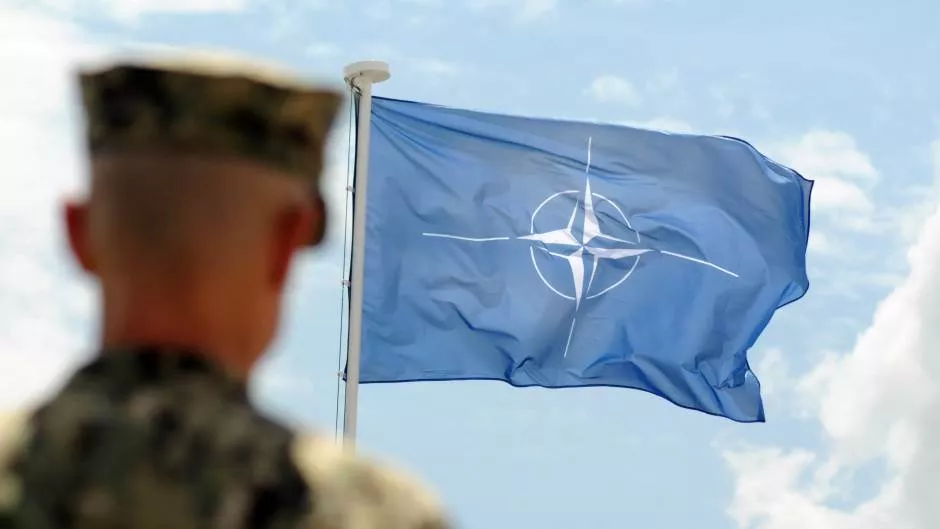
Accession to NATO Priority #1
The constant and increasingly evident crises in our country are the best argument for pushing Bosnia and Herzegovina's NATO path towards full membership. Because, in addition to protecting its members from external attacks, and such are not excluded in the case of BiH, it also helps in resolving internal crises.
Therefore, primarily the pro-Bosnian bloc, but also the political representatives of Croats who are not dependent on HDZ, should emphasize BiH's membership in NATO as the first priority of their actions.
Because the reforms required for NATO accession are far more purposeful for BiH society than those on the European path, and that NATO path is hindered solely by the false military neutrality of the RS entity and its actual bias towards Russian and Serbian interests. On the other hand, the same representatives of the RS are pushing the narrative of the necessity of internal political dialogue and agreement, so pro-Bosnian parties and all those who want a secure and peaceful, sovereign and independent Bosnia and Herzegovina must insist on pushing the NATO path first and foremost.
NATO guarantees peace, and political representatives have plenty to say about peace in turbulent times they create. At the same time, joining NATO also requires a more serious fight against corruption, an effective judiciary, and the experiences of neighboring countries have shown that it also brings a better economic position to countries that join it.
Joining NATO would certainly facilitate the continuation of reforms on the path to the European Union, because under the umbrella of the world's largest military alliance, the atmosphere would be much more relaxed, and the possibilities for hotheads to lead to new bloodshed much smaller.
In addition to all this, the option of further expansion of Russian influence in Bosnia and Herzegovina, which has been spreading in recent years and is much more pervasive than that from the West, would be avoided.
There are, of course, those European followers of the Kremlin's policy, who regularly create problems in our country, and during the year that is ending, they were led by Janez Janša and Viktor Orbán, and Emmanuel Macron joined them.
We must not forget the interests of neighboring countries, which, with their policies, acts, and methods of special warfare, have greatly contributed to the existing crisis, as well as all previous crises. These policies would also be suppressed and much less cancerous if Bosnia and Herzegovina became a full member of NATO.
Judicial Reform and Fight Against Corruption Priority #2
Although international politicians have imposed electoral legislation on us as a vital issue, while they themselves repeat the narrative of a corrupt BiH society, the judiciary is the biggest cancer on the internal front.
Millions in criminal activity are tried as petty theft, indictments for high corruption have been absent for years, and the top officials of the judiciary are a well-protected species from any criticism and sanctions. And while official Washington sends legal and criminal emissaries to fight corruption, nothing has changed in Bosnia and Herzegovina in this regard for a long time.
Citizens have become hostages of a system in which their fate is semi-publicly bought and sold for the interests of a few families and their circles. And what reaches the court is dragged out, trivialized, and turned into a media charade until it is consumed by the tooth of time.
Therefore, all those who swear to work in the interest of Bosnia and Herzegovina must understand that it is time to reconstruct the judiciary, to start eradicating corruption before it eradicates Bosnia and Herzegovina.
I am primarily referring to the SDA, whose current and former cadres are the main actors in most of the scandals that only the media are still uncovering. It is precisely this SDA, which strives to be the leader, that must finally initiate reform processes if it does not want to disappear from the political scene one day, consumed by judicial processes.
On the other hand are the coalition partners and civic parties, which, in that pro-Bosnian narrative, should work more decisively and clearly on cleaning up corruption. Declarative commitment and proposals are a waste of time, and all parties that want to be part of this pro-Bosnian bloc must insist on reforming the judiciary, and even pressure the SDA to start pushing for such action itself. Because, otherwise, a privatized state in the grip of crime will be of no use to anyone, whether whole or in three parts.
European Union - Priority on Hold
Too often, Europeanized Brussels officials try to teach us values that we in these regions had even before the states that make up the EU were formed.
Too little has been done within BiH on the European path for us to blame them alone. However, the fact is that we will wait for the train to Brussels for almost another decade, and it is questionable whether they will open the doors for us.
Therefore, reforms from the European path can and must no longer come before NATO and judicial reform. And these reforms should be segmented, i.e., primarily address and reform areas that affect the daily lives of BiH citizens, and then everything else.
The European Union has proven too uninterested in resolving major reform steps, and even what they have done, they have done outside their own principles, guided by the wishes of certain policies, not by the rulings of their own court.
Decisions of the European Court of Human Rights in the Zornić and Sejdić-Finci cases have been disregarded by international officials, showing that they too do not hold conventions and human rights in high regard.
The flood of conservative, anti-Muslim, and radical currents in the EU has not stopped, and this will only further complicate the accession of countries like Bosnia and Herzegovina. This certainly does not mean that BiH should abandon its European path; on the contrary, it must be pursued because the reforms it brings are necessary for us.
However, blindly pushing the European narrative while everything else in the country stands still, crises multiply, and people flee is dangerous and disastrous. Therefore, if there are truly pro-Bosnian forces, a change in political discourse must happen, looking more towards the North Atlantic Treaty Organization than towards the European Union, which has put itself on a long delay.
Komentari (0)
Prijavite se za komentiranje
PrijavaJos nema komentara. Budite prvi!
Minuta
Sve →Iz drugih kategorija

High Representative Not Elected: Germans, French and British Sabotaged Americans, New Attempt at End of June

ČOVIĆ WITHOUT MERCY: How Those Who Brought Ademović to Office Created a Political Hell for Him



Sunny Saturday, quite warm



Tragedy in Albanian resort: Two minors drown












