
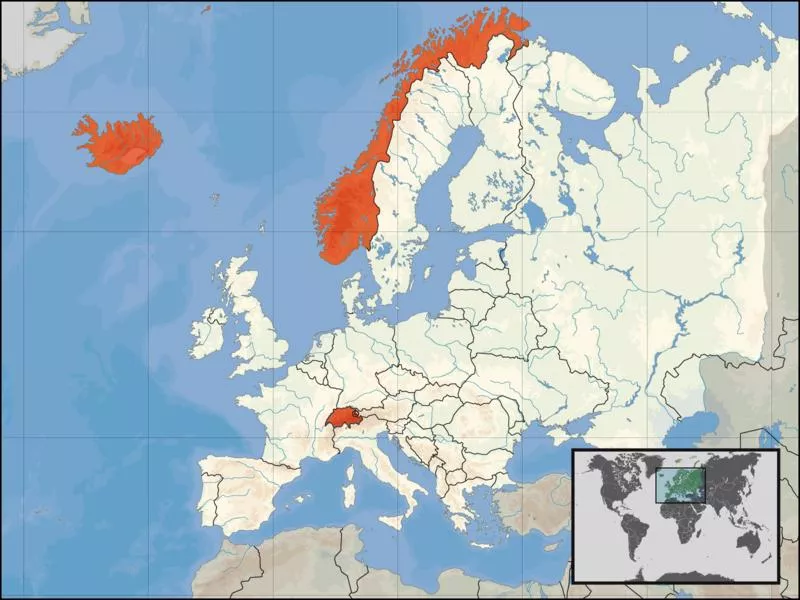
As of January 1, 2015, the EFTA agreement enters into force for Bosnia and Herzegovina, enabling the placement of fruits and vegetables from our country to the markets of the member states of this economic group, it was announced on Monday by the Ministry of Foreign Trade and Economic Relations of BiH, reports the Bosnian news agency Patria.
But what is the EFTA group and how much can it truly contribute to the development of Bosnia and Herzegovina's economy?
The European Free Trade Association (EFTA) was founded in 1960 as a reaction to the establishment of the EEC (European Economic Community) to prevent the danger of economic discrimination.
EFTA was founded by Austria, Denmark, Norway, Portugal, Sweden, Switzerland and the United Kingdom. In 1961, Finland became an associate member of EFTA, and in 1986 a full member. Iceland joined EFTA in 1970, and Liechtenstein in 1991.
However, the European Economic Community (abbreviated EEC), which was founded in 1957 in Rome by the six member states of the European Coal and Steel Community (Belgium, France, West Germany, Italy, Luxembourg and the Netherlands), would weaken EFTA several years later, as EFTA members began joining the EEC (the United Kingdom, Ireland and Denmark in 1973, and Portugal in 1986).
Of all the member countries of the EFTA community, only Liechtenstein, Norway, Iceland and Switzerland remain today, while the other members have joined the EEC or the EU.
Zlatko Hurtić, an economic expert from Sarajevo, explained in an interview with the Bosnian news agency Patria that every new market can have a positive impact on BiH's economy, including the EFTA market, but this will not happen until BiH products become more competitive, first on the BiH market and then on world markets.
- To have an effect from new markets, BiH products must first become competitive with other producers - explained Hurtić for NAP.
This means that products originating in BiH must be less burdened by taxes, fees must be lower, the gray market must be reduced, along with a series of other processes that must be adopted in the country to make BiH products more competitive.
From the EFTA market, says Hurtić, Bosnia and Herzegovina could derive the most concrete benefit from Norway, which is a large consumer of fish, and that is one of the great potentials of Bosnia and Herzegovina, writes NAP.
Komentari (0)
Prijavite se za komentiranje
PrijavaJos nema komentara. Budite prvi!
Minuta
Sve →Iz drugih kategorija

High Representative Not Elected: Germans, French and British Sabotaged Americans, New Attempt at End of June

ČOVIĆ WITHOUT MERCY: How Those Who Brought Ademović to Office Created a Political Hell for Him



Sunny Saturday, quite warm



Tragedy in Albanian resort: Two minors drown












