
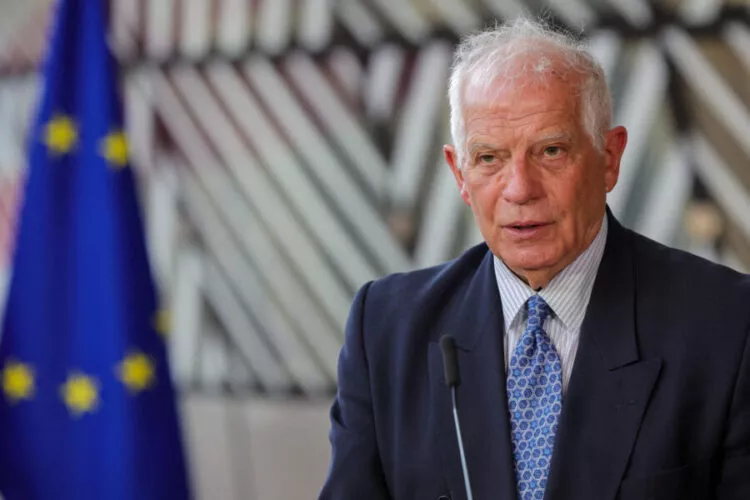
Blog by the High Representative of the EU for Foreign Affairs and Security Policy and Vice-President of the European Commission Josep Borrell
Two weeks after the conflict triggered by the horrific terrorist attack on Israel on October 7, it is time to consider what the EU stands for, what it is doing, and what it can do in the future to help free hostages, protect civilians, prevent the conflict from spreading to the region, and achieve a just and lasting peace.
Two weeks ago, on Saturday, October 7, I was hoping for a peaceful day after visiting Ukraine, where we were holding informal meetings of the EU Foreign Affairs Council. But early in the morning, news arrived of Hamas's terrorist attack on Israel and the killing of a large number of Israeli civilians near Gaza. I had a similar feeling as I did on the morning of February 24, 2022, when Russia launched its invasion of Ukraine. We faced another turning point in history, a moment of great human suffering and defining the EU's global role in the years to come.
Two weeks of intensive work on the current crisis
Since then, I have dedicated most of my time and energy to the conflict that erupted after this horrific terrorist attack by Hamas on Israel. On Sunday, we issued a statement from the 27 EU member states, and during our meeting in Oman on October 10, we reached a common position with the Gulf Cooperation Council, followed by an extraordinary informal Foreign Affairs Council the same day, where we further harmonized our common position. Last Tuesday, we discussed the issue intensively at an extraordinary European Council, followed by a plenary debate in the European Parliament on Wednesday.
The conflict was also the focus of the EU-US summit in Washington on Friday, which I attended with Council President Michel and European Commission President von der Leyen, as well as at the peace summit in Cairo on Saturday, where I accompanied Council President Michel. We will also consider what the EU stands for, what it is doing, and what it could do in the future during our Foreign Affairs Council today in Luxembourg. As has already been highlighted at these meetings, I will clarify that we are committed to acting on four principles: a strong stance, humanity, coherence, and proactive political engagement.
A strong stance begins with a clear condemnation of Hamas's terrorist attack on October 7, which killed over 1,400 people, mostly civilians, and took more than 200 hostage. The equivalent of 1,400 deaths in Israel would be 67,000 deaths in the European Union. Hamas intended to kill as many Jews as possible in a kind of jihadist pogrom, the largest loss of life the country has suffered since its creation. If anyone needed confirmation that Hamas is a terrorist organization, that confirmation came with their recent actions.
As President Biden emphasized in his address to the American nation, the Jewish people know, perhaps better than anyone, that there is no limit to the pain people want to inflict on others. During my visit to Ukraine a few days ago, I was at Babi Yar, where the Nazis shot 33,771 Jews in 1941. I paid tribute in memory of these victims. As I told the rabbi responsible for preserving the memory, nothing is more horrific than killing another human being simply because they are of a different faith or nationality. After our tragic experiences, one of the fundamental reasons for Europe's existence stems from such principles.
Commitment to respecting international law
The second principle is the principle of humanity. Israel, of course, has the right to defend itself. But like all other rights, this right comes with limitations, and those limitations are established by international law, particularly international humanitarian law. Cutting off water and electricity supplies and pressuring civilians to leave their homes are contrary to international law.
Such norms apply regardless of the identity of the victim or perpetrator. Hamas should not be confused with the Palestinian people, and the civilian population of Gaza cannot be held collectively responsible for the criminal acts of Hamas. We agree with our American allies on this matter. Indeed, President Biden also emphasized to the Israeli authorities the urgent need for Israel to adhere to the laws and customs of war.
We immediately and most strongly condemned Hamas's appalling terrorist attack, also calling for the immediate and unconditional release of all hostages. But the tragic loss of Palestinian lives is equally painful to us. Let us not forget that the denial of people's humanity is always a prelude to the worst kind of violence. We cannot ignore the humanity of Palestinian civilians who also want to live in peace. Several thousand, a large proportion of them children, have already lost their lives. We mourn the Israelis who lost their lives in horrific circumstances. We also mourn the Palestinian children, innocent victims of this conflict.
Clear statements against one tragedy should not prevent us from speaking out against another. The moral strength to condemn one thing allows us, and indeed obliges us, to condemn another, committed elsewhere, by others. Otherwise, we are useless when it comes to resolving conflicts.
The Commission has decided to triple our humanitarian aid to Gaza. And the aid should be delivered quickly. But this humanitarian aid must reach Gaza, which is still a difficult challenge. We have worked intensively over the past week with the UN, the US, and our partners in the region to make this possible. Ahead of the summit in Cairo on Saturday, the first 20 trucks were allowed to enter Gaza. This is a first step, but much more humanitarian aid is needed every day to meet the basic needs of the civilian population in the enclave. It is also necessary to ensure fuel for desalination plants and power stations. Hospitals cannot operate without water and electricity.
Do not believe fake news about our aid to the Palestinian people
Regarding our aid to the Palestinian people in general, there have been claims that it is used to finance Hamas. This is simply not true. We very precisely monitor where our funds go, and those funds go to cover the basic needs of the Palestinian population. We are ready for another round of review, and the review will be carried out by the Commission. But Europeans should not tolerate false accusations or spread fake news that undermines our hard work on the ground, as happened during last week's debate in the European Parliament.
The need for political coherence
The third principle that must guide our actions is the principle of political coherence. We cannot appear divided in our views on such a sensitive issue. The EU's position has been harmonized at the extraordinary informal Foreign Affairs Council I convened in Oman on October 10 and confirmed at the extraordinary European Council last Tuesday: “We condemn in the strongest possible terms the terrorist attacks by Hamas on Israel and the Israeli people. We affirm that Israel has the right to defend itself in accordance with humanitarian and international law. And the European Union has mobilized to provide humanitarian support to those most in need. We are also committed to the peace process for a lasting peace based on a two-state solution, and thus to supporting the Palestinian authorities.” There is no other EU position, and every sentence of this statement is part of this single position.
It is important to clarify this issue because, during my intensive contacts in recent weeks, numerous Arab leaders and other interlocutors have pointed to alleged double standards by the EU, especially given our firm stance on Ukraine compared to our perceived positions on Israel and Palestine. Such criticisms could be heard even before October 7, during our discussions on Russia's aggression against Ukraine. But since then, the criticisms have become louder. Both conflicts differ in their nature, but they are indeed connected when we talk about their geopolitical consequences.
Our commitment to values and norms must not leave room for criticism of alleged double standards. And these criticisms must be countered with both words and deeds. Otherwise, Russia will exploit it against Ukraine. Above all, it is important that we achieve a common position in voting on resolutions in the UN Security Council or before the UN General Assembly in the coming days.
Proactive commitment to resolving the root conflict
The fourth principle is a proactive commitment to resolving this conflict.
We must, of course, first try to prevent the conflict from spilling over into Lebanon and other neighboring countries, which would destabilize the entire Middle East region and also affect Europe. In recent days, I have had a series of contacts with all relevant regional actors, and we have been working with the UN and the US on this issue. We must also seek an urgent solution for the status of Gaza.
But we must also address the root conflict. So far, we must admit that we have not been overly effective. I was in Gaza after the bombing in 2008, and this is the fourth major war in Gaza that I have witnessed. And if we do not stop this cycle of violence, it will happen again in the future. The level of trust between Israelis and Palestinians, which was already extremely low in recent years, is now at the level of the Dead Sea. Fear and hatred of the other dominate, collectively and individually.
We are entering a new phase of the century-old Israeli-Palestinian tragedy, which could be extremely dangerous for global peace, and the international community must mobilize to avoid it. For too long, we have tried to dismiss the Palestinian issue as if it no longer existed or as if it would resolve itself.
The international community, of which we are a part, has not done what was necessary to implement the Oslo Accords, now 30 years old. Since Oslo, the number of Israeli settlers has tripled in the occupied territories, while a viable Palestinian state has been squeezed into a maze of disconnected areas. Every day we call for a two-state solution, but as a Palestinian representative told me during the UN General Assembly: “Besides calling for it, what are you doing to achieve that solution?”
Peace does not come on its own; peace must be built. The hardest decisions are always made at the edge of the abyss. And we have now reached that point. However unattainable and difficult this solution may seem, the two-state solution remains the only viable solution known to us. And if we have only one solution, we must invest all our political energy to achieve it.
With the EU Special Representative Koopmans, we have already worked with Saudi Arabia, Egypt, Jordan, and the Arab League over the past year to help revive the Middle East peace process and a two-state solution. Following recent events, this approach must, of course, be thoroughly adapted. We will intensify our efforts, together with our partners in the region and beyond.
The way we handle this crisis will define the EU's credibility and global role in the years to come.
Komentari (0)
Prijavite se za komentiranje
PrijavaJos nema komentara. Budite prvi!
Minuta
Sve →Iz drugih kategorija

High Representative Not Elected: Germans, French and British Sabotaged Americans, New Attempt at End of June

ČOVIĆ WITHOUT MERCY: How Those Who Brought Ademović to Office Created a Political Hell for Him



Sunny Saturday, quite warm



Tragedy in Albanian resort: Two minors drown












