By: Rasim Belko @rasimbelko
Is the fact that the American ambassador is directly talking to federal deputies about the adoption of the Law on the Southern Interconnection actually a defeat for the current Government of the Federation of Bosnia and Herzegovina and Prime Minister Nermin Nikšić, who, for the interests of a political party, kept the aforementioned law in drawers?
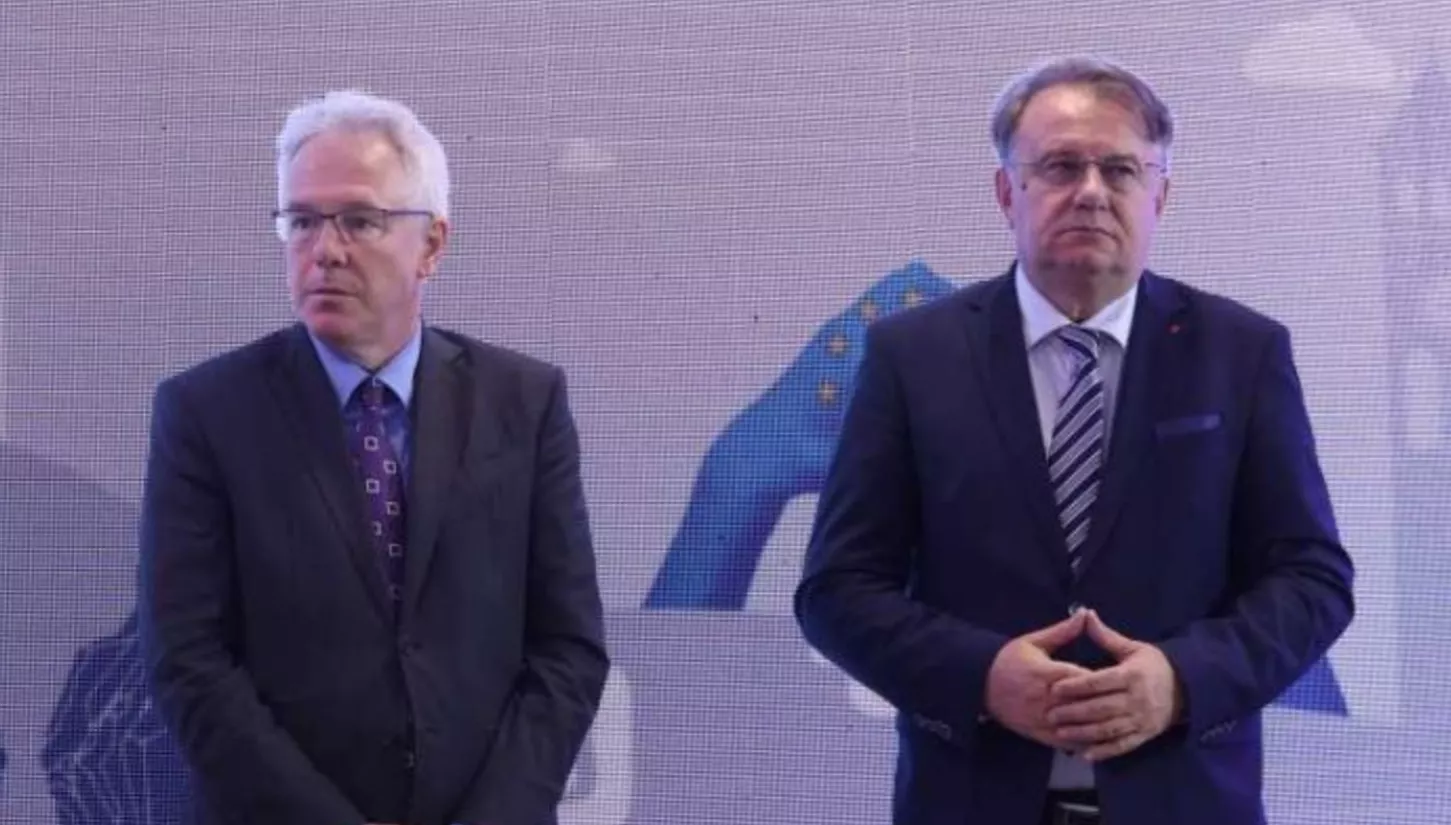
This was one of the questions we asked the presidents of the party clubs who were at a meeting with US Ambassador Michael Murphy and US Special Envoy for the Western Balkans Alexander Kasanof yesterday.
We also asked the heads of parliamentary clubs if we can expect the law to be adopted at one of the two sessions of the House of Representatives of the FBiH in December, and what happens next, i.e., can the law pass the House of Peoples as well, and how to ensure its implementation if the law is adopted, given that the international community, led by the US Embassy, has given Dragan Čović and HDZ BiH significant leverage at the top, as well as in the vertical of the system in the FBiH?
The answers and the silence we received instead of answers indicate that the American delegation clearly leveled the positions in the Parliament of the Federation yesterday and showed the political immaturity of Bosnia and Herzegovina how state interests are defended. True, they come from a position of power, but that is not the only argument.
As we learn, it was agreed that the law would be passed without much political provocation. And perhaps the silence to our questions lies within that agreement.
The president of the NES Club, Irfan Durić, says that the Law on the Southern Interconnection passed the procedure through the Parliament of the Federation of Bosnia and Herzegovina almost three years ago.
“Also, the fact that the American administration has given great importance to this law and guidelines towards its realization should be a message to all political parties in the Federation of Bosnia and Herzegovina to adopt the aforementioned law as soon as possible,” Durić answers Patrija’s inquiry.
He adds: “I want to believe that all political actors will contribute to this law being adopted by both houses as soon as possible.”
Mahir Mešalić, president of the Democratic Front Club, was also at the meeting with the American delegation, who tells Patrija: “Probably disappointed by the non-adoption of the law by the current FBiH Government, the US Embassy and high-ranking State Department officials addressed the parliamentarians directly so that the Law on the Southern Interconnection would finally be resolved. All parties present at the meeting agreed on the law of the previous Government, i.e., agreed that the law must be in procedure within 30 days.”
“Unfortunately, even after Mr. Antony Blinken’s letter to Mr. Konaković in January this year, nothing has been done, although the opposition in the FBiH Parliament has proposed adopting the said law on several occasions,” states Mešalić.
He explains that the law that American officials are seeking is actually the law from 2021.
“That law stipulates that BH Gas, as a state company, is the sole holder of the Southern Interconnection project and the sole authorized distributor of gas that would come through this interconnection. This is a long-term solution for BiH, as it would enable diversification, i.e., it would end energy dependence on Russian gas, because in addition to the current gas from the east, we would also have American gas,” Mešalić told Patrija.
The head of the DF Club says that “Dragan Čović does not have the possibility to block the House of Peoples of the FBiH, in case any party from the Trojka bloc decides to support it. The Trojka must choose between HDZ and the American administration.
He notes that HDZ has the option to invoke vital national interest, but that even if they decide to take that step, it can only postpone the adoption of the law in the short term.
Admir Čavalić also spoke for Patrija and emphasized that the FBiH Government is not capable of proposing this law and that this has been clear from the beginning.
“We had promises at the beginning of the year that the FBiH Government would send its proposal to the parliamentary procedure. After the promise was broken, the talk about some kind of working group began. I still haven't received information on who makes it up and whether they are doing anything on this issue. Now it is clear to everyone that time is only being bought and that the topic of the Southern Interconnection is being tried to be 'swept under the rug'. So, the Federal Parliament is logically the next address,” states Čavalić.
Čavalić expects the law to be on the agenda of the session to be held on December 18th of this year.
“We certainly plan to request an addition to the agenda, so I expect all political subjects who attended the meeting yesterday to vote for the addition and then ultimately support this proposal. Of course, there are numerous unknowns and the greatest responsibility lies with the presiding officer Mioković, as well as the political subjects from the majority. I note that in September I requested an addition to the agenda with this law and we had 46 votes in favor. It was just a little short. I hope that those 4-5 votes (of reason) will appear in December,” says Čavalić.
When asked what happens after the House of Representatives of the FBiH adopts the law, Čavalić says: “Those are further problems to solve. Now the priority of all priorities is for this to pass the House of Representatives of the FBiH Parliament. That is the first and at the same time the most difficult step.”
In summary, it is clear that Elmedin Konaković, as the head of BiH diplomacy, has not done what the partners he swears by asked of him. Nermin Nikšić, as prime minister, and the third partner in the Trojka, Edin Forto, have also ignored them, even though they installed him in power.
The Southern Interconnection is a project that Bosnia and Herzegovina needs in the form adopted by the previous convocation of the FBiH Parliament. There is no doubt about that.
What will be a dilemma is how US Ambassador Michael Murphy will explain upon his return to the US that he has installed a government in Bosnia and Herzegovina that, judging by the reaction of the Russian Embassy, has been largely inclined towards Moscow's interests. At the same time, the part of that government called Trojka will have to explain to the public why the interests of BiH and the US did not take precedence over the interests of Čović and Moscow.
Or to simplify, did the Trojka talk to us about agencies, foreign pawns, and Russophilia while simultaneously working in the greatest interest of Russian policy.
Komentari (0)
Prijavite se za komentiranje
PrijavaJos nema komentara. Budite prvi!
Minuta
Sve →Iz drugih kategorija

High Representative Not Elected: Germans, French and British Against Americans, New Attempt at End of June

ČOVIĆ WITHOUT MERCY: How Those Who Brought Ademović to Office Created a Political Hell for Him



Sunny Saturday, quite warm



Tragedy in Albanian resort: Two minors drown












