
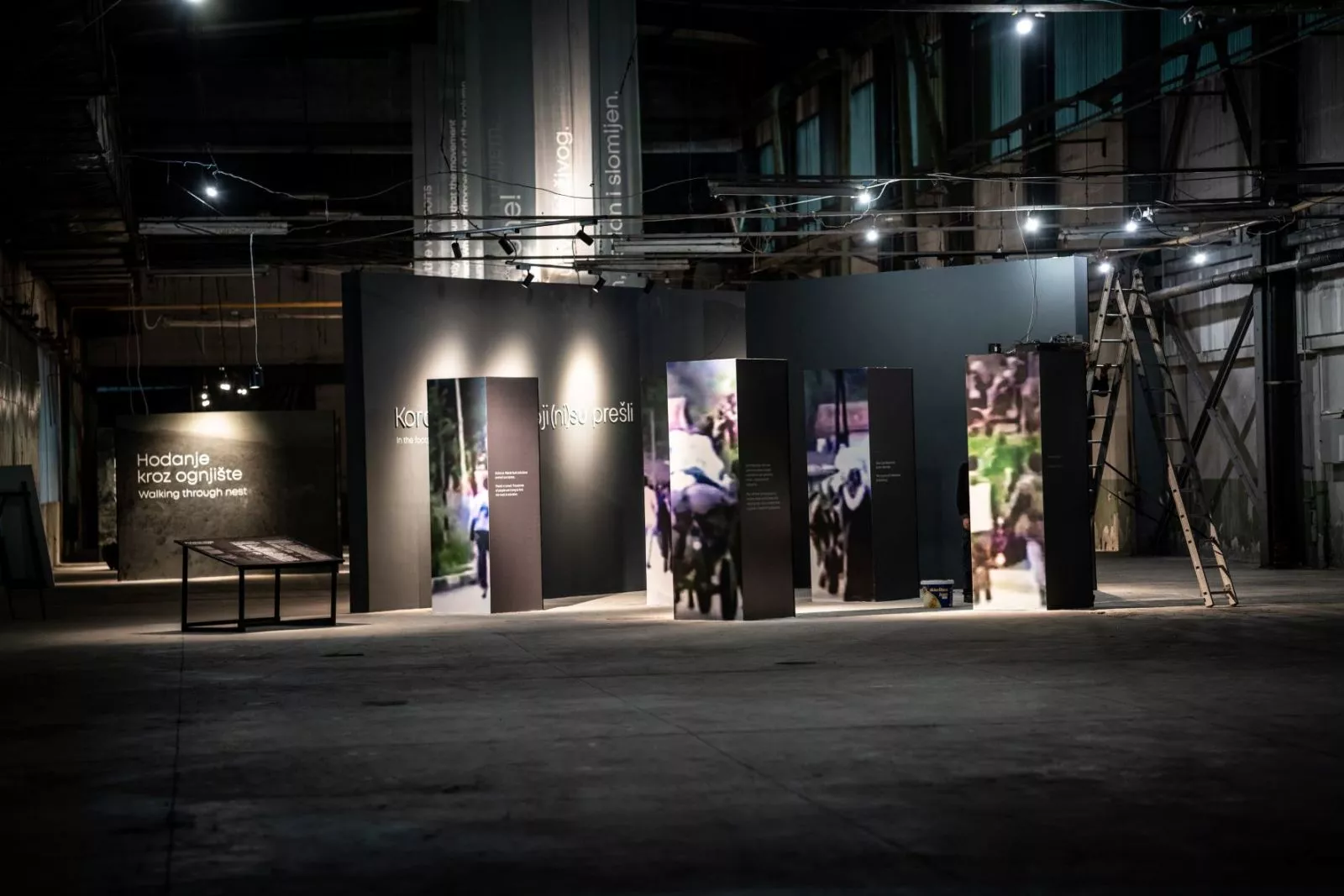
(Patria) - The 18th anniversary of the official opening of the Srebrenica-Potočari Memorial Center and Cemetery for the victims of the 1995 genocide was marked by the opening of the exhibition 'In the Footsteps of Those Who Did (Not) Make It'. The exhibition was realized as part of the 'Truth, Dialogue, Future' program, through which the UK Government supports the activities of the Memorial Center.
'On this day, September 20, 2003, during the third collective funeral, when 107 genocide victims were buried alongside the previously buried 828 genocide victims, the Srebrenica-Potočari Memorial Center and Cemetery for the victims of the 1995 genocide was opened, which four years later would grow from a Foundation into a state institution. From the day of its official opening until today, over the past 18 years, the Memorial Center has been visited by over a million people, guests from all over the world, who came here to pay tribute to the victims of the genocide, to research the genocide, to learn more about Srebrenica, to contribute to the civilizational struggle for justice. Today, a collection of personal belongings of genocide victims has seen the light of day, which, along with the oral history exhibition and several artistic installations at the Memorial Center, has completed the experience of every visitor who wants to learn more about the scale of the genocide against Bosniaks in the UN safe zone of Srebrenica,' said Ševket Hafizović, President of the Steering Board of the Memorial Center.
The curatorial team consisted of Azir Osmanović, Elma Hašimbegović, and Elma Hodžić, Bernard Pavlinović worked on graphic design, and Armin Šepić was the technical consultant for implementation. Samina Tanović worked on the visual and spatial design.
'The exhibition is the result of the work of the Memorial Center's research team, which has been continuously working for two years to collect personal belongings of victims and witnesses of the genocide along the route of the Death March column in July 1995, as well as the shelters where they hid for days and months after the fall of Srebrenica under the control of the so-called VRS. The exhibition consists of narratives, photographs, witness statements, and personal belongings collected at significant historical locations. We are grateful to the UK Government for their support in bringing this activity to completion,' explained Azir Osmanović, curator of the Memorial Center.
The exhibition includes numerous items found on the Death March route, footwear of those who traveled this path (so-called 'mrtvare' - death shoes), as well as extensive information clarifying the broader context of the fall of Srebrenica, the path taken by the Bosniaks of Srebrenica, and descriptions of the crimes committed along the route.
'18 years have passed since the opening of the Memorial Center. The first tear, and the last tear that falls on this sacred Bosnian land, still hurts. The tear of a mother, a sister, a brother, a child. Nothing diminishes our pain, but at least we remain grateful and aware of the struggle waged and won by the mothers and women of Srebrenica, thanks to whom Potočari exists and endures, this place where at least those killed in the genocide have their peace,' concluded Ševket Hafizović, Chairman of the Steering Board of the Memorial Center.
Tanović highlighted the importance of the exhibition and spoke more about the process that led to the realization of the display.
'It is a great task to set up an exhibition in a space of historical significance, which is today a place of remembrance. The exhibition 'In the Footsteps of Those Who Did (Not) Make It' is composed of several visual levels. The historical context of the exhibition is enhanced through two artistic installations, which are imbued with exhibits and narratives. The installation establishes a relationship between the visitor, the theme, and the museum object, and its visual design encourages reflection and creates an additional experience. Months of teamwork have enabled the exhibition to visually support what the historical narratives and exhibits convey,' said Samina Tanović.
'For us young people working on this project, this has been an exceptional experience. We have learned from the greatest experts in this field, which forms the basis for us to continue working in this direction in the future, so that the exhibitions of the Memorial Center form a cohesive whole that tells a unique story about the genocide. Thanks to the 'Truth, Dialogue, Future' project, which we are implementing with the support of the UK Government, our team is building capacities that will certainly make the Memorial Center a focal point for genocide research, as well as museum and research work in the region in general,' added Ahmo Mehmedović, one of the team members.
The exhibition 'In the Footsteps of Those Who Did (Not) Make It' will be part of the permanent exhibition of the Memorial Center and is open to visitors.
Komentari (0)
Prijavite se za komentiranje
PrijavaJos nema komentara. Budite prvi!
Minuta
Sve →Iz drugih kategorija

High Representative Not Elected: Germans, French and British Sabotaged Americans, New Attempt at End of June

ČOVIĆ WITHOUT MERCY: How Those Who Brought Ademović to Office Created a Political Hell for Him



Sunny Saturday, quite warm



Tragedy in Albanian resort: Two minors drown












