
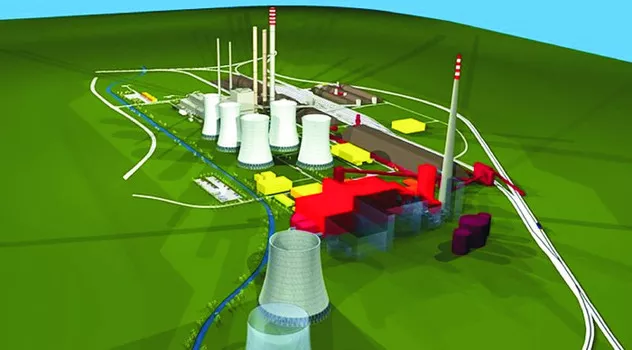
The spectacular announcement of the largest post-war investment in Bosnia and Herzegovina, the construction of Block 7 of the Tuzla Thermal Power Plant, is becoming increasingly certain and could also uncover the biggest post-war scandal in BiH, writes the BiH news agency Patria.
All that is known about the giant project is that it is worth close to one and a half billion BAM. Elektroprivreda BiH would pay 15 percent, and the Chinese Exim Bank the remaining 85 percent. The repayment period is 15 years. However, all other details of this project are unknown. Among them is the interest rate at which the Chinese would provide the money.
Experts warn that even with so little information about the project, it is already clear that the initial contract between Elektroprivreda and Chinese partners would have to be changed.
When the cooperation was signed a few years ago, it was estimated that a megawatt of electricity could be sold at a price of around 100 BAM, and a gigajoule of coal purchased at a price of around 4 BAM. However, electricity and coal prices are nowhere near that now. The price of electricity has fallen to around 80 BAM, and the price of coal has risen to as much as 6 BAM. The planned profit of the Tuzla Thermal Power Plant would therefore be halved, if there were any profit at all.
- The continuation of this project is very questionable – warns Amer Jerlagić, former director of Elektroprivreda BiH, for Patria.
- Finally, under very strange circumstances, only one supplier was chosen, who skillfully exploited this and significantly raised prices compared to market prices. The second problem is the excessive cost of the investment itself, which would now not be profitable at all, as financial circumstances have changed – adds Jerlagić.
There are many unanswered questions, and Elektroprivreda BiH remains silent. For starters, it would be good to hear how it is possible to conclude a commercial contract without obtaining the consent of the founder before its conclusion.
Furthermore, it is unclear how JP Elektroprivreda BiH, which is 100 percent state-owned, could conclude any commercial contract without first publishing a public tender and thus obtaining the best bidder.
Amidst all the doubts, it is unclear why a commercial contract was signed if Elektroprivreda was only supposed to receive a loan, and what obligations Elektroprivreda undertook with that commercial contract. Although no one has seen that commercial contract yet, it is clear that as soon as it is characterized as such and is binding, it is concluded by companies exposed to market laws.
It is interesting that a joint working group was formed with the employer, which is Elektroprivreda, and the contractor – the Chinese consortium, to facilitate the implementation of the project. However, what kind of so-called working group is it if there is a commercial contract between them in parallel, because it is logical that they, as contracting parties, act according to that contract and therefore do not need any working group!?
Incidentally, both the Council of Ministers of BiH and the Government of the Federation of BiH have provided support to Chinese investors for the construction of Block 7 of the Tuzla Thermal Power Plant. Since the very idea, when the Memorandum of Understanding was signed in Belgrade on December 17, 2014, the public in BiH has been deprived of any additional information.
Komentari (0)
Prijavite se za komentiranje
PrijavaJos nema komentara. Budite prvi!
Minuta
Sve →Iz drugih kategorija

High Representative Not Elected: Germans, French and British Sabotaged Americans, New Attempt at End of June

ČOVIĆ WITHOUT MERCY: How Those Who Brought Ademović to Office Created a Political Hell for Him



Sunny Saturday, quite warm



Tragedy in Albanian resort: Two minors drown












