
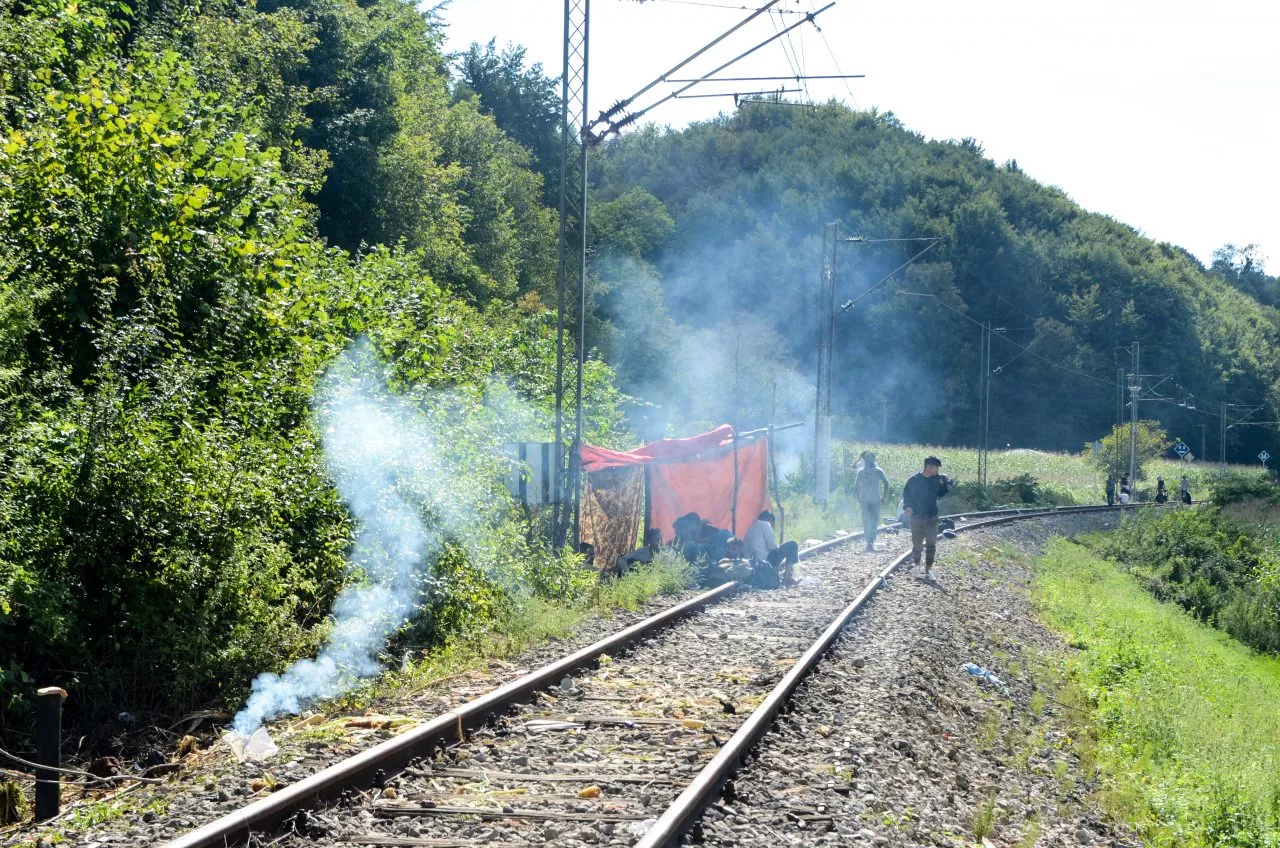
(Patria) - Algerian Khalid, along with several hundred other refugees and migrants, was transferred by police from Bihać outside the Una-Sana Canton, about five kilometers north of Bosanska Otoka. While he cannot return to Bihać nor go further through Republika Srpska, no one is taking care of him and hundreds of others as they spend nights under the open sky.
"We have no food, no water. People are drinking water from a dirty stream. This is not for humans. Even animals are treated better, they are given food, water, shelter, and they threw us into the woods and are still beating us," says Khalid, writes BIRN.
On the entity line, between two police checkpoints (Ministry of Internal Affairs of Una-Sana Canton and Republika Srpska), exhausted people on the move have been staying for days without food, water, access to doctors, toilets, or shelter.
"Yesterday I wanted to bathe in the river in Bihać, and the police came, picked us up, and beat us," says Abdel Kajum, showing bruises on his arm, claiming they were from police baton blows.
After complaining in previous years about cases of violence by Croatian police and forced illegal returns across the border, so-called pushbacks, migrants are increasingly complaining about the violent conduct of police officers in Bosnia and Herzegovina.
To draw attention to their hopeless situation, migrants have twice blocked the main road near Bosanska Otoka, where they were brought by buses a few days ago.
"We briefly blocked traffic on this section. We don't want to prevent people from traveling, we just want the authorities to hear about our problems. We have been here in the woods for six days and no one knows about us. More than three hundred migrants are starving here," warns Khalid.
A little further from the road, a local resident watches a group of migrants from his balcony in front of his house. He says he has lost patience because this whole situation has been going on for too long, there are many migrants, and the police constantly bring groups of people to their properties.
"From the beginning, I have tried to help these people, I gave them food, shoes, but we are losing patience. It's not a problem for me when a migrant picks corn from my field to eat, but a hundred pass by today, and that's hundreds of cornstalks, in a month they will pick thousands, and I will be left without income," says the resident of the hamlet along the Bosanska Otoka – Novi Grad road, somewhat angrily.
According to data from the International Organization for Migration, there are currently about 8,000 refugees, migrants, and asylum seekers in BiH, of whom 5,780 migrants are staying in seven official temporary reception centers, while the rest are on the streets.
Due to the increased number of refugees and migrants on the streets, local residents in several cities organized protests in mid-August, blocking roads and not allowing migrants to move.
Several groups have also been created on social networks, directly calling for violence and spreading hate speech against migrants and the volunteers who help them. Refugees and migrants are called "scum and vermin who should be locked up in barbed wire, expelled, or bombed." Stoning and burning buses carrying refugees and migrants, or asylum seekers, has been proposed.
For days, the exact locations and routes of refugees and migrants passing through western BiH have been published, and they have been targets of attacks and threats.
Adil from Morocco experienced one such incident. He went from Sarajevo to Velika Kladuša intending to continue his journey to Italy from there. He slept in an abandoned house near Velika Kladuša with two friends, and one evening locals came and, as he said, threatened them with weapons and drove them away.
Several protests and road blockades were held in the town and villages during those days, from which they realized that it was not safe to stay in Velika Kladuša, so they returned to Sarajevo. Adil is an English teacher and his goal is to reach England, where part of his family lives.
He regretted leaving his country and currently cannot move forward or go back, stating that the entire situation is having a very negative impact on his psycho-physical health.
Activists and volunteers have recorded several more extreme cases of beatings and intimidation of people on the move, both by police officers and by some local residents. Numerous posters can be seen on the roads with a stylized skull and the inscription "game over," warning migrants that they are no longer welcome.
On the other hand, volunteers and activists from Bihać, Velika Kladuša, and other cities are trying to help refugees and migrants, but they are increasingly afraid for their own safety. Names and pictures of people helping migrants are even publicly posted on social networks, exposing them to lynching.
A source for the Balkan Investigative Reporting Network of Bosnia and Herzegovina (BIRN BiH), who has been collecting and distributing humanitarian aid since the first arrival of migrants in these areas, is now afraid and does not want her name published.
"I am afraid of the reactions of my fellow citizens, and the police do not allow us to distribute aid either. If I distribute it, I do it in secret," she says.
Due to public pressure, the authorities in the Una-Sana Canton have banned the transport and entry of refugees and migrants into this canton. The provision of accommodation for migrants is prohibited, and a decision has been made to urgently relocate migrants out of the canton.
Similar measures are being implemented by the police of Republika Srpska, by organizing the transport of migrants from this BiH entity to the entity line near Bosanska Otoka. According to data from the Ministry of Internal Affairs of the Una-Sana Canton, 440 exhausted and starving people are located in meadows and forests between the two entities, and they are not allowed to move in any direction.
The situation in the Una-Sana Canton has become increasingly complex in the past period. Due to the increased number of migrants on the streets, the population is increasingly vocal in their dissatisfaction, claiming to feel betrayed by state authorities and that the entire burden and care for migrants has fallen on them.
In the far west of BiH, in the towns of Tržac and Šturlić, encounters between the local population and migrants are frequent. Migrants in this area are going on "games," as they call attempts to cross the borders through forests and mountains to Italy, or they are returned if caught by Croatian police during the crossing.
"We have no problems with migrants, and they usually just pass through here. If they ask for food and I have it, I give it to them. I know it's hard for them, and I see them today with children aged three or four. Where are they going like this?" asks resident Mile, whose house and property are located on the road where migrants regularly pass as he begins to dig up this year's potato harvest.
"It's awkward and you feel sorry because a person is looking for bread, and you can't help them. It's especially difficult when families with children pass through here," says Mirzet from the village of Johovica, while his wife, holding a child in her arms, adds that they have given diapers and strollers to migrants, and that they often see the same faces because they are returned from Croatia.
They say they are concerned and would help more if they could, while at the same time having a certain degree of distrust and fear.
"You wake up in the morning, and there's a tent set up by migrants not far from your house. You don't feel safe because there are all sorts of people, and then there's the coronavirus. The state should take responsibility and get more involved with the migrants. The people here suffer the most and cannot bear this situation," says a resident of Johovica, adding that the police also bring migrants to the village and leave them in front of people's houses.
A few kilometers away, in Šturlić, a group of about fifteen refugees, including children from Afghanistan, are sitting on the asphalt, eating and packing things into large backpacks for their journey to Croatia.
They fled extremists, terrorists, and explosions, and want to start a better and safer life in the EU.
"Life in Afghanistan is insecure, dangerous, and there are frequent attacks. I worked as a midwife in a private clinic for three years, and we had to leave. We crossed seven countries, mostly on foot, and over a year," says Fazila from Afghanistan, adding that she and her family tried to cross Croatian territory five times, but the police would turn them back, take their money, and burn their belongings. That morning, they set off on foot from Velika Kladuša because no one wants or dares to transport migrants, even though they would pay. It is difficult to travel with small children; they are tired, and the things they carry are too heavy.
"The journey is difficult and dangerous, we sleep in the forest at night and it's cold, but for the sake of our children's future, we have to keep going," says Zahra from Afghanistan, placing a four-year-old boy on her husband's back in a carrier, and taking a five-year-old by the hand, setting off with the group at dusk on an uncertain journey westward.
Komentari (0)
Prijavite se za komentiranje
PrijavaJos nema komentara. Budite prvi!
Minuta
Sve →Iz drugih kategorija

High Representative Not Elected: Germans, French and British Sabotaged Americans, New Attempt at End of June

ČOVIĆ WITHOUT MERCY: How Those Who Brought Ademović to Office Created a Political Hell for Him



Sunny Saturday, quite warm



Tragedy in Albanian resort: Two minors drown












