
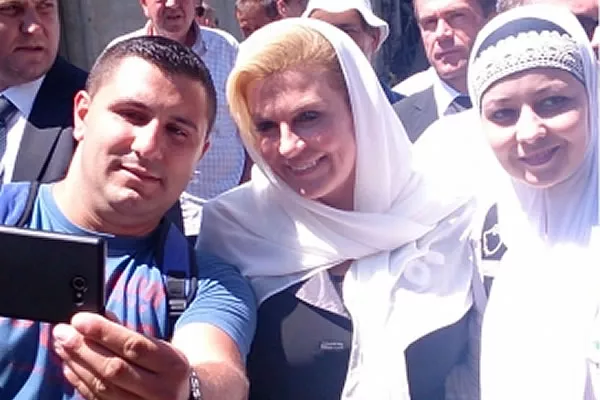
Presumably, Kolinda Grabar-Kitarović and the rest of the state leadership assessed that Trump and his people respond well to stories about potential Islamic terrorists in the heart of Europe, and Zagreb saw in this, and still sees, an opportunity to secure powerful support in realizing its political plans in Bosnia and Herzegovina, while turning a blind eye to dangerous right-wing radicalism and neo-Ustasha ideology within its own ranks, writes journalist Ivica Đikić for Al Jazeera, commenting on the statements of Croatian President Kolinda Grabar-Kitarović, who claims that up to 10,000 extremists currently live in BiH, reports the Patria agency.
Croatia's plans, Đikić believes, essentially concern the further disintegration of Bosnia and Herzegovina and securing an even greater degree of protection for Dragan Čović and the Croatian Democratic Union of Bosnia and Herzegovina in practicing political omnipotence, arbitrariness, and genuine disregard for the lives of their voters, who are emigrating en masse, primarily because of this and due to possessing Croatian passports. Although, Đikić adds, it is justified and logical to seek a model that would allow Croats to be represented in the Presidency of Bosnia and Herzegovina by someone chosen by the majority of Croats.
"It is another question whether the amendments to the Election Law of Bosnia and Herzegovina promoted by Čović are the best and most constructive path toward that goal," says Đikić.
"Croatia and the leadership of Croats in Bosnia and Herzegovina are in a great hurry, because there is fear of the final Hague verdict for six former political and military leaders of the former self-proclaimed Croatian Republic of Herceg-Bosna, a verdict expected in November this year: spreading panic about the Islamist threat in Bosnia and Herzegovina thus also serves as a call to America to engage more strongly in lobbying so that at least the qualification of a joint criminal enterprise disappears from the Hague ruling.
Instead of pursuing a policy that would confront the Bosnian-Herzegovinian sin of Croatian politics during the 1990s and that would not allow a potential convicting Hague verdict to be used for political disenfranchisement and stigmatization of Croats living in Bosnia and Herzegovina today, Zagreb and Mostar are acting in a way that plays into the hands of those who impatiently await turning the decision from The Hague into a means of political struggle against the least numerous constituent people as an obstacle to creating a different Bosnia and Herzegovina," Đikić believes.
Read the full text by clicking HERE.
Komentari (0)
Prijavite se za komentiranje
PrijavaJos nema komentara. Budite prvi!
Minuta
Sve →Iz drugih kategorija

High Representative Not Elected: Germans, French and British Sabotaged Americans, New Attempt at End of June

ČOVIĆ WITHOUT MERCY: How Those Who Brought Ademović to Office Created a Political Hell for Him



Sunny Saturday, quite warm



Tragedy in Albanian resort: Two minors drown












