
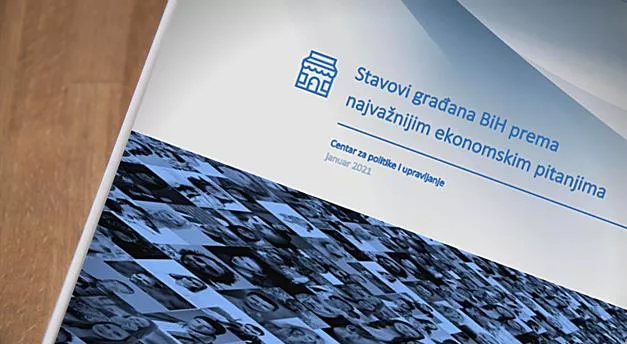
The Center for Policy and Management conducted a survey in 2020 on the attitudes of BiH citizens towards the most important economic topics, and in the publication "Attitudes of BiH Citizens Towards the Most Important Economic Issues" provided an overview of public perception regarding Bosnia and Herzegovina's current level of economic development and which economic policies citizens deem necessary for economic progress.
The majority of Bosnia and Herzegovina's citizens are interested in economic issues, specifically around 65%. These are citizens' views on the state of the economy, satisfaction with public services, and how our economic policies should look in the future.
BiH's Biggest Problem: In all regions of the country, regardless of education level or employment status, one-third of the population sees corruption as the key problem in the country, while one-third of citizens see political elites as the key problem.
How Citizens View the BiH Economy?
Economic Growth and Investments: Due to modest economic growth rates before the pandemic-induced crisis, only 11% of citizens believe we have experienced economic development in the last 4 years, while nearly half of the adult population, 47%, believes the economy has declined, and 39% believe we have stagnated economically. As many as 77% of citizens agree with the statement that legal uncertainty is one of the most significant obstacles to investment growth in the country.
Poverty: According to 38% of citizens, poverty in the country is a consequence of corruption, while 34% believe poverty is a result of the failure of planned economic management through political control. 6.1% of the surveyed population believes the war is responsible for poverty. These views on poverty indicate that citizens are aware of systemic responsibility for poverty in the country, but there is an intergenerational gap on this issue – younger people in the country predominantly believe poverty is a consequence of failed planned economy through political control, while citizens over 50 believe idleness and laziness are the key reasons for poverty in the country.
Attitudes Towards the Future of the BiH Economy
Market Economy: As a result of Bosnia and Herzegovina's economy based on a market economy, private sector, and open market, 41% of citizens see an improvement in the economic situation, 35% believe new jobs would be created, while 23% of citizens believe exports of our products would increase. Less than 8% believe such an economy would result in worker exploitation, a worsening economic situation, or increased unemployment. Slightly less than half of the population (48%) believes that a market economy represents the key to BiH's economic progress.
Privatization: Due to the privatization process so far, characterized by a lack of transparency and poor economic effects, most citizens still fear that the privatization process will result in negative consequences. Over half of BiH's population believes state-owned enterprises should not be privatized (54%), while 42% support the privatization of all or companies not of strategic importance.
Employment: As many as 86% of citizens believe the state should subsidize job creation. 10% of citizens attribute the responsibility for finding a job to the individual – who, in their opinion, is solely responsible for finding their own employment, 53% believe it is the state's obligation to provide adequate vocational education or retraining for everyone so that individuals can find jobs, and 37% of citizens believe the state is obliged to find a job for every individual.
The solution for creating new jobs, according to 43% of the population, lies in opening new state-owned factories, and a nearly equal number (42%) of citizens believe it is necessary for the state to regulate the system so that citizens can start businesses and create new jobs themselves. For 14% of citizens, the solution is for the state to subsidize the economy.
Taxes: Eight out of ten citizens of BiH agree that wealthier segments of society should pay a higher income tax rate and that the tax burden on labor needs to be reduced. 44% of citizens believe the VAT rate of 17% should not be changed, 35% believe it is necessary to introduce two VAT rates because a single VAT rate is not fair, while 14% of citizens believe it would be justified to increase the VAT rate if additional revenue would ensure better healthcare services for all citizens.
Entrepreneurship: Six out of ten citizens of BiH do not feel free and safe to start their own business. This is not surprising, given the generally poor perception of labor taxation and the fact that 67% of citizens believe it is the task of inspections to show strength and strictness towards companies that violate regulations, while only 15% of citizens believe inspections should have a partnership approach with companies to help them comply with regulations. Seven out of ten citizens believe that agriculture is our ticket to accelerated development.
Subsidies and Economic Protectionism: Nine out of ten citizens of BiH believe the state should help exporters. Eight out of ten citizens believe that what can be produced in BiH should not be imported, and seven out of ten surveyed believe that the development of domestic industry should be protected by tariffs from competition.
Healthcare, Public and Social Services: Eight out of ten citizens of BiH believe that mandatory health insurance should finance healthcare provided by public institutions and private practices. 84% of citizens agree with the statement that public procurement is prone to corruption, and 67% believe that the digitalization of public administration would improve the quality and accessibility of public services and reduce the misuse of public funds. 76% of citizens agree with the assertion that work needs to be done on a fairer direction of social transfers, and six out of ten surveyed believe that the social protection system is unclear and inefficient.
Nearly six out of ten citizens of our country believe that life in Bosnia and Herzegovina will not be better in the future than it is now.
The Center for Policy and Management has compiled an overview of "popular misconceptions" – topics where citizens' views are not supported by facts and economic reality, which may be the result of a lack of information or economic populism in political discourse.
More on the research findings and pop-misconceptions on the website of the Center for Policy and Management at THIS LINK.
Komentari (0)
Prijavite se za komentiranje
PrijavaJos nema komentara. Budite prvi!
Minuta
Sve →Iz drugih kategorija

High Representative Not Elected: Germans, French and British Sabotaged Americans, New Attempt at End of June

ČOVIĆ WITHOUT MERCY: How Those Who Brought Ademović to Office Created a Political Hell for Him



Sunny Saturday, quite warm



Tragedy in Albanian resort: Two minors drown












