
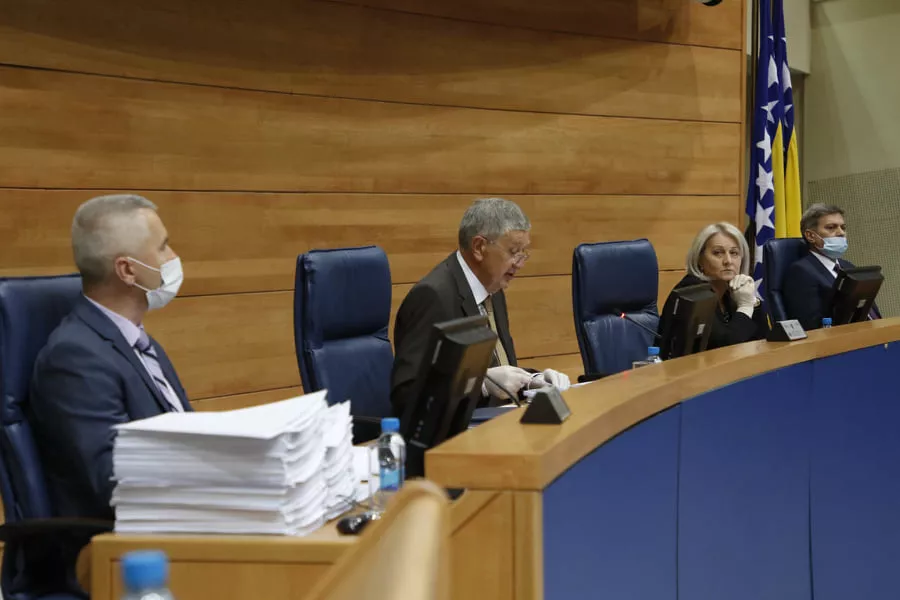
Written by: Dr. sc. Enver Išerić
The term parliament originates from the Italian word “parlale” which means to speak-to discuss, and from this term the term parliamentarism is derived, which in a broader sense denotes a system of representative governance in which popular sovereignty is expressed through free and multi-party elections in which the people elect representatives who will make decisions in their name. In a narrower sense, parliamentarism is a system of parliamentary government as a form of organization of power in which the executive power is politically accountable to the representative body.
The issue of the effective functioning of the parliament and other institutions of Bosnia and Herzegovina, as well as the issue of the realization and protection of fundamental human rights, guaranteed by international human rights documents, is related to the question of the nature of parliamentarism in Bosnia and Herzegovina according to the 1995 Constitution. Democratic processes announced in 1990 were halted by a brutal aggression against Bosnia and Herzegovina in 1992, and after the cessation of aggression and the signing of the Dayton Peace Agreement.
Bosnia and Herzegovina experienced two blows or "shocks" to its legal system. The first time was the violent secession of part of its territory and the establishment (in 1992) of the so-called Republika Srpska, the second time was the "violent" establishment of a new constitutional order. Namely, constitutional law and practice do not recognize or have recorded a case where other states participate in the adoption of a country's constitution (in the case of Bosnia and Herzegovina, neighboring states that committed genocide), nor can a country's constitution be the subject of an agreement - a treaty between two or more states. These are brief notes for parliament as a representative body of citizens, in an attempt to understand the reasons why Bosnia and Herzegovina, as a state, but also as a society as a whole, is in an extremely difficult situation.
Therefore, dealing with this issue, as early as 2001, with the aim of realizing representative governance, as a form of exercising popular sovereignty, I proposed that deputies be allowed to be only deputies and to engage only in their representative work. This would ensure the strengthening of parliament and better governance of the state, and the representative service would become a service that requires work and responsibility.
I also advocated for a position that entails taking radical measures in the development of parliamentary culture through the education of citizens and members of all legislative bodies, as well as in the development of legal culture, which implies the adoption of laws that ensure human rights and freedoms and their strict application, which is a condition for the functioning and sustainability of the state community, because "a plant does not grow in soil that is incapable of feeding it."
It is true that deputies are allowed to be only deputies (employed), but still, generally speaking and with honorable exceptions, they have not started to engage in their representative work. The latter part, related to parliamentary culture, has not even been attempted, but Bosnia and Herzegovina as a state has now experienced a third "shock", namely the blocking of the work of its institutions by parliamentary parties from the Republika Srpska entity.
The pro-Bosnian bloc of parties has not yet found an adequate response to these blockades, and I believe that members of all institutions of Bosnia and Herzegovina belonging to this bloc must work daily, and even make decisions, using the constitutional term "All decisions in both Houses shall be made by a majority of votes of those present and voting," because other provisions on quorum and entity, or voting by caucuses in the House of Peoples, cannot be applied due to the blockade of work that the Constitution of Bosnia and Herzegovina and the rules of procedure of the Houses of the Parliamentary Assembly do not allow.
However, not only have adequate responses to such a situation not been found, but the state of Bosnia and Herzegovina, as an employer of its institutional members, pays salaries for sabotage, i.e., obstruction of the work of its institutions.
As such a situation is unknown in legal theory, and I am sure it is unrecorded in the practice of modern states, because the logic of things itself dictates that a salary is received for work, I want to point out some provisions of the regulations that do not allow the payment of salaries to those who do not perform their duties.
The Rules of Procedure of the House of Representatives and the Rules of Procedure of the House of Peoples of the Parliamentary Assembly of Bosnia and Herzegovina stipulate that deputies and delegates have the right and duty to attend the session of the House of which they are a member (Article 7, Paragraph (2) of the Rules of Procedure of the House of Representatives and Article 8, Paragraph (2) of the Rules of Procedure of the House of Peoples).
The rules of procedure of the Houses also stipulate that deputies and delegates are entitled to a salary for performing their duties and other compensation, in accordance with the law and decisions of the Joint Commission for Administrative Affairs, and all deputies and delegates are entitled to a deputy-delegate lump sum and compensation for certain material costs. (Article 12 of the Rules of Procedure of the House of Representatives and Article 13 of the Rules of Procedure of the House of Peoples).
Article 66, Paragraph 3 of the Rules of Procedure of the House of Representatives stipulates that "As a rule, the House meets twice a month," and Article 56, Paragraph 3 of the Rules of Procedure of the House of Peoples stipulates that "As a rule, the House meets at least once a month."
From the cited provisions of the Rules of Procedure of the House of Representatives and the House of Peoples of the Parliamentary Assembly, the conclusion is that deputies and delegates have the right and duty to attend sessions and that they are entitled to a salary for performing their duties. Therefore, if deputies and delegates do not perform their duties, they are not entitled to a salary.
The Parliamentary Assembly of Bosnia and Herzegovina adopted the Decision on the Organization of the Secretariat of the Parliamentary Assembly of Bosnia and Herzegovina, within which the Professional Service of the House of Representatives of the Parliamentary Assembly of BiH, the Professional Service of the House of Peoples of the Parliamentary Assembly of BiH, and the Joint Service were established, and within these services, organizational units are established in accordance with work needs, and their scope of work is determined by the Rulebook on Internal Organization of the Secretariat of the Parliamentary Assembly of Bosnia and Herzegovina. (Item II of the Decision on the Organization of the Secretariat of the Parliamentary Assembly of Bosnia and Herzegovina.)
The head of the service is responsible, among other things, for the timely, lawful, proper, and quality performance of tasks within the competence of the service they manage, which includes the lawful payment of salaries to deputies and delegates.
Within the Secretariat, a Joint Service has been established which calculates salaries, deputy lump sums, prepares payment orders, and calculates and prepares payment orders for compensation of employees and members of the Parliamentary Assembly.
We can justifiably ask on what basis the Joint Service calculates and pays salaries to members of the Parliamentary Assembly who do not perform their duties in accordance with the rules of procedure of the Houses and who violate the solemn oath by which they undertake "to conscientiously perform their entrusted duties; to respect the Constitution of Bosnia and Herzegovina and fully implement the General Framework Agreement for Peace in Bosnia and Herzegovina; to protect and advocate for human rights and fundamental freedoms, and to protect the interests and equality of all peoples and citizens."
The Constitution of Bosnia and Herzegovina also stipulates that the Houses shall adopt their rules of procedure, and the provisions of the rules of procedure have the force of constitutional provisions.
The payment of salaries to members of the Parliamentary Assembly of Bosnia and Herzegovina during periods of blockade, when they do not perform their duties, is contrary to the rules of procedure of the Houses, has no legal basis, and constitutes a criminal offense under Article 220 of the Criminal Code of Bosnia and Herzegovina, which stipulates: "An official or responsible person in the institutions of Bosnia and Herzegovina who, by exploiting their official position or authority, exceeding the limits of their official authority or failing to perform their official duties, obtains any benefit for themselves or another, causes damage to another, or severely violates the rights of another, shall be punished by imprisonment from six months to five years," and "if property benefit is obtained through the criminal offense from paragraph 1 of this Article in an amount exceeding 10,000 KM, the perpetrator shall be punished by imprisonment from one to ten years."
The aforementioned act also constitutes a criminal offense under Article 222 of the Criminal Code, which stipulates "An official or responsible person in the institutions of Bosnia and Herzegovina who, with the aim of obtaining unlawful property benefit for themselves or another, by submitting false calculations or in another way deceives an authorized person to make an unlawful payment, shall be punished by imprisonment from six months to five years."
Therefore, it is necessary to immediately suspend all salary payments to those who do not perform their duties as prescribed by the Constitution and rules of procedure or other regulations, because a salary is received only for work, i.e., for performing one's duties.
Komentari (0)
Prijavite se za komentiranje
PrijavaJos nema komentara. Budite prvi!
Minuta
Sve →Iz drugih kategorija

High Representative Not Elected: Germans, French and British Sabotaged Americans, New Attempt at End of June

ČOVIĆ WITHOUT MERCY: How Those Who Brought Ademović to Office Created a Political Hell for Him



Sunny Saturday, quite warm



Tragedy in Albanian resort: Two minors drown












