
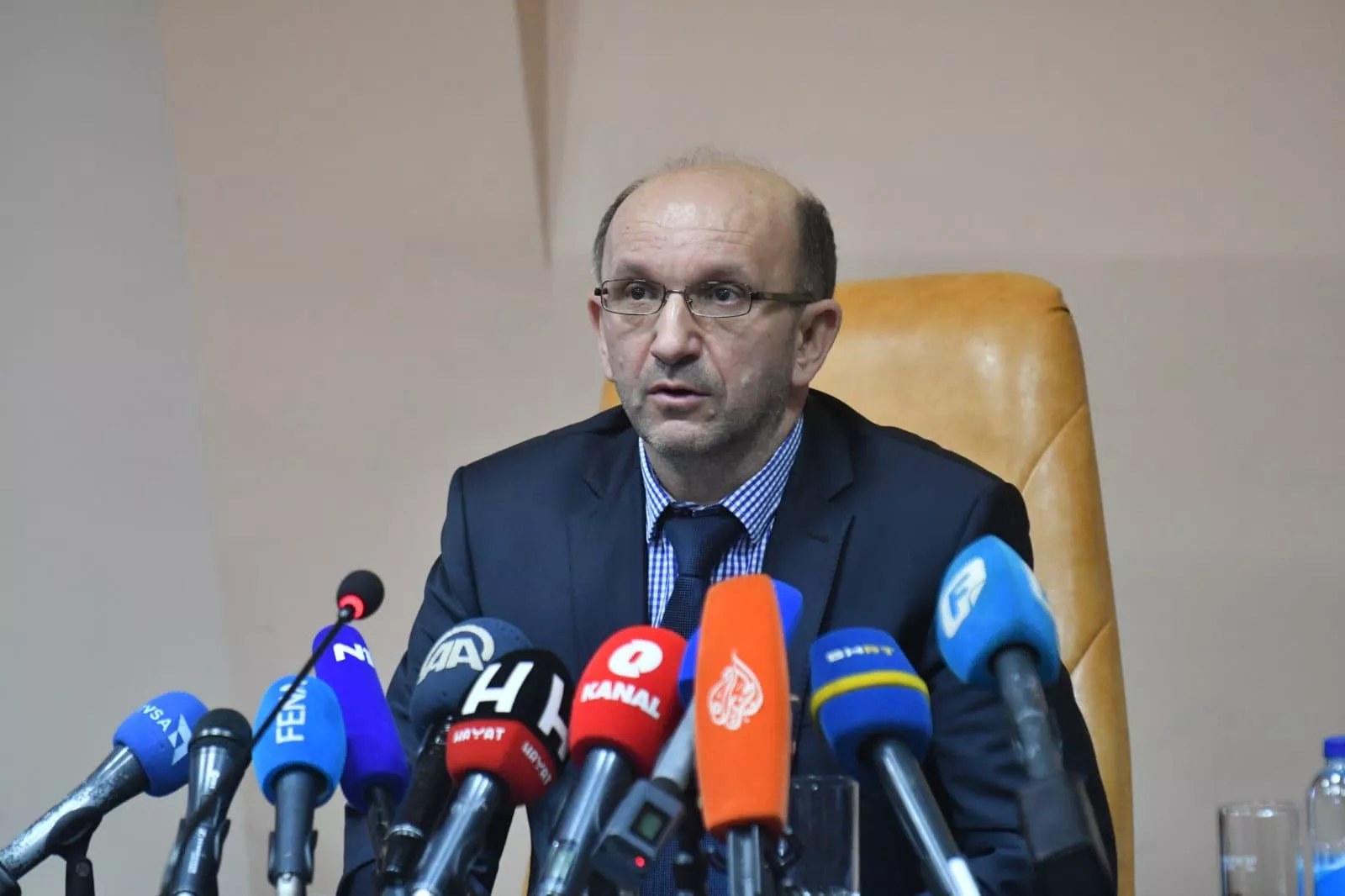
Interview by Ernad Metaj
The Tax Administration of the Federation of Bosnia and Herzegovina (PU FBiH) recorded record tax revenue collection in the first seven months of this year, indicating that this body has significantly improved its work, and that certain measures of the FBiH Government are yielding results. This year, 14 criminal charges have been filed in the area of taxation, and rapid actions have uncovered 8,644 workers employed "off the books". The results of this body's work could be even better if the legislative and executive authorities were more receptive to proposals for improving legal solutions that have been submitted to them, and if they ensured funds for the staffing and technical strengthening of the FBiH Tax Administration. Šerif Isović, director of the FBiH Tax Administration, speaks to Patria about the activities they are undertaking, as well as what still needs to be done to avoid being a society of injustice, irrationality, and inefficiency.
Patria: The pandemic has changed the way of life and business, how has this affected the work of PUFBiH?
The coronavirus pandemic has negatively affected the entire social community, including the Tax Administration. By the decision of the Government of the Federation of Bosnia and Herzegovina dated March 16, 2020, a state of emergency due to the coronavirus (COVID-19) was declared in the Federation of Bosnia and Herzegovina. In accordance with this, the Tax Administration of the Federation of BiH took all available measures to protect the health of its employees, taxpayers, and other citizens. All prescribed and recommended hygiene and occupational safety measures issued by the crisis headquarters of the ministries of health and the Institute for Public Health were implemented, which, among other things, largely involved the Tax Administration switching to so-called "remote" operations, i.e., communication with clients via e-mail, fax, or mail, and minimizing direct contact in all aspects of our business. Despite reduced staffing, financial, and material capacities, we have implemented adequate work modalities, and even during the pandemic and the economic downturn, we have achieved good results in terms of our primary mission – collecting public revenues. Thus, in 2020, taxpayers paid 5.1 billion KM in public revenues, with a decrease of 2.98%, which is approximately three times less than the percentage decrease in indirect taxes.
Patria: Revenues are significantly higher this year, is the reason the easing of epidemiological measures, increased productivity, or more efficient work of the Administration?
The growth of public revenues is the result of several factors, and it is difficult to say precisely which factor contributes how much to the growth of public revenues. Namely, the payment of public revenues is contributed by taxpayers who timely fulfill their tax obligations, measures of the FBiH Government, the work of other control bodies, and the activities and efficiency of the Tax Administration. As far as the work of the Tax Administration is concerned, we carry out activities on a systemic and long-term basis, so some activities that we carried out in previous years have a positive impact on current and future payments. A lot could be said about these activities of the Tax Administration. Much has been publicly announced, and I will only mention now that in rapid actions alone, we have discovered and reported 8,644 workers who were working "off the books", that we have increased the number of fiscal devices by 56,434 compared to 2015, that in the past years we have issued payment orders worth over 1.86 billion KM, enforcement collection decisions worth over 761 million KM, and that in IT we have developed 122 new analytical reports that contribute to monitoring the work of taxpayers and the more efficient work of the Administration. All these and other activities have a continuous positive effect on both current and future growth in public revenue collection.
Regarding collection, and considering the consequences of the pandemic, I can say that it is good, and that in the first seven months of 2021, 3,200,837,050.00 KM was collected, which represents a growth compared to 2020 of 10.14% or 294,685,750.00 KM. It is particularly significant that collection in 2021 is also higher than collection in the first seven months of 2019, which was a record for public revenue collection. Namely, the total collection for the first seven months of this year is higher than the collection in 2019 by 150,990,573.00 KM or 4.95%. This is an excellent result and a good indicator of the growth of economic activity, as well as the more efficient work of the Tax Administration. The slight economic recovery in the region and its immediate surroundings, and the measures taken by the FBiH Government, have led to some growth in economic activities and increased employment compared to the period when the crisis first appeared, but certainly all the reforms and activities we have undertaken within the institution in all areas of work (inspections, transparency, improvement of the information system, electronic filing of returns, new communication channels with taxpayers, good cooperation with citizens, media, etc.) have had a direct effect on revenue collection, and these effects can be expected in the future.
Patria: You have expressed disagreements with the audit report and media reports about seized assets and the cost of their storage. How much seized property do you have and what is its ultimate fate?
We have not expressed disagreements with the audit, but primarily with the tendentious reporting of certain media outlets that did not report that the Administration received a positive opinion on its financial statements, but instead reported a part of the Report in a negative context, which could have given the public a false impression of the Tax Administration's work. For the objective information of the public regarding the aforementioned, the Tax Administration has issued a response in which it informed the public about certain facts that indicate the actual state of affairs.
We in the Tax Administration have been exposed to various forms of pressure for a long time, and various channels of communication are used for these pressures, involving various entities, including entities from the government, politics, taxpayers, and employees within the Administration itself who are prevented from realizing personal interests, not fulfilling their obligations, or are opponents of positive changes in the Tax Administration. I have repeatedly stated that I am not satisfied with the situation in the Administration in many segments. However, if we objectively consider the situation in which I found the Tax Administration, the resources that have been available to the Tax Administration in recent years, the current state of the Administration, and the growth in public revenue collection, I can say that enormous positive changes have been achieved. Positive changes have been achieved in all segments of operations, and this is not just my personal conclusion but also the conclusion of international institutions that have analyzed the work of the Tax Administration. I have not publicly spoken about the specific weaknesses of the Tax Administration that I found until now. I did not do so for several reasons; firstly, for example, if I had publicly stated that the Tax Administration could not retrieve and print a list of taxpayers who do not file tax returns, a list of tax debtors, it could have encouraged taxpayers to be undisciplined, to increase the grey economy, etc. I am saying this now that we have rectified these shortcomings. Secondly, I did not spend my energy and time on what was, how someone worked before me, but rather directed the energy and work of employees towards solving problems and needs, developing solutions and lessons from weaknesses, rather than living and working according to past principles and shifting responsibility. Much could be said about all of this, but since we should not live in the past but learn from it, I consider it irrational because the mere fact that we have achieved a growth in public revenue collection of approximately 40%, and that we have received praise from significant domestic and international institutions... speaks volumes...
Patria: In your statement, you mentioned that the PU has a problem with spatial capacity. We have known for a long time that you lack employees, does this suggest that the authorities do not care about you being efficient?
The Tax Administration has been pointing out to the authorities and the public for a long time the problems that significantly limit its work and efficiency. The Administration objectively does not have the real capacity to effectively fulfill its obligations. This primarily relates to the insufficient number of employees, accommodation facilities, material-technical equipment, and the salaries of employees are significantly lower than the salaries of some entities for which we collect revenue. Employees of the Administration are discriminated against compared to other employees financed by revenues collected by the Administration, both in terms of accommodation and material-technical working conditions, as well as salaries. I think it is inappropriate for employees of some debtors to have average salaries higher than employees of the Administration. Due to low salaries, IT specialists are constantly leaving the Administration, and if this trend continues, the information system will be significantly endangered. As of August 23, 2021, a total of 1,263 employees are employed in the Tax Administration, and the number of systematized positions is 1,744, which means the Administration has 481 fewer employees than the systematized number. For several years, the budget has approved a number of employees at 1,332, however, this number is almost impossible to achieve due to complicated employee recruitment procedures, which take an average of 7 months. For comparison and illustration, the Tax Administration in 2002 and 2003, when it had a significantly smaller scope of work (it did not have a Unified System, fiscalization, gambling...), had 297 more employees than it has today. It is absurd that the PU Sarajevo, which collects approximately 37% of direct taxes, has worse accommodation conditions now than in 1997.
With a larger number of employees, better accommodation facilities, and better technical equipment, the Tax Administration would be able to more effectively control risk areas where the grey economy occurs and be a better service to taxpayers, which would also affect public revenue collection, taxpayer satisfaction, and the country's prosperity.
Employees of the Tax Administration, despite performing a very important function in this society, work in very poor and inadequate business premises where working conditions are very difficult. The mere fact that the organizational units of the Tax Administration are located in 91 locations, that employees of the same organizational unit are distributed across multiple locations and are dislocated, and that many organizational units do not have a counter hall that would prevent direct contact between taxpayers and employees, speaks to the aforementioned claim.
It is not good if funds are approved and given from the budget to tax debtors, while funds for the Tax Administration are limited and not provided in sufficient amounts for its work and operations. Such actions undermine the economic system, hinder development, tolerate and encourage the grey economy. To put it mildly, it is inappropriate for taxes paid by taxpayers to be transferred through the budget to debtors who evade paying taxes, and for the Tax Administration not to be provided with funds to the extent necessary to effectively fulfill its legally prescribed obligations. Investing in the Tax Administration is not an expense but an investment that pays off many times over. However, despite the growth in public revenue collection of approximately 35%, the budget for the Tax Administration from 2015 to 2018 was lower than in 2014, and in 2020 the budget was at the level of 2014.
It is known to the public that due to poor working conditions, employees went on strike at the end of 2019, which was suspended due to the non-implementation of election results and now due to the pandemic. Employees of the Tax Administration, while waiting for their problems to be resolved, have shown reasonableness and patience so far, but if the problems are not resolved in the near future, I fear that the strike will be reactivated.
Patria: The largest tax debtors are companies owned by the FBiH, how can financial discipline be built if the government sends a message to citizens that taxes can go unpaid?
Unfortunately, taxpayers whose owners are FBiH authorities owe approximately 53% of the total debt in enforcement collection. Financial discipline can be built through a clear, stable, sustainable, and fair legal framework and equal treatment of all taxpayers, regardless of ownership structure. The FBiH Tax Administration builds an impartial and objective approach towards all taxpayers regardless of ownership structure, and it is up to the rule-makers, i.e., the legislative authorities, to recognize the risks in public revenue collection as weaknesses in the legal framework governing the collection and recovery of taxes, by prescribing adequate procedures and activities for improving tax collection.
Patria: That is a huge debt that has been accumulating for years, why not write it off if it is uncollectible?
Debt can only be written off in accordance with the law. Public revenue debts have accumulated for over 15 years and are a consequence of: taxpayer abuse, the work of the Tax Administration, poor legal and legislative solutions, lengthy second-instance and court proceedings, limited resources for the development of the Tax Administration, and other reasons. The debt situation is indeed worrying, and we have been pointing this out for a long time. We have repeatedly pointed out that the problem of debt should be resolved systemically, i.e., that a law should be passed to regulate the issue of paying tax debt. We have pointed out that one of the primary reform activities should be resolving tax debt and finding measures to prevent its growth and occurrence in the future. In this regard, the FBiH Tax Administration submitted a draft Law on the write-off and collection of tax debt to the Federal Ministry of Finance back in November 2017, which would regulate the conditions, methods, and procedures for the write-off and collection of due, but uncollected, tax debt. Also, in order to more effectively implement the enforcement collection procedure, the Tax Administration submitted to the Federal Ministry of Finance proposals for amendments to the Rulebook on Enforcement Collection Procedures for Tax Obligations, proposals for amendments to the Law on Business Companies, and a proposal for the Law on Crafts. Unfortunately, these proposals from the Tax Administration have not been realized, and if they had been, the situation would certainly be significantly better.
Patria: You attempted to enforce the debt of state-owned companies, but the FBiH Government stopped it with a decision on consolidation. According to your latest reports, this has not solved the problem?
In general, I believe that the problem cannot be solved qualitatively with partial solutions, i.e., by passing laws for only a certain number of taxpayers. Partial solutions lead to inequality among taxpayers, and they have certainly led to their ineffectiveness, as confirmed by the status of taxpayers for whom partial solutions, i.e., special laws, were passed. Namely, the Law on Financial Consolidation of Business Companies in FBiH, passed in 2014, stipulates that during the consolidation process, enforcement proceedings cannot be initiated against the assets of business companies with majority state capital that are undergoing consolidation. Since the entry into force of this law, decisions on financial consolidation have been made for 23 taxpayers, of which 19 decisions were made by the FBiH Government, and 4 decisions were made by cantonal governments (Tuzla and Herzegovina-Neretva cantons). Of the 23 taxpayers for whom financial consolidation decisions have been made, bankruptcy proceedings have been initiated for 8, 5 are in enforcement collection, and for 7 business companies, the deadline for financial consolidation has been extended by decisions of the FBiH Government. It is characteristic that 15 taxpayers have increased their tax debt by over 100 million KM from the adoption of the first financial consolidation decision to the present day, and only 3 taxpayers have settled their obligations, but not under this law but under the Law on the Interest Rate of Default Interest on Public Revenues.
Regarding tax debt, as early as 2016, the Tax Administration took several measures and activities for debt collection and submitted several initiatives, some of which are: freezing debt and paying frozen debt in installments for up to five years without interest calculation, interest write-off, write-off of enforcement collection costs, payment of 10% of the principal debt within 15 days, write-off of part of the principal debt (direct taxes older than 10 years and health insurance contributions in cases where health protection was not used), simultaneous exchange of payment orders between debtors and beneficiaries of public revenues in cases of mutual obligations and receivables, to release debtors from the obligation to provide guarantees or to provide for the possibility of securing guarantees through bills of exchange, to prevent salary payments without simultaneous payment of taxes and contributions on salaries, to oblige banks by law not to allow the execution of salary payment orders without paying contributions, to stipulate by law that the Tax Administration has an online connection with banks, to pass a regulation on tax accounting, to amend regulations governing collection and enforcement collection. We proposed that all public entities are obliged to pay current obligations on time, and if they fail to do so, the Tax Administration shall, without delay, carry out all enforcement collection activities, and in case of delay in installment payments exceeding 30 days or current obligations, to stipulate the obligation to initiate bankruptcy proceedings.
In parallel with these proposals, the Tax Administration recommended that all management bodies and founders of debtors urgently, and no later than within 30 days, analyze their operations and implement rapid, serious, and fundamental changes in all key activities that will lead to a reduction and rationalization of costs, an increase in the volume of work and revenues, in order to create conditions for timely payment of public revenues. We also proposed that the law prohibit the holding of all public functions by managers of business companies and other business entities who have committed tax evasion or have knowingly avoided reporting and paying taxes.
Patria: How is it possible that JP Autoceste had a debt of 60 million KM at the end of 2020?
That is a question for JP "Autoceste Federacije BiH" and, according to Article 3 of the Law on the Tax Administration, it constitutes tax secrecy, so I cannot provide an answer without the written consent of "Autoceste". The Tax Administration, in accordance with the Law, can only publish a list of tax debtors in enforcement collection. This is not a good legal solution for several reasons, one of which is that the Administration is sometimes exposed to public unilateral accusations from taxpayers who have generally not operated legally, and the Administration cannot publicly respond without their written consent, thus depriving the public of complete information and creating an incorrect perception of its work.
Patria: We have a practice of some private companies opening new firms after accumulating large debts for contributions, why was there no timely reaction for collection and how to prevent similar things?
That practice existed before; now, as a rule, a new company cannot be registered if the owner has a tax debt. Namely, in the process of registering business entities for which the court is competent, a pre-registration procedure is carried out before assigning an identification number. In the pre-registration process, at the request of the competent court, the Tax Administration will assign the corresponding identification number to the taxpayer after determining that its founder or owner has no outstanding tax obligations within its jurisdiction. If the Tax Administration determines that the founder or owner has outstanding tax obligations, the Tax Administration will suspend the process of assigning the taxpayer's identification number until the tax obligations are paid. The suspension of the assignment of the identification number can last for a maximum of 12 months from the date of the court's request. After this period, the Tax Administration is obliged to inform the competent court about the outcome of the request for assigning the identification number.
Patria: We have workers whose contributions for work have not been paid for years, how can they exercise their rights if you could not collect them, does the FBiH Government have to settle the obligations in such cases for people to retire?
The FBiH Government has no legal obligation to pay contributions for employees to debtors, however, the FBiH Government has allocated significant funds from the budget in previous years for linking work experience and thus helped a larger number of workers to exercise their right to a pension.
Patria: You resolved your status through the courts, you openly clashed with political lobbies, and it took its toll. How much can an individual contribute to building a fairer society?
I believe that every individual, especially those working in the public sector, can make a significant contribution to a better social situation. This will happen if everyone does their job correctly and professionally. I believe that one should not falter in the face of any irrational, immoral, and illegal obstacles. The biggest problems of this society are injustice, irrationality, and inefficiency. If synergy were created in defending and realizing these values, and if there were a critical mass in positions from which changes could be made, this society would be significantly reborn in a short time. For a better society, we need more professionals and true leaders in many positions who will work and promote values that contribute to a better and fairer society.
Patria: Analyzing your reports, one gets the impression that about 25% of those inspected have undeclared workers? What is your estimate of the scope of the grey economy?
Unfortunately, we initiated and are carrying out rapid actions precisely because of the grey economy and the fact that a significant number of taxpayers do not declare their workers, do not record turnover, operate without a business license, etc. So far, in rapid actions, we have discovered 8,644 workers who were working off the books, 2,974 taxpayers who were operating off the books without the approval of the competent authority, 2,689 taxpayers who did not have a fiscal device installed, and 8,118 taxpayers who did not issue receipts. Unfortunately, due to these irregularities, we have sealed 5,255 premises and issued fines totaling over 38.7 million KM.
Patria: What is the cooperation with the prosecutor's offices like, how many criminal proceedings have been initiated for non-compliance with tax laws?
Cooperation with the prosecutor's offices is relatively good. This year, the FBiH Tax Administration has filed 14 reports on criminal offenses in the area of taxation with the competent prosecutor's offices. The amount of evaded tax based on the filed reports is 1,717,340.16 KM. Furthermore, 9 pieces of information on other criminal offenses have been submitted to the competent police agencies.
Patria: It always seems to the public that tax and inspection authorities generally build the state only in areas with a majority Bosniak population. What is the control and financial discipline like in Herzegovina and the coastal region?
The policy of the Tax Administration is to have the same approach towards all taxpayers, regardless of where they are located or what business they conduct. The parameter for control is not the taxpayer's headquarters but financial and tax discipline, filing tax returns, turnover through fiscal devices, payment of public revenues, timely reporting of employees, etc. We strive to conduct uniform inspection supervision, which can be easily seen from our reports on completed inspection supervision throughout the Federation of BiH. Also, we conduct significant activities and training of employees to ensure equal treatment of all taxpayers. The Tax Administration has a large number of employees, and it is not impossible that an individual does not act according to the established policy and strategy. In such cases, when we discover them, we take active measures to prevent their actions and take measures, and taxpayers can, without any fear, report such employees through our open lines with full discretion.
Patria: What should be done to make public revenue collection more efficient and to have a fairer society?
Many things need to be done. The tax system is one of the most important levers and instruments for the development of any developed country, and it can be said that tax capacity determines the capacity of the state. The main goal of any tax policy should be to build a tax system that will result in the development of the country, an increase in GDP, an increase in employment, and an increase in the standard of living of the population in general. Every country needs a fair, clear, simple, precise, and unambiguous, stable, stimulating, and transparent, and therefore secure, tax system that will enable the collection and recovery of revenues at minimal costs for both taxpayers and the tax administration. Furthermore, taxation should be based on the country's development needs and the economic strength of taxpayers. Taxes should encourage fairer competition in the market, and the tax system should enable more efficient and effective operation of tax authorities and tax collection. If we build the tax system on these foundations and foster the principle of synergy among all actors in this process, efficient collection will not be lacking. In this regard, I want to emphasize that the Tax Administration has encouraged joint cooperation in the past and in the activities of adopting the legal tax framework. It has initiated more than 30 initiatives for amendments to laws and other regulations that, if adopted, would have led to significant positive effects. The implementation of these proposals would result in fairer taxation, the abolition of employer contributions, an increase in the tax base by taxing incomes that are not taxed or are inadequately taxed, prevention of abuses, simplification of the control, calculation, and collection system of public revenues, increased discipline in reporting and de-registering employees, a higher number of declared employees, increased collection of public revenues, timely action by the Tax Administration, reduced costs for the Administration in supervision and collection of public revenues, fairer social protection for employees, reduction of fictitious payments, greater market value impact, and better market competition, which would have positive repercussions on the overall situation in the economy and society as a whole.
The Tax Administration consistently acts as a socially responsible institution and has constantly proposed, even before the pandemic, certain reforms in the tax system, and thus in fiscal policy. I have repeatedly emphasized the need for a serious and comprehensive tax reform, which, in my opinion, has been lacking in the true sense. Answers to the question of why this is the case should primarily be sought from those who are the initiators, i.e., from those who propose the first draft laws and bylaws. I must admit that I often think that our tax system and tax policy are "captured", and even "privatized" by their proponents, and this practice of passing laws should stop.
Komentari (0)
Prijavite se za komentiranje
PrijavaJos nema komentara. Budite prvi!
Minuta
Sve →Iz drugih kategorija

High Representative Not Elected: Germans, French and British Sabotaged Americans, New Attempt at End of June

ČOVIĆ WITHOUT MERCY: How Those Who Brought Ademović to Office Created a Political Hell for Him



Sunny Saturday, quite warm



Tragedy in Albanian resort: Two minors drown












